10 of Swords — Tarot Card Meaning
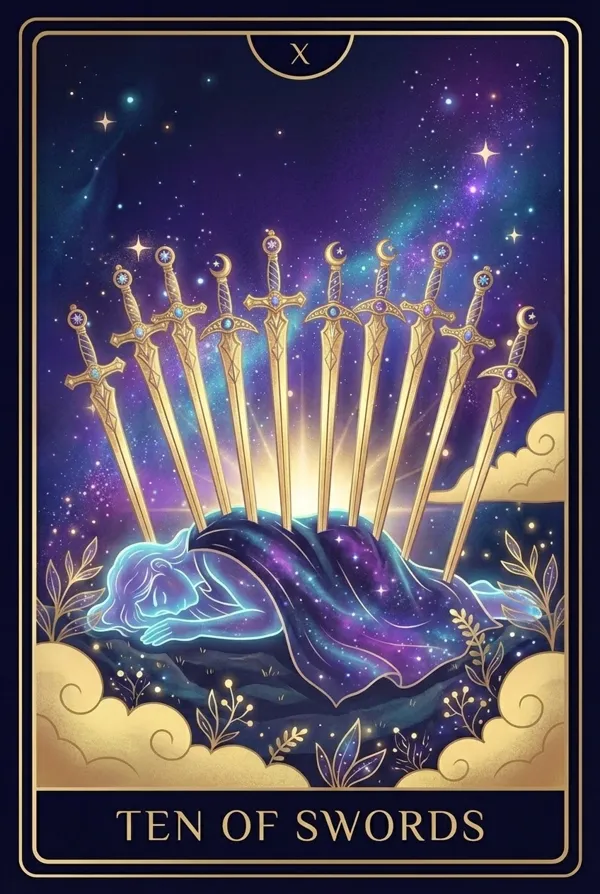
The 10 of Swords marks the moment something is finally, undeniably over. It is a hard card, but it is the end of the fall rather than the beginning of one — and the sky behind the figure is already turning light.
Overview of the Card's Meaning
The 10 of Swords arrives when a situation has reached the bottom. Something has collapsed: a relationship, a role, a belief about yourself, a version of the future you were counting on. The card does not predict the collapse so much as name it, which is often why it feels shocking to draw. Part of you already knew. What makes this card bearable is its structure. Swords are the suit of thought, speech, and truth, and ten is completion. The suffering it shows is the end of a cycle of thinking, not a permanent condition. Nothing more can be taken by this particular loss. That is a grim kind of relief, and it is real relief. If you drew this card while genuinely in crisis, treat it as a mirror for reflection rather than a verdict, and reach for real support — a trusted person, a doctor, a counsellor. A card can help you understand what you feel. It cannot carry you, and it is not meant to.
Symbolism and Imagery
In the Rider-Waite-Smith image, a figure lies face down with ten swords in their back. The number is excessive on purpose: no wound needs ten blades. The exaggeration points to how the mind piles thought upon thought after a loss, rehearsing the same injury until it feels far larger than the original event. Behind the figure, a black sky meets a band of pale gold at the horizon. That light is part of the card's meaning, not a comfort added later. The dark has already peaked. The still water suggests the storm has passed, and the figure's right hand is raised in a gesture read as a blessing — even here, something in you is capable of grace.
Upright Meaning
Upright, the 10 of Swords speaks of ruin that has completed itself. A job ends, a relationship breaks, an illusion finally cracks. The pain is genuine and the card does not minimize it. What it insists on is direction: from here, the movement is upward, because there is nowhere further down. It also describes the specific exhaustion of an overworked mind. You have analyzed this from every angle. You have replayed the conversation, drafted the message you never sent, imagined every version of what you should have done. The card suggests that additional thinking is no longer producing insight, only injury. Sometimes it points to being on the receiving end of another person's cruelty, gossip, or dishonesty. If so, the reading is not that you deserved it. It is that this chapter of it is finished, and your energy is better spent on recovery than on understanding someone who was never going to explain themselves.
Reversed Meaning
Reversed, the 10 of Swords usually describes recovery in progress. You are sitting up. The swords are coming out, slowly, and the relief is uneven — some days feel like proof of healing and others feel like relapse. Both belong to the same process. It can also warn of the opposite pattern: prolonging an ending that has already happened. Rehearsing the story, keeping the wound open so the injustice stays visible, resisting the last step because letting go can feel like agreeing it was fine. It was not fine. Releasing it is not agreement.
Upright Keywords
Painful ending, Rock bottom, Betrayal, Mental exhaustion, Completion, Release
Reversed Keywords
Recovery, Survival, Slow healing, Resisting closure, Narrow escape, Letting go
In Love
If You Are Single
For single readers, this card often follows heartbreak that has run its full course. The relationship, the situationship, the long hope for someone who kept you uncertain — it is over, and the mind is still working on it. That gap between fact and feeling is normal and temporary. It can also reveal a story you carry about love: that it always ends this way, that you are the one who gets left, that wanting too much is the mistake. Ten swords are a lot of conclusions to draw from a finite number of experiences. This card asks which of them you have been treating as evidence rather than as pain.
If You Are in a Relationship
In an existing relationship, the 10 of Swords points to something reaching its limit — often communication rather than affection. Words have become weapons or have stopped entirely. One or both people may feel deeply hurt by things that were said, or by silence that said more. This does not automatically mean the relationship ends. It does mean the current way of relating cannot continue. Some couples meet this card at the point where honesty finally becomes possible, when there is nothing left to protect and the real conversation happens. Others meet it as the moment they admit the ending they have both been avoiding. If betrayal is present, the card asks for accuracy about what was broken and whether repair is genuinely being offered. Rebuilding requires the other person's active participation, not only your willingness to forgive.
About an Ex or Getting Back Together
Regarding an ex, this card most often describes finality rather than return. The story has concluded, and what remains is the mental aftermath — the grievance, the imagined vindication, the version where they finally understand what they lost. Occasionally it appears when contact resumes after a long silence, and here it is worth being clear-eyed. Reconnection under the 10 of Swords tends to reopen the original dynamic rather than heal it, unless something structural has genuinely changed. Ask what is different now, and require an answer more specific than feeling.
In Career and Work
Professionally, the 10 of Swords speaks of endings that arrive from outside your control: redundancy, a role dissolved, a project cancelled after everything you put into it, a workplace where undermining became normal. The card acknowledges the injustice without pretending it can be argued away. It frequently shows burnout in its late stage — not tiredness, but the point where the work has stopped meaning anything and you are running purely on obligation. If that is the situation, the card suggests the collapse is doing something useful by making continuation impossible. The practical reading is to stop defending the position and start planning the next one. Salvage what is portable: skills, relationships, the specific evidence of what you accomplished. Leaving badly treated work rarely feels like a victory at the time, and often looks like one within a year.
In Money and Finances
Financially, this card can describe a loss that has already occurred — a debt that finally came due, a failed venture, savings drained by circumstances you did not choose. Its message is that the bleeding has stopped, even if the balance is painful to look at. It also points to catastrophic thinking about money, which can be more disabling than the numbers themselves. Avoiding the statement, assuming ruin, refusing to make a plan because the plan would confirm the situation. The card asks you to open the account, write the actual figure down, and work from reality.
What This Card Says About How Someone Feels About You
Asked how someone feels about you, the 10 of Swords rarely indicates indifference. It suggests emotional exhaustion around you — someone who feels defeated by the situation, who may believe the connection has already failed, or who is carrying hurt they have not voiced. Sometimes it reveals a person who feels wronged, whether or not that reading is fair. They may be replaying the conflict privately and reaching conclusions you have never been given the chance to answer. This is why the card so often accompanies silence. It can also, less comfortably, indicate someone who has finished with the feeling. Not angry, not longing, simply done thinking about it. If you are hoping for a hidden flame, this card asks you to plan around the possibility that the fire went out and to place your hope where it can be met.
This Card as Advice
Stop adding swords. Whatever you are still turning over tonight, the analysis has finished producing anything useful. Set the story down for a defined stretch of time — a day, a week — and see what your mind does when it is not being asked to solve an ending. Then do the ordinary things that carry people through: sleep, food, movement, one person you can tell the truth to. Recovery from this card is physical before it is philosophical. Meaning tends to arrive after rest, not instead of it. And when you are ready, look for the light at the horizon deliberately. Name one thing this ending has freed you from. Not to be positive about it, but because accurate accounting includes what you no longer have to carry.
Is This Card a Yes or a No?
As a yes-or-no card, the 10 of Swords reads as no for continuing the current situation. If you are asking whether something can go on as it is, the answer is that it cannot, and forcing it usually extends the pain rather than changing the outcome. For questions about whether the worst is over, it leans yes. This card sits at the bottom of the arc, so it often confirms that the difficult phase has passed its peak even if the aftermath is ongoing. For questions about a person returning or a decision being reversed, it leans no. That is not a prediction of permanent loss in every area of your life — it is a signal that this particular door has closed, and that your energy is better invested elsewhere.
Combinations With Other Cards
With The Sun, the reading brightens considerably: the ending clears the way for something genuinely good, and recovery is faster than expected. With The Star, healing is the emphasis and faith slowly returns. With the Ace of Swords, a difficult truth arrives that ends the confusion cleanly. With the 3 of Swords, grief is doubled and the theme is heartbreak that has fully surfaced — painful, but no longer hidden. With The Tower, an ending is sudden and structural rather than gradual. With the 8 of Swords, the pattern is mental imprisonment before collapse: the trap was largely built from thought. With the 6 of Swords, the movement is toward departure and calmer water, which is one of the most hopeful pairings for this card. With the Ten of Pentacles or 4 of Wands, an ending in one area coincides with stability building in another. With the Death card, transformation is unavoidable and the invitation is to cooperate with it rather than resist.
This Card as Your Card of the Day
As your card of the day, the 10 of Swords is not a forecast of disaster. Most often it points to a thought pattern that is costing you more than the situation itself. Notice what you rehearse today, and how many times. It can also mark a day when something you have been dreading finally happens and turns out to be survivable. If that is the case, be gentle with your evening. Cancel what can be cancelled.
Common Misconceptions
The most common misreading is treating the 10 of Swords as a prophecy of catastrophe or betrayal that is bound to happen. The card describes an ending that has already bottomed out, and readings are reflective rather than predictive. It shows a state of mind and a stage of a cycle, not a sentence passed on your future. The second mistake is the opposite: softening it into a cheerful message about new beginnings. That skips the part that matters. People who draw this card usually need their pain acknowledged before they can hear anything about dawn. Both things are true at once, and the order matters. A third is reading the swords in the back as proof that someone specific betrayed you. Sometimes that is the case. Often it describes truth arriving from a direction you were not watching, including truth about your own choices. And a fourth is assuming the card is always about other people's cruelty, when it frequently describes how relentlessly we injure ourselves with our own thinking.
Historical Background and Spiritual Depth
In the Rider-Waite-Smith system, each suit's ten completes its lesson, and the Swords' lesson is the limit of the intellect. Air-suit cards move fast and cut cleanly, but thought alone cannot resolve grief, and the tens show where a suit's strength becomes its cost. The Ten of Pentacles arrives at legacy; the Ten of Swords arrives at the end of arguing. Older Marseille decks show ten crossed blades with no figure, leaving the meaning more abstract — a saturation of conflict rather than a person destroyed. Pamela Colman Smith's decision to place a body under the swords gave the card its emotional force, and probably its reputation for dread. Read psychologically, the card resembles what therapists describe as rumination: the mind returning compulsively to an injury in search of a solution that thinking cannot supply. Understood that way, the dawn is not mystical optimism. It is the observation that this state ends when the mind is finally allowed to stop.
Self-Reflection Questions
What has actually ended here, and what am I still keeping alive by thinking about it? Which of my conclusions are facts, and which are pain wearing the clothes of fact? Who could I tell the truth to this week? What has this ending freed me from that I have not yet let myself notice?
Frequently Asked Questions
What does the 10 of Swords mean in tarot?
It marks an ending that has reached its lowest point — a loss, collapse, or exhausted way of thinking. The pain is real, but the cycle is complete and the movement from here is upward.
Is the 10 of Swords a yes or no card?
It reads as no for continuing the current situation as it is. For questions about whether the hardest part has passed, it leans yes, since the card sits at the bottom of the arc.
Does the 10 of Swords mean betrayal?
It can describe harm you did not see coming, which is why betrayal is a common reading. It can equally describe a truth arriving from a blind spot, including truth about your own choices.
What does the 10 of Swords reversed mean?
Usually recovery in progress — sitting up, removing the swords, healing unevenly. It can also warn against prolonging an ending that has already happened.
What does the 10 of Swords mean for feelings?
It often shows someone emotionally exhausted around the situation, carrying unspoken hurt, or believing the connection has already failed. Sometimes it means they have simply finished thinking about it.
Is the 10 of Swords the worst card in the deck?
It has a fearsome reputation, but it is the end of a difficult cycle rather than the start of one. The dawn at the horizon is part of its actual meaning, not a consolation.
What should I do if I draw the 10 of Swords during a crisis?
Treat it as a mirror for reflection, not a verdict, and reach out for real support — someone you trust, a doctor, or a counsellor. A card can help you name what you feel; it is not a substitute for care.
Journaling Prompts
- Write the ending in plain factual sentences, with no interpretation. Then read it back and mark what is fact and what is fear.
- List what you no longer have to carry now that this is over.
- Describe the thought you rehearse most often. What is it trying to protect you from?
- Write a short note to yourself six months from now, from the version of you that has recovered.
Related Cards
Start a Personal Reading · Today's Card · Explore the Full Library · Career Reading · Yes or No Reading