Three of Swords — Tarot Card Meaning
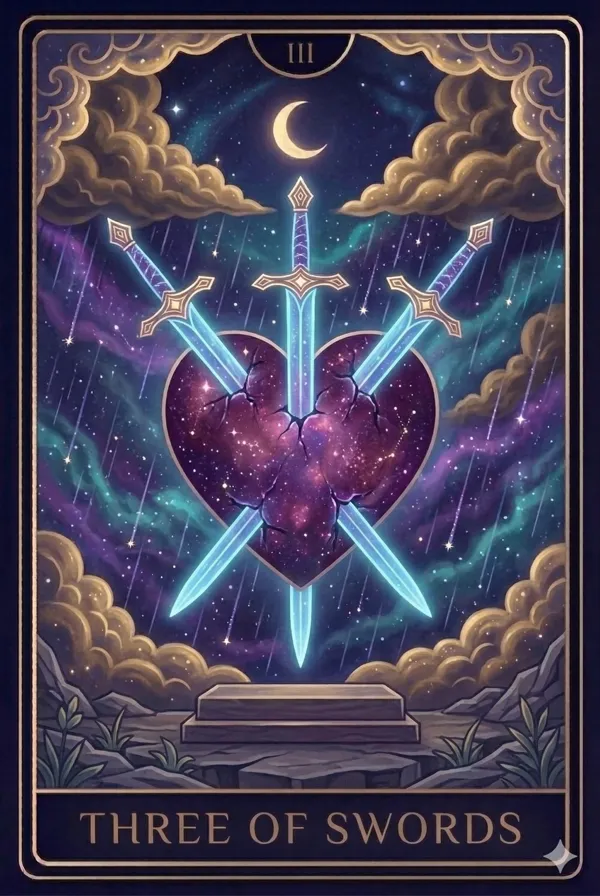
The Three of Swords is the heart that hurts. It does not soften the pain, but it tells the truth about it — and truth, however sharp, is where real healing begins.
Overview of the Card's Meaning
The Three of Swords (3 of Swords) is one of the most recognisable images in tarot: a heart pierced by three swords under a stormy sky. It represents heartbreak, grief, emotional pain, and painful truths. It can describe a breakup, betrayal, disappointment, loss, or hurtful words.
The card does not exist to frighten you. It acknowledges that pain is part of life and that grief deserves space. Swords are the suit of the mind and truth, so the Three often describes pain that comes with clarity — understanding something you did not want to know. Its message is that facing and feeling the hurt is the path through it.
Symbolism and Imagery
In the Rider-Waite-Smith image, a red heart floats against a grey, rainy sky, pierced by three swords. There are no people in the scene, making the pain feel universal and internal. The swords represent thoughts, words, or truths that wound.
The rain and clouds suggest sadness and tears, but also cleansing. Storms pass. The heart remains whole in shape, suggesting that it can survive and heal even though it has been hurt.
Upright Meaning
Upright, the Three of Swords signals heartbreak, grief, emotional pain, or disappointment. You may be going through a breakup, loss, betrayal, or difficult realisation. Words may have hurt, or a truth may have surfaced.
The card asks you to allow yourself to feel. Suppressing pain often prolongs it. Cry, talk to someone you trust, write it out. Over time, the clarity that comes with pain can help you make healthier choices. Grief is not weakness; it is love with nowhere to go.
It is worth remembering that the card shows a heart, not a broken one. Pain is happening to something that is still intact. Many people find that the sharpest phase of grief is followed by unexpected clarity: you understand what you need, what you will no longer accept, and who has truly shown up for you.
Reversed Meaning
Reversed, the Three of Swords often signals recovery, healing, and releasing pain. You may be moving through grief, forgiving, or learning to let go. The worst is passing.
It can also describe suppressing grief, refusing to acknowledge hurt, or reliving painful memories. The reversed Three asks whether you are truly healing or avoiding. Support, time, and self-compassion help the wound close.
Upright Keywords
Heartbreak, Grief, Emotional pain, Painful truth, Sorrow, Loss, Betrayal
Reversed Keywords
Healing, Recovery, Forgiveness, Releasing pain, Suppressed grief, Moving on
In Love
If You Are Single
If you are single, the Three of Swords may describe lingering heartbreak from the past, or disappointment in dating. You may be guarded after being hurt.
Give yourself time to heal before seeking a new relationship. Healing does not mean forgetting; it means allowing the pain to teach you without letting it define you.
If you notice that past heartbreak makes you expect the worst from new people, gently test that belief. Let someone show you, slowly, that they are different, and let your trust grow in proportion to their consistency rather than all at once.
If You Are in a Relationship
In a relationship, the Three of Swords can describe conflict, hurtful words, betrayal, or a painful realisation. It may point to a breakup, separation, or difficult period.
It does not always mean the end. Some couples work through painful truths and come out stronger. Honest communication, accountability, and support — including professional help — can make healing possible.
If the hurt came from words said in anger, the Three of Swords asks both people to take responsibility for their part. Apologies that name the specific hurt are more healing than general ones. If the pain involves betrayal or harm, your safety and wellbeing come first, and outside support can help you decide what is right.
About an Ex or Getting Back Together
With an ex, the Three of Swords describes the pain of the breakup and the grief that follows. It acknowledges that the hurt is real.
It does not strongly support reconciliation. Instead, it encourages processing the pain fully so that you can move forward with clarity and self-respect.
Practical steps help: limit contact while the wound is fresh, remove reminders that reopen it, and spend time with people who remind you of who you are outside the relationship. Healing is rarely linear. Some days will feel worse than others, and that is part of the process, not a sign you are failing.
In Career and Work
Professionally, the Three of Swords can describe disappointment, rejection, conflict, or painful feedback. A project may fail, or you may face criticism.
Use the pain as information. What can you learn? Seek support, take time to recover, and focus on what you can change.
If you received hard feedback, separate the information from the delivery. Even badly expressed criticism may contain something useful. Once the sting fades, decide which parts to act on and which to set aside.
In Money and Finances
With money, the Three of Swords can describe financial loss, disappointment, or stress. It may reflect painful realisations about your situation.
Face the facts honestly and seek qualified advice. The card describes emotional impact, not specific financial outcomes.
What This Card Says About How Someone Feels About You
When the Three of Swords describes how someone feels about you, it may show hurt, sadness, or disappointment. They may feel wounded by something that happened between you, or they may be dealing with grief that affects how they relate to you.
It can also show guilt or regret. Honest conversation, if safe, may help clarify things.
If you are the one who caused the hurt, this card asks for a sincere acknowledgement rather than defensiveness. If you are the one hurting, you are allowed to take time before deciding what the relationship means to you now.
This Card as Advice
The Three of Swords advises you to allow yourself to grieve. Acknowledge the pain rather than pushing it away. Talk to someone, write, rest, and be gentle with yourself.
Also look at the truth the pain reveals. What have you learned? What boundaries or choices will protect your heart in future? Healing takes time, and that is okay.
Notice the difference between feeling the pain and replaying it. Feeling moves through you; replaying keeps you circling the same scene. When you catch yourself rehearsing the hurt, gently return to the present — a walk, a conversation, a task that occupies your hands.
Is This Card a Yes or a No?
For yes-or-no questions, the Three of Swords usually leans no. It suggests pain, disappointment, or a difficult truth.
Reversed, it can lean towards healing and moving forward.
If you are asking whether you will heal, the reversed Three of Swords and nearby cards like The Star or Temperance suggest that you will, with time and support.
Combinations With Other Cards
With the Five of Cups, grief and loss are emphasised. Beside the Ten of Swords, a painful ending is complete. With The Star, healing and hope follow heartbreak.
Paired with the Two of Cups reversed, a relationship rupture causes pain. With the Six of Swords, you move away from pain towards calmer waters. Beside the Nine of Swords, anxiety and grief keep you awake. With Temperance, gradual healing restores balance. With the Ace of Cups, the heart opens again.
This Card as Your Card of the Day
As your card of the day, the Three of Swords invites you to acknowledge any sadness you have been avoiding. Let yourself feel it, and offer yourself kindness. Pain shared with someone you trust often feels lighter. Even a short walk, a glass of water, or an early night counts as care on a heavy day.
Common Misconceptions
One mistake is reading the Three of Swords as a prediction of betrayal. It describes pain and painful truth, not necessarily deception. Another is assuming it means a relationship must end; some couples heal from it.
People also overlook its healing potential. Pain acknowledged is pain that can begin to heal.
Historical Background and Spiritual Depth
In the Golden Dawn tradition, the Three of Swords is called the Lord of Sorrow. Pamela Colman Smith's 1909 design of the pierced heart is among the most iconic images in tarot.
Astrologically, it is associated with Saturn in Libra: difficult lessons in relationships and fairness.
Self-Reflection Questions
What pain am I carrying that I have not fully acknowledged? What truth has this hurt revealed? What would help me heal gently?
Frequently Asked Questions
Is the Three of Swords a yes or no card?
It usually leans no, suggesting pain or disappointment. Reversed, it can lean towards healing.
What does the Three of Swords mean in love?
It can signal heartbreak, conflict, or a painful realisation in a relationship.
Does the Three of Swords mean cheating?
Not necessarily. It describes heartbreak and painful truth, which may involve betrayal but often does not.
What does the Three of Swords mean for an ex?
It reflects the pain of the breakup and encourages processing grief rather than expecting reconciliation.
What does the Three of Swords reversed mean?
Reversed, it usually signals healing, forgiveness, and releasing pain, though it can also show suppressed grief.
What does the Three of Swords mean for someone's feelings?
It may show hurt, sadness, disappointment, or regret about something between you.
Is the Three of Swords always bad?
It describes pain, but it also brings truth and the beginning of healing. Acknowledged grief can lead to growth.
Journaling Prompts
- What hurt am I still carrying?
- What truth did this pain reveal?
- Who can I lean on right now?
- What do I need to forgive — in others or in myself?
Related Cards
Start a Personal Reading · Today's Card · Explore the Full Library · Career Reading · Yes or No Reading