Death — Tarot Card Meaning
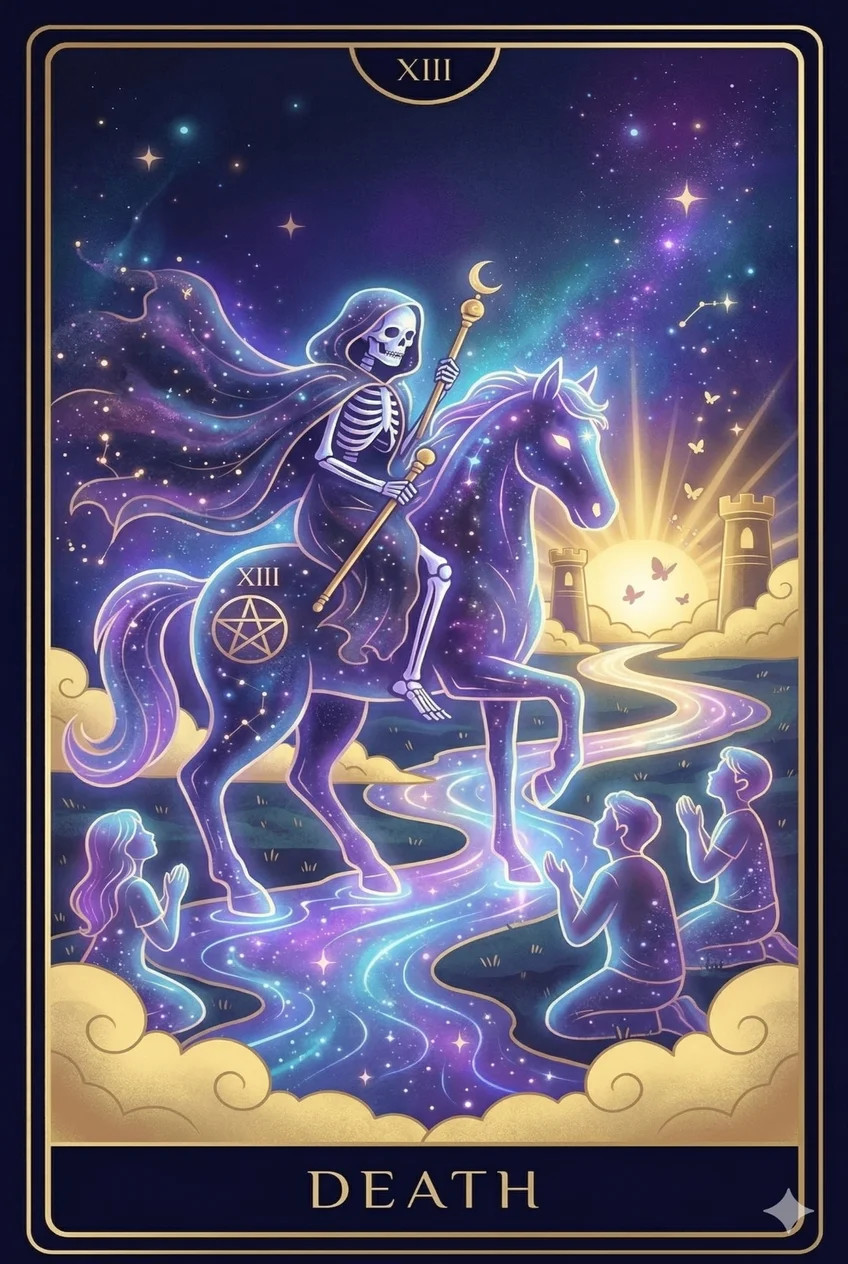
Death is the most misunderstood card in the deck. It rarely speaks about a literal ending of life; it speaks about the end of a chapter — and about the space that opens once you stop holding a door that has already closed.
Overview of the Card's Meaning
Death is the thirteenth card of the Major Arcana, and few cards create as much fear on first sight. In practice, it is one of the most honest cards a reading can offer. It describes transformation through ending: a relationship, role, habit, belief, or version of yourself that has completed its purpose. Something is finishing so that something else can begin, and the card asks you not to confuse the discomfort of transition with disaster.
When Death appears, change is usually already in motion. You may have felt it for a while — the job that no longer fits, the dynamic that has run its course, the identity you have outgrown. The card does not create that ending; it names it. Its invitation is to let go cleanly rather than slowly, and to grieve what deserves grieving without trying to resurrect what has finished. Read in this way, Death is not a threat but a clearing.
Symbolism and Imagery
In the Rider-Waite-Smith image, a skeleton in black armour rides a white horse. Armour suggests that this force cannot be bargained with; the white horse suggests purity of purpose rather than cruelty. The black banner carries a white five-petalled rose, a symbol of life and beauty that continues through change.
Before the rider, people respond differently: a king has already fallen, a bishop pleads, a maiden turns away, and a child looks up with open curiosity. Each figure is a way of meeting change — resistance, negotiation, avoidance, or acceptance. In the distance a river flows towards the sea, and the sun rises between two towers. The ending is real, but the horizon is a sunrise, not a sunset.
Upright Meaning
Upright, Death signals a decisive ending and the transformation that follows it. A chapter is closing, often one you already sensed was finished. This can be a relationship stage, a job, a home, a belief about yourself, or a pattern you have repeated for years. The card asks you to accept what is ending instead of extending it out of fear or habit.
The transition may feel uncomfortable, but it is clarifying. Clearing out what no longer works creates room for a life that fits who you are now. Death favours clean, conscious endings: honest conversations, tidy closures, and a willingness to stand briefly in the in-between without rushing to fill the space.
Reversed Meaning
Reversed, Death often points to resistance to a necessary change. You may be holding on to a situation that has clearly ended, delaying a decision, or keeping a door half-open because walking through it feels too final. The result is stagnation: energy spent maintaining something that no longer gives back.
It can also describe a transformation happening slowly and internally, before it becomes visible. Ask what you are afraid would happen if you let this ending be complete. Often the fear is less about loss than about uncertainty. A small, concrete step — returning the keys, cancelling the subscription, saying the true sentence — can release a great deal of stuck energy.
Upright Keywords
Endings, Transformation, Transition, Letting go, Release, Renewal, Closure
Reversed Keywords
Resistance to change, Stagnation, Fear of endings, Delay, Holding on, Slow inner change
In Love
If You Are Single
If you are single, Death suggests the close of an old romantic pattern. You may be letting go of a type you keep choosing, a story that love always ends the same way, or the lingering attachment to someone from the past. That release is what makes something genuinely new possible.
This is a good time to notice how you have changed and to date — or rest — as the person you are now rather than the person you used to be. Death does not say love is over; it says an old version of your love life is. Give yourself permission to be a beginner again, with fewer assumptions and clearer standards.
If You Are in a Relationship
In a relationship, Death describes a transformation, not necessarily a break-up. The relationship as it was may be ending so that a different version can begin: moving in, becoming parents, recovering from a crisis, or ending a dynamic that one or both of you have outgrown. Couples who survive major transitions often feel this card in their bones.
The card asks for honesty about what has truly changed. If the bond still has life in it, the transformation can deepen intimacy, because you stop performing the old roles. If the connection has already ended in every way but name, Death may support a respectful, conscious ending. Either way, pretending nothing is changing is the option it does not support.
About an Ex or Getting Back Together
With an ex, Death is one of the clearest signs of an ending. It usually describes the chapter as complete and asks you to let it close. That does not erase what the relationship meant; it simply stops treating it as unfinished business that requires your hope or energy.
If you are asking about reconciliation, Death rarely points to a return to the old relationship. Even if contact resumes, the old version would need to die for anything healthy to grow. More often, the card supports grieving fully, removing reminders that keep the wound open, and investing the freed energy in your present life.
In Career and Work
Professionally, Death often marks the end of a role, project, company chapter, or career direction. You may be outgrowing a job, facing a restructure, or realising that the work you trained for no longer matches who you are. Although it can feel destabilising, this card frequently precedes a more authentic professional path.
Treat the transition practically: update your skills, talk to people already doing the work you want, and close the old chapter well — handovers, references, and a clean exit protect your reputation. Death favours deliberate change over drifting until the decision is made for you.
In Money and Finances
With money, Death can describe the end of a financial phase: a source of income closing, a debt being cleared, a spending pattern you are ready to drop, or a major restructure of how you manage resources. Endings here can be relieving as well as challenging.
The card supports cutting what drains you — unused subscriptions, unsustainable commitments, risky habits — and building a new structure from what remains. If an income stream is ending, plan the bridge rather than ignoring the gap. Seek qualified advice for significant decisions; the card describes a turning point, not a specific financial outcome.
What This Card Says About How Someone Feels About You
When Death describes how someone feels about you, it often points to deep change in their feelings or their life. They may be going through a transformation that changes how they relate to you, or they may feel that something between you has ended or needs to end. Sometimes it shows feelings that have shifted from one form into another — friendship becoming more, or passion becoming distance.
It can also describe someone who feels profoundly changed by knowing you. The card is intense rather than casual. Look at the surrounding cards and their actions: Death says something important is transforming, not that the outcome is necessarily the one you hope for.
This Card as Advice
Death advises you to let what has ended be ended. Name the chapter that is closing, honour what it gave you, and stop spending energy keeping it alive. Grief is appropriate; endless delay is not. The quickest way through a transition is usually to accept it.
Make the ending conscious: have the conversation, sign the papers, clear the space, change the routine. Then allow a short period of not knowing. You do not need the next chapter fully written before you close this one. Trust that clearing ground is itself productive work.
Is This Card a Yes or a No?
For yes-or-no questions, Death usually leans no if you are asking whether something will continue as it is, and yes if you are asking whether a change, ending, or fresh start is coming. It is less a verdict than a clarification: the current form of the situation is ending.
If you ask whether to leave, close, or let go, Death often supports yes. If you ask whether an old relationship or job will return to how it was, the answer tends to be no. Death never refers to physical death in a reading; treat it as a symbol of transition.
Combinations With Other Cards
With The Tower, change is sudden and structural; with Death alone it is more gradual and inevitable. Beside The Star, the ending clears space for healing and renewed hope. With Temperance, the card that follows it, transformation settles into balance and recovery.
Paired with the Eight of Cups, you are walking away from something emotionally empty. With the Ten of Swords, a painful chapter is finished and cannot get worse. Beside the Six of Swords, a transition carries you towards calmer waters. With the Ace of Wands or Ace of Cups, an ending makes room for a vivid new beginning. With The Hanged Man, a long pause finally resolves into release.
This Card as Your Card of the Day
As your card of the day, Death asks you to finish something. Delete the draft you will never send, return what is not yours, end the conversation that keeps looping, or let a habit stop today. Notice the relief of a clean ending. You do not need to change your whole life; one deliberate closure is enough.
Common Misconceptions
The biggest mistake is reading Death literally. In tarot practice it does not predict physical death, illness, or harm, and no responsible reading uses it that way. If health or safety worries are on your mind, those deserve real-world care and professional advice, not a card.
Another mistake is treating Death as purely negative. Many endings it describes are healthy: leaving a draining job, ending a cycle of conflict, outgrowing an old self. A third mistake is expecting the change to be instant. Death is often a process — ending, transition, and only then renewal — and the middle part can feel empty before anything new appears.
Historical Background and Spiritual Depth
Death is card XIII, and in many historical decks it was left unnamed, reflecting old superstitions about the number thirteen. Pamela Colman Smith's 1909 design gave it the armoured rider, the rose banner, and the rising sun. It sits between The Hanged Man, the pause of surrender, and Temperance, the patient blending that follows transformation.
Its astrological correspondence is Scorpio, the sign of depth, intensity, and regeneration. Psychologically, Death describes the necessary endings that allow growth — what some traditions call shedding a skin, and what modern psychology might describe as letting an outdated identity go.
Self-Reflection Questions
What in my life has already ended that I am still treating as alive? What am I afraid would happen if I let it close completely? Which part of me is ready to be shed, and what would I do with the energy I am currently spending keeping the past in place?
Frequently Asked Questions
Does the Death card mean someone will die?
No. In tarot, Death symbolises endings and transformation, not physical death. It describes a chapter closing — a relationship stage, job, habit, or identity — so that something new can begin.
Is Death a yes or no card?
Death usually leans no if you ask whether a situation will stay the same, and yes if you ask whether change or a fresh start is coming. Its core message is that the current form of something is ending.
What does Death mean in love?
In love, Death points to transformation. For a couple it can mean a relationship entering a new phase or ending an old dynamic; for someone single it often shows an old pattern or attachment finally closing.
What does Death mean for how someone feels?
It often shows deep change — feelings shifting form, someone going through a transformation, or a sense that something between you has ended. Read it alongside the surrounding cards and the person's actions.
What does Death reversed mean?
Reversed, Death usually points to resisting a necessary change: holding on to something that has ended, delaying a decision, or transforming slowly on the inside before anything shifts outwardly.
Is the Death card good or bad?
Neither. It is honest. Many endings it describes are healthy and freeing, though transitions can feel uncomfortable while they are happening.
What does Death mean for an ex?
Death generally describes the relationship with an ex as complete. It encourages grieving and closing that chapter rather than expecting a return to how things were.
Journaling Prompts
- Which chapter of my life has quietly finished, even if I have not said so out loud?
- What do I need to grieve before I can move on?
- Where am I bargaining with a change instead of accepting it?
- Who am I becoming now that this version of me is ending?
Related Cards
Start a Personal Reading · Today's Card · Explore the Full Library · Career Reading · Yes or No Reading