Temperance — Tarot Card Meaning
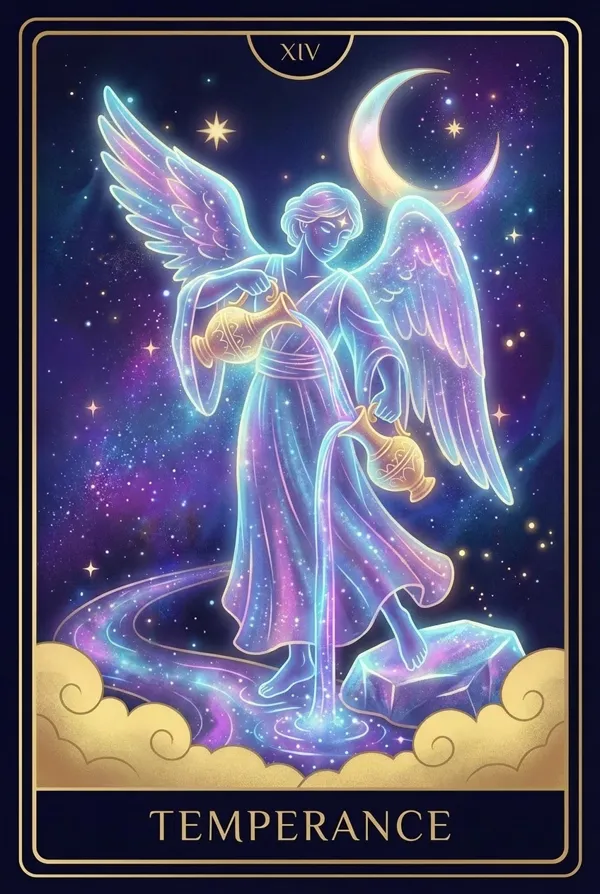
Temperance is the art of holding two true things at once without forcing either to disappear. It is patience with a purpose, not passivity.
Overview of the Card's Meaning
Temperance is the fourteenth card of the Major Arcana, arriving after Death has cleared away what could no longer continue. Its work is quieter than that ending: it blends, adjusts, and integrates. Where earlier cards act with force, Temperance moves by proportion. It asks how much, how often, and in what combination — questions that rarely feel dramatic but usually decide whether something lasts. When this card appears, life is often asking for moderation in a specific, practical place: the pace of a relationship, the balance between work and rest, the mixture of honesty and gentleness in a difficult conversation. Temperance rarely arrives to announce that everything is already harmonious. It appears when harmony is being made, slowly, through small corrections. Its promise is not that the tension will vanish, but that you can hold it steadily enough to keep growing inside it.
Symbolism and Imagery
In the Rider-Waite-Smith image, a winged figure pours liquid between two cups in a continuous stream that seems to defy gravity. Nothing is spilled and nothing is finished — the exchange itself is the point. One foot rests on land and the other in water, joining conscious effort with emotional and instinctive life. Irises grow near the water, and a narrow path leads toward distant mountains with a crown of light above them. The path is not a shortcut; it climbs. A triangle within a square on the figure's robe suggests spirit contained within practical form. Together the symbols describe patient alchemy: something is being combined carefully enough that neither ingredient is wasted, and the result is stronger than either alone.
Upright Meaning
Upright, Temperance supports a measured approach. You may be finding the middle ground between extremes, recovering after intensity, or learning to sustain something instead of sprinting through it. This card favours consistency over bursts, and it suggests that the slower route is currently the more intelligent one. It often points to emotional regulation: feeling something fully without letting it govern every decision. In practical terms, that can mean waiting a day before replying, splitting a large goal into repeatable steps, or letting two conflicting needs sit together until a workable third option appears. Temperance is not indecision. It is the discipline of not solving a subtle problem with a blunt instrument, and of trusting that steady effort compounds in ways sudden effort cannot.
Reversed Meaning
Reversed, Temperance usually describes imbalance that has become habitual. That may be excess — overwork, overgiving, overthinking, overcorrecting — or it may be avoidance dressed as calm, where you appear moderate but have quietly stopped engaging at all. Both drain the same reservoir. This position can also show impatience with a process that genuinely needs time, or the strain of trying to blend two things that do not actually mix: incompatible commitments, contradictory values, a schedule that only works if you never get tired. Rather than reading it as failure, treat it as a request for an honest audit. Where are you pouring more than you receive? Which extreme feels safer than the middle, and why? Reversed Temperance is a signal to adjust the proportion, not to abandon the effort.
Upright Keywords
Balance, Moderation, Patience, Integration, Healing, Sustainability, Middle path
Reversed Keywords
Excess, Imbalance, Impatience, Burnout, Overgiving, Avoidance
In Love
If You Are Single
If you are single, Temperance suggests letting a connection develop at its own pace and noticing whether you can stay recognisably yourself inside it. You may be recovering from something intense, and this card supports that recovery without rushing you into a story about what it means. It also gently questions the belief that strong feeling equals compatibility. A promising connection here tends to feel steady rather than dizzying — someone whose presence lowers your shoulders instead of raising your heart rate. Temperance does not tell you to suppress desire or settle for lukewarm company. It suggests that clarity arrives faster when you are not oscillating between hope and self-protection, and that the right pace usually reveals more than an accelerated one.
If You Are in a Relationship
Within a relationship, Temperance points to negotiation and blending. Two people with different rhythms, needs, or histories are working out a shared proportion: how much time together, how much independence, how much is said and how much is held. This is ordinary, unglamorous relationship work, and it is exactly where longevity is built. The card often arrives during repair after conflict. It favours a measured conversation over a decisive confrontation, and small consistent gestures over one grand correction. If one partner has been carrying more — emotionally, practically, financially — Temperance asks for a rebalancing that is real rather than promised. Patience is a virtue here only when both people are actively contributing to the mixture. Endless patience with a static situation is not moderation; it is depletion.
About an Ex or Getting Back Together
Regarding an ex, Temperance most often indicates cooling, integration, and time. Intensity is settling into something you can look at more clearly. That may allow calmer contact, a workable co-parenting arrangement, or simply the ability to remember the relationship without being pulled back into it. This card can accompany renewed contact, but it never suggests resuming the old dynamic at the old temperature. Anything rebuilt here would need a different pace and a genuinely different balance of effort. It is equally common for Temperance to describe healing that leads somewhere else entirely — the ache becoming perspective rather than a reunion. Notice whether waiting is helping you heal or quietly keeping a door open that costs you something to guard.
In Career and Work
Professionally, Temperance favours sustainable progress: reasonable hours, realistic timelines, and skills built by repetition. If you have been oscillating between overwork and burnout, this card recommends a pace you could still keep in three months. Collaboration and mediation are also highlighted — you may be the person translating between two positions or blending different working styles into one workable process. It is a strong card for craft. Improvement here comes from returning to the work regularly rather than waiting for an inspired surge. If you are choosing between options, Temperance suggests a middle path may exist that you have not yet named: a phased transition, a part-time trial, a smaller version of the ambitious plan. It rarely rewards the dramatic gesture, but it protects what you are building.
In Money and Finances
With money, Temperance points to moderation and gradual accumulation. Budgeting, steady saving, paying down obligations in consistent increments, and resisting both anxious hoarding and impulsive spending all fall under its influence. Progress may feel unexciting; that is usually a sign it is working. The card can also flag a mixture that needs adjusting — spending that reflects two incompatible lifestyles, or generosity that has stopped being proportionate to your means. Recalibrate quietly and specifically rather than imposing a severe restriction you will abandon within a month. Financial temperance is less about discipline as punishment and more about designing a pattern you can actually sustain.
What This Card Says About How Someone Feels About You
As a description of how someone feels about you, Temperance suggests warm, considered, and settling emotions rather than infatuation. They may feel calm around you, quietly hopeful, and unwilling to rush — often because the connection matters enough that they do not want to mishandle it. There can be a sense of someone deliberately taking their time. This measured quality has two possible readings, and honesty requires naming both. Sometimes it is care: they are integrating feelings, healing, or making sure they can offer something real. Sometimes it is ambivalence held comfortably in place, where patience becomes a way of avoiding a decision. The card does not tell you which. Watch whether their steadiness includes movement over time. Genuine Temperance energy in someone's feelings tends to look like consistency, not stillness.
This Card as Advice
Temperance advises you to adjust the dose rather than change the direction. Ask which single proportion in your life is currently off — sleep, work, giving, spending, speaking, waiting — and correct it by a small, sustainable amount. Extremes are seductive because they feel decisive; the middle requires you to keep paying attention. Where you are caught between two options, consider whether the real answer is a blend rather than a winner. Where you are impatient, ask what genuinely cannot be hurried. And where you have been endlessly patient, ask what you are waiting for and whether anything is actually changing. Temperance supports steadiness with a direction, not simply endurance.
Is This Card a Yes or a No?
For yes-or-no questions, Temperance is best read as a qualified yes, with timing attached. The answer often becomes yes if you allow the situation to develop at its natural pace, moderate your approach, or take a middle route rather than an all-or-nothing one. Pushed for speed or intensity, the same situation may not hold. When the question demands an immediate, definitive outcome, treat Temperance as not yet. It is a poor omen for ultimatums and a good one for gradual approaches. Reversed, it leans towards no in its current form: something is out of proportion, and the imbalance needs addressing before the answer can turn.
Combinations With Other Cards
With The Star, Temperance describes patient healing after difficulty — hope that is being rebuilt gradually rather than restored in one moment. Beside The Devil it becomes a genuine counterweight, pointing directly at moderation where compulsion, excess, or an unhealthy attachment has taken hold. With the Two of Cups it suggests a relationship finding a workable balance between two distinct people. Alongside the Eight of Cups, waiting may already have served its purpose and departure could be the more honest form of balance. With the Knight of Swords or the Seven of Wands, the reading pulls in two directions and Temperance argues for a slower, less combative approach. Next to Judgement, the invitation is to integrate what you have learned before making a decisive move. With the Four of Pentacles, examine whether your caution has become rigidity. In most spreads Temperance modifies its neighbours, softening urgency and asking for proportion rather than dictating a result.
This Card as Your Card of the Day
As your card of the day, Temperance suggests choosing a moderate version of everything. Do the work without draining yourself, reply without heat, eat and rest at reasonable times, and decline the impulse to resolve everything before evening. If a conversation is charged, let a little time pass before responding. A good day under this card usually feels unremarkable in the moment and noticeably steadier by the end.
Common Misconceptions
The most common misreading is treating Temperance as a soft instruction to be endlessly patient no matter the circumstances. Patience is only balance when something is actually being blended. Waiting alone in a situation that never shifts is not moderation, and the card does not ask you to tolerate imbalance indefinitely. A second mistake is confusing Temperance with emotional suppression. The figure pours freely between cups; nothing is sealed off. Regulating a feeling means staying in contact with it while choosing your response, not deciding you no longer have it. Third, reversed Temperance is often over-read as chaos or collapse. More often it is ordinary excess: too many commitments, one relationship absorbing all the effort, or a pace nobody could sustain. Finally, this card is not boring by nature. What it protects — health, craft, trust, recovery — is usually what people most regret losing to intensity.
Historical Background and Spiritual Depth
The name comes from the classical virtue of temperantia, one of the four cardinal virtues alongside justice, fortitude, and prudence. Three of these appear directly in the Major Arcana, and their presence reminds us that early tarot imagery drew on widely understood moral instruction rather than a hidden esoteric code. In medieval and Renaissance art, Temperance was frequently shown mixing water with wine — literally diluting strength to make it usable. Later occult writers connected the card to alchemy and the patient combining of opposites, and to the sign Sagittarius with its long-range aim. Across all these layers, the underlying idea holds remarkably steady: something valuable is produced by careful proportion over time, and haste tends to waste the ingredients.
Self-Reflection Questions
Which proportion in my life is currently out of balance, and what would a small correction look like? Where am I waiting patiently for something that is not actually moving? What two things am I trying to hold together, and what would let both exist without one consuming the other?
Frequently Asked Questions
Is Temperance a yes or no card?
Temperance reads as a qualified yes with timing attached. The answer tends to become yes when you let the situation develop at its own pace or take a middle route, and not yet when an immediate, all-or-nothing outcome is demanded.
What does Temperance mean in love?
It points to pace, blending, and steadiness. Two people are working out a shared proportion of closeness and independence, and progress usually comes from small consistent adjustments rather than one decisive conversation.
What does Temperance reversed mean?
Reversed, it usually shows habitual imbalance: overwork, overgiving, impatience with a process that needs time, or calm that has become avoidance. It asks you to adjust the proportion rather than abandon the effort.
Does Temperance mean I should just be patient?
Only when something is genuinely being built. Patience is balance when a situation is developing; waiting indefinitely in a static situation is depletion, and this card does not ask you to tolerate that.
What does Temperance mean for someone's feelings?
It suggests warm, considered feelings and a deliberate unwillingness to rush. That can reflect real care or comfortable ambivalence, so watch whether their steadiness includes movement over time.
Is Temperance a good card for healing?
Yes, it is one of the clearest healing cards in the deck, particularly after intensity or loss. It favours gradual recovery, sustainable routines, and integration rather than a sudden return to normal.
Why is Temperance one of the virtue cards?
It takes its name from temperantia, a classical cardinal virtue. Justice and Strength reflect two others, which shows how much early tarot imagery drew on familiar moral teaching rather than hidden symbolism.
Journaling Prompts
- Where am I pouring more than I receive, and what would a fairer proportion look like?
- Which part of my life am I trying to rush that genuinely needs time?
- What extreme feels safer to me than the middle ground, and why?
- What pace could I actually sustain for the next three months?
Related Cards
Start a Personal Reading · Today's Card · Explore the Full Library · Career Reading · Yes or No Reading