The Devil — Tarot Card Meaning
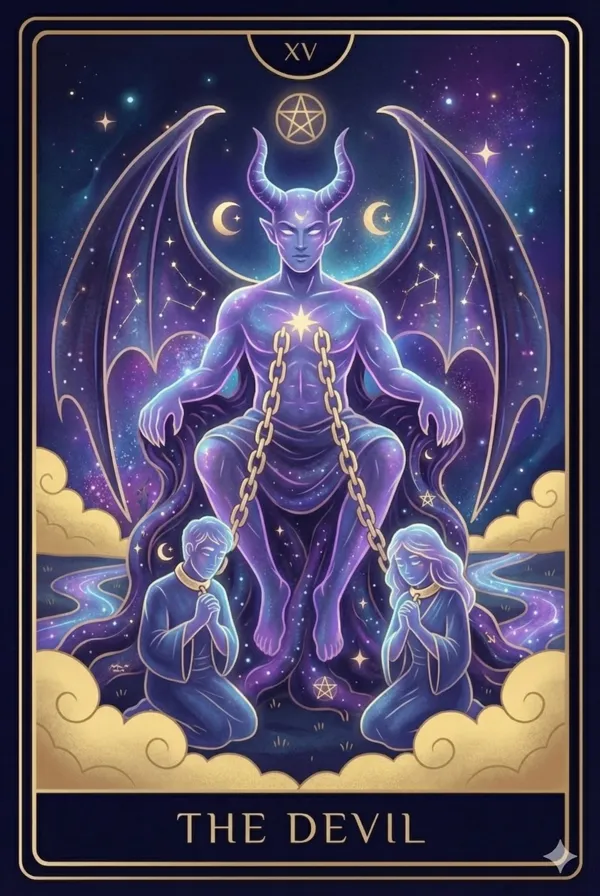
The Devil shows where you have handed your power to something — a habit, a fear, a person, a story. Look closely at the chains in the image: they are loose enough to lift off.
Overview of the Card's Meaning
The Devil is the fifteenth card of the Major Arcana and one of the most misread. It does not describe evil or literal demons. It describes attachment, compulsion, and the ways we give our power away: to habits, addictions, unhealthy relationships, materialism, fear, or beliefs that keep us small.
When The Devil appears, something has more control over you than it should. It may be pleasurable, familiar, or comforting, which is exactly why it is hard to release. The card is not a judgement; it is an awareness. Once you see the chain clearly, you can choose differently. The Devil's deepest message is that the bondage is often less permanent than it feels.
Symbolism and Imagery
In the Rider-Waite-Smith image, a horned figure with bat wings sits on a black pedestal. An inverted pentagram above its head suggests spirit placed beneath matter. It holds a torch pointed downward, a symbol of energy directed towards the lower, instinctual realm.
Below, a naked man and woman are chained to the pedestal. They have small horns and tails, suggesting they have begun to resemble what binds them. Yet the chains around their necks are loose; they could lift them off. The pair mirrors The Lovers, card VI, showing what happens when union becomes bondage. The Devil's image is about the illusion of being trapped.
Upright Meaning
Upright, The Devil points to attachment, temptation, or unhealthy patterns. You may feel stuck in a situation, relationship, or habit that you know is not good for you, or you may be acting from fear, shame, or compulsion rather than choice. Material concerns, status, or instant gratification may be taking up too much of your energy.
The card also has a raw, honest side: desire, sensuality, and ambition are not wrong in themselves. The problem is imbalance and loss of choice. Ask where you feel powerless and what you are getting from staying. Naming the payoff is often the first step to freedom.
Reversed Meaning
Reversed, The Devil often signals release: breaking a habit, leaving a toxic situation, recognising a pattern, or reclaiming your power. The chains are coming off, and you may feel lighter, clearer, and more in control of your choices.
It can also describe the struggle of detachment — relapse, temptation returning, or confronting the shadow you have avoided. Freedom is a process. Be patient with yourself, get support where you need it, and celebrate each choice that reflects who you want to be.
Upright Keywords
Attachment, Temptation, Addiction, Materialism, Shadow self, Control, Passion
Reversed Keywords
Release, Breaking free, Reclaiming power, Detachment, Recovery, Facing the shadow
In Love
If You Are Single
If you are single, The Devil may describe a strong attraction that is more about chemistry than compatibility, or a pattern of being drawn to people who are unavailable or unkind. It can also point to lingering attachment to someone from the past that keeps you from moving on.
The card invites honesty about what you are actually seeking. Passion is welcome, but notice when it overrides your judgement. If a connection makes you feel anxious, secretive, or smaller, The Devil asks you to step back and choose relationships that leave you free.
If You Are in a Relationship
In a relationship, The Devil can describe intense passion and physical chemistry. It can also describe unhealthy dynamics: codependency, jealousy, control, staying together out of fear, or dependence on the relationship for identity or security.
The card asks both people to look honestly at what binds them. Some couples use a Devil moment to break unhealthy patterns and build a freer, more honest connection. If the relationship involves control, abuse, or danger, prioritise your safety and seek professional support; a card is not a substitute for real-world help.
About an Ex or Getting Back Together
With an ex, The Devil often describes a lingering attachment — an on-off cycle, obsessive thoughts, or a connection that is hard to leave even though it is not healthy. There may be strong chemistry or emotional dependency that keeps pulling you back.
If you are asking about reconciliation, The Devil suggests looking carefully at why. Is it love and growth, or habit, fear of loneliness, and unfinished craving? The card supports freedom more than reunion. Cutting contact, removing reminders, and getting support can help break the loop.
In Career and Work
Professionally, The Devil can describe feeling trapped in a job for money, status, or security, or working in an environment of unhealthy pressure, manipulation, or overwork. It may also point to ambition that has tipped into obsession.
Ask what is really keeping you there and what it costs you. Sometimes the trap is financial and needs a careful exit plan; sometimes it is a belief that you cannot do anything else. The Devil encourages you to reclaim choice, even if the first step is small, such as updating your CV or setting a boundary on working hours.
In Money and Finances
With money, The Devil often warns of debt, impulsive spending, financial dependence, or letting money dominate your decisions. It can also describe feeling trapped by financial obligations.
The first step is visibility: list what you owe, what you spend, and what triggers impulsive choices. Create a plan, cut the habits that drain you, and seek qualified advice if debt feels unmanageable. The card describes patterns and pressures, not a specific financial outcome.
What This Card Says About How Someone Feels About You
When The Devil describes how someone feels about you, it often shows intense attraction, desire, or obsession. The feelings can be powerful and physical, but not necessarily healthy or balanced. They may feel drawn to you in a way they cannot easily control.
The Devil can also show possessiveness, jealousy, or a connection based on need rather than freedom. Pay close attention to behaviour. Strong feelings are not the same as respect, kindness, or commitment.
This Card as Advice
The Devil advises you to look honestly at what has power over you and to take that power back one choice at a time. Name the habit, person, or fear. Notice the payoff that keeps you attached, and look for healthier ways to meet that need.
You do not have to break free in one dramatic gesture. Loosen the chain: one boundary, one day without the habit, one honest conversation. Seek support from friends or professionals where needed. The chains in the card are loose — freedom is closer than it feels.
Is This Card a Yes or a No?
For yes-or-no questions, The Devil usually leans no, or at least cautions you. It suggests that the situation involves attachment, temptation, or something that may not be in your best interest.
If you are asking whether to give in to a temptation or return to an unhealthy pattern, The Devil's answer is generally no. If you ask whether you can break free, the reversed Devil leans yes.
Combinations With Other Cards
With The Lovers, desire and choice are tangled; the question is whether a connection is freely chosen. Beside The Tower, a dramatic break frees you from an unhealthy attachment. With the Eight of Swords, the sense of being trapped is mostly mental.
Paired with the Seven of Cups, illusion and temptation cloud judgement. With the Four of Pentacles, possessiveness and fear around money or control are highlighted. Beside the Nine of Swords, guilt or anxiety fuels a cycle. With Strength, inner courage and compassion help you master the impulse. With the Ace of Swords, clarity cuts through the illusion.
This Card as Your Card of the Day
As your card of the day, The Devil invites you to notice one moment when you act on autopilot — reaching for your phone, the snack, the old argument, the self-criticism. Pause and choose differently once. Small acts of freedom add up. Notice what you were really seeking, and give yourself that need in a healthier way.
Common Misconceptions
The most common mistake is reading The Devil as evil, danger, or a curse. It is a symbol of attachment and the shadow, not of supernatural threat. Another mistake is treating it as shameful. Everyone has patterns that hold them; the card simply makes one visible.
People also overlook its positive dimension: desire, sensuality, ambition, and engagement with the material world are not wrong in themselves. Finally, The Devil does not mean you are permanently trapped. The loose chains in the image are the point.
Historical Background and Spiritual Depth
The Devil is card XV and follows Temperance, the card of balance. When balance is lost, attachment takes over. It precedes The Tower, suggesting that if we do not release unhealthy structures ourselves, life may break them for us.
Its astrological correspondence is Capricorn, the sign of ambition, material achievement, and structure — strengths that can become rigidity or obsession. Pamela Colman Smith's 1909 design deliberately mirrored The Lovers, showing how love and union can turn into bondage when freedom is lost.
Self-Reflection Questions
What has more power over me than I want it to? What am I getting from staying attached? If the chain is looser than I believe, what is one small step I could take today to lift it?
Frequently Asked Questions
Is The Devil a yes or no card?
The Devil usually leans no or signals caution, especially when you ask about giving in to temptation or returning to an unhealthy situation. Reversed, it can lean yes for breaking free.
Is The Devil an evil card?
No. In tarot, The Devil symbolises attachment, compulsion, and the shadow side of human nature — not literal evil. It makes an unhealthy pattern visible so you can choose differently.
What does The Devil mean in love?
In love, The Devil can describe intense passion and chemistry, but also codependency, jealousy, or staying together for unhealthy reasons. It asks you to look honestly at what binds the relationship.
What does The Devil mean for someone's feelings?
It often shows strong attraction, desire, or obsession. The feelings may be powerful but not necessarily balanced or healthy, so watch how the person actually treats you.
What does The Devil reversed mean?
Reversed, The Devil usually signals release — breaking a habit, leaving a toxic situation, or reclaiming your power — though the process may involve setbacks.
What does The Devil mean for an ex?
It often shows lingering attachment or an on-off cycle that is hard to break. The card generally supports freedom and healthy distance more than reconciliation.
Why are the chains loose on The Devil card?
The loose chains show that the bondage is partly an illusion. The figures could lift the chains off, just as we can often free ourselves from patterns once we see them clearly.
Journaling Prompts
- Which habit or relationship do I keep returning to even when I want to stop?
- What need is this pattern trying to meet?
- Where do I feel shame, and what would self-compassion change?
- What would freedom look like in one ordinary day?
Related Cards
Start a Personal Reading · Today's Card · Explore the Full Library · Career Reading · Yes or No Reading