Letter (Card 27)
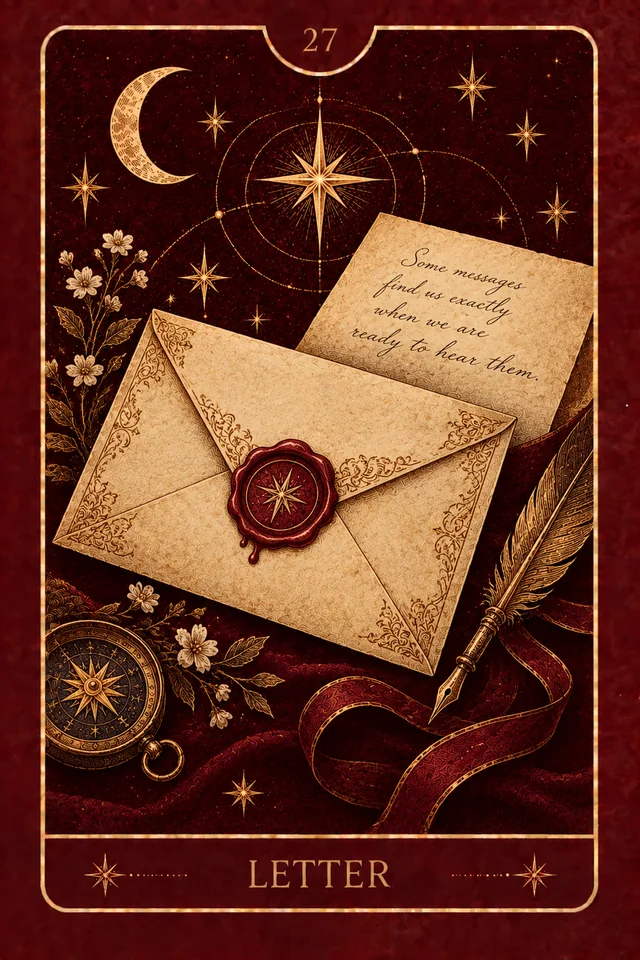
Letter is the written channel: a message, document, form, notice or piece of news on paper or screen. It tells you communication exists, not that one particular person is about to text.
Core meaning
Letter denotes written or formal communication: messages, emails, documents, applications, invoices, notices, certificates and records. It is broader than “a text” and more concrete than general talk; Birds handles conversation, while Letter is what can be read, filed, sent or saved. The card is neutral about content. Bouquet makes it pleasant; Coffin can end it; Key confirms it; Snake complicates it. Its most common modern trap is turning any appearance into a promise that a specific person will contact you. Letter says the channel is active. It does not identify the sender or guarantee the message you hope for.
One card is a word, not a sentence
One card is a word, not a sentence. Letter says written communication, but not from whom, about what, or whether it is welcome. A reader who turns it into “he will message tonight” is inventing the sender and timing. Pairs create the smallest reliable sentence. Letter + Bouquet is the textbook example: Letter is the noun, Bouquet modifies it, and pleasant written communication becomes good news or an invitation. Bouquet + Letter starts with the gift or pleasant gesture and uses writing as the delivery method. Same cards, different emphasis.
The image
The traditional image is a sealed letter, paper or document, often with a writing tool nearby. It is deliberately static: the content is enclosed, not displayed. That is why Letter can mean known information and something not yet read at the same time. A document exists, but its effect depends on who opens it and what follows. The playing-card insert is the Seven of Spades, but the everyday object matters more. Unlike Birds, there is no conversation in the picture. The message may be private, formal, delayed or carefully worded.
In love and relationships
In love questions Letter means communication, often more formal or considered than a spontaneous conversation. It can be a text, email, message thread, written apology or a conversation that should be put into words. With Heart, it carries affection. With Ring, it concerns commitment or agreements. With Snake, check hidden interests or unclear wording. It is honest to say that Letter does not prove that a specific person will contact you. Rider + Letter supports an incoming message; Letter + Rider keeps the focus on the communication moving. Without the person card or another action card, do not fill in the sender.
In work and career
At work Letter is paperwork and formal communication: offers, contracts, CVs, applications, reports, invoices, policies, certifications and official replies. Ring + Letter is an agreement documented; Letter + Ring is paperwork that binds. Key + Letter confirms a decision in writing. It often asks you to read carefully, keep records and move a verbal matter into written form. In a job search it can show an application or response, but Rider is needed for strong movement and Key or Sun for confirmation. Letter describes the channel, not the offer’s quality.
In money questions
In money questions Letter is the financial document: invoice, statement, bill, contract, tax form, approval, refund notice or record of payment. Fish + Letter is money arriving as a document or figure; Letter + Fish is paperwork whose subject is money. Key can confirm access or approval; Mice can show repeated small deductions hidden in terms; Snake warns of unstated conditions. Letter does not mean money itself. It tells you where the financial answer can be found and why reading the terms matters more than the headline.
As a person
As a person, Letter may describe someone who communicates in writing, works with documents or handles administration: a writer, clerk, lawyer, administrator, editor, accountant or contact person. It can also describe communication that is formal, reserved or precise rather than warm. Letter does not mean a “letter-like” personality without context. Dog beside it makes the correspondent dependable; Snake adds self-interest or complexity; Man or Woman identifies the sender only when those significators and the question support that role.
Timing
Letter has no fixed traditional date. Its timing depends on the process around the document: drafting, sending, delivery, reading and response. Rider shortens the movement; Mountain delays it; Anchor keeps it pending; Clover opens a narrow window. In practical readings, Letter says the next step is a message or document, so timing follows the communication channel. A form that has not been sent is not “on its way,” no matter how hopeful the surrounding cards look.
Position in a spread
Near the significator, Letter is personal correspondence, a document you must handle or news reaching your immediate life. Farther away it can belong to another person, institution or part of the situation not yet visible to you. In a line, the card before Letter often identifies the topic; the card after it shows the message’s effect. Heart + Letter expresses affection in words. Letter + Heart is communication about love. That order distinction is one of the clearest reasons not to treat pairs as interchangeable.
In the Grand Tableau
House 27 governs written communication, documents and records. A card landing there is made textual or official: Fish in the Letter house points to a financial document, Ring to a contract, Heart to loving words, Clouds to unclear paperwork. Letter itself near the significator makes a document or message personally relevant; far away it may sit with another party. The house is especially useful in work and administrative questions because it identifies where the answer is written down.
Yes or no
Letter is neutral-to-positive for whether communication or documentation exists, but it is not a universal yes. It can say yes, there is a message or process; the content decides whether that helps. With Key or Sun, the written answer is likely favourable or confirmed. With Clouds, the message is unclear; with Coffin, communication stops or a document closes a matter; with Snake, read the conditions. For “will they text me?”, Letter alone is insufficient. It indicates the channel, not the named sender.
Common misreadings
The biggest misreading is “Letter equals the person I want will message me.” It does not. The card shows written communication generally; the sender, subject and result require other cards. Second, people overlook documents and reduce the card to casual texting. Contracts, bills, applications and records often matter more. Third, order is ignored: Letter + Bouquet is a pleasant message, while Bouquet + Letter is a pleasant gesture expressed in writing. Fourth, Letter is treated as proof of honesty. Paper can record truth or obscure it; Snake and Clouds still matter.
Card combinations
Letter shows the noun-plus-modifier grammar especially cleanly. In Letter + Bouquet, the noun is the message and Bouquet makes it pleasant: good news, kind words or an invitation. In Bouquet + Letter, the noun is the gift or pleasant gesture and Letter is only the channel. That is why order is never cosmetic. Links below point to partner pages that already exist; unbuilt cards remain plain text.
- Letter + Bouquet — A pleasant message: good news, kind words, an invitation or welcome paperwork. The message is the subject; Bouquet improves and softens it.
- Bouquet + Letter — A gift or pleasant gesture delivered in writing. Bouquet is the subject, so the emphasis is the invitation or kindness, not the document itself.
- Letter + Rider — A message moving quickly or news travelling now. The communication is the subject and Rider adds speed and approach.
- Rider + Letter — An arrival that takes written form. The approach is the subject; Letter identifies the incoming thing as a text, email, form or notice.
- Heart + Letter — Affection expressed in words: a loving message, confession or reconciliation written down. Feeling is the subject and Letter is its channel.
- Letter + Heart — Communication about love. The message is the subject, often a necessary conversation or written news concerning a relationship.
- Ring + Letter — A commitment put into writing: a contract, proposal, terms or agreement recorded. The bond is the subject; the document formalises it.
- Letter + Ring — Paperwork that binds you once accepted. The document is the subject and Ring is its effect — read the terms before signing.
- Letter + Key — A confirmed written answer or document that unlocks access. The communication is the subject and certainty completes it.
- Letter + Snake — A message or document with a complication, hidden condition or self-interested wording. Verify before responding or signing.
- Letter + Coffin — Communication ending, a document closing a matter, or a final notice. The message is the subject and Coffin brings it to rest.
- Coffin + Letter — Written news after silence, or paperwork produced by an ending. The closure is the subject and Letter delivers the next step.
Frequently asked questions
What does the Letter card mean in Lenormand?
Letter means written communication or documents: a message, email, notice, application, invoice, contract or record. Its content and sender come from neighbouring cards.
Does Letter mean someone specific will message me?
No. It indicates that the communication channel matters. Rider can bring it closer and a person card can identify someone, but Letter alone does not promise a message from a named person.
What is the difference between Letter and Birds?
Letter is written, saved or formal communication. Birds is spoken conversation, calls, chatter and exchange. Letter can be filed; Birds is more immediate and social.
What does Letter + Bouquet mean?
A pleasant written message: good news, kind words or an invitation. Letter is the noun and Bouquet modifies it — the clearest example of Lenormand’s noun-plus-modifier grammar.
Is Letter a yes or a no?
It is neutral about yes or no. It confirms communication or documentation matters. Key and Sun can make it favourable; Clouds, Snake and Coffin qualify it.
Does Letter have a reversed meaning?
No. Lenormand does not traditionally use reversals. Order and neighbouring cards determine whether the message is pleasant, official, delayed, complicated or final.
What does Letter mean at work?
Paperwork and formal communication: offers, contracts, applications, reports, invoices and official replies. It asks you to read the terms and keep the record.