Heart (Card 24)
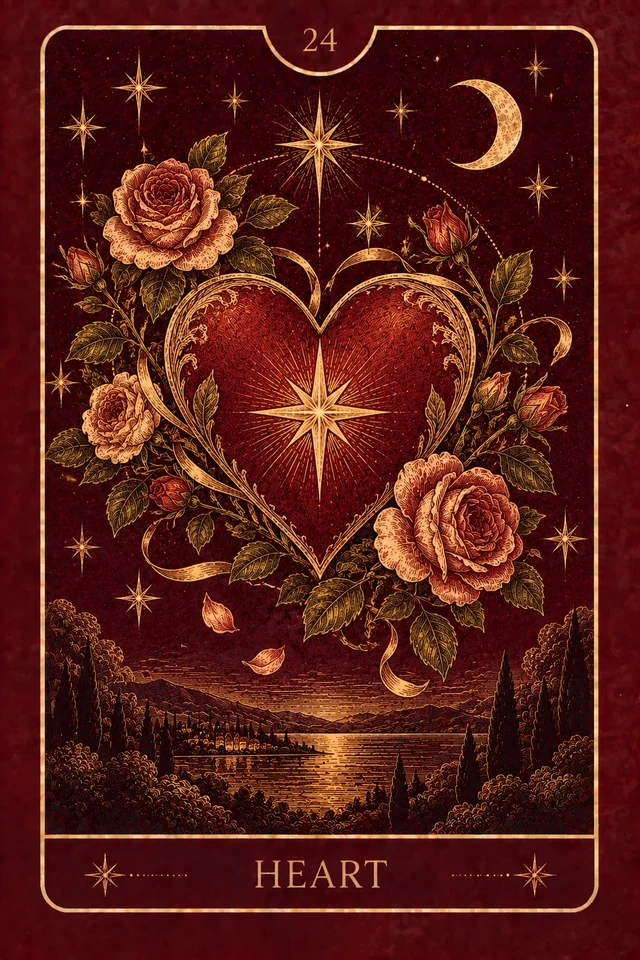
The Heart is the deck's plain word for affection. It does not predict a wedding, a reunion or a name — it says feeling is genuinely present, and leaves the shape of that feeling to the card beside it.
Core meaning
Heart denotes love and warm attachment: romance, but also the fondness between friends, family and colleagues. It describes the emotional temperature of a situation rather than its outcome. When Heart appears, care is real and freely given — someone means what they feel. What it never says on its own is what will be done about that feeling. Affection and commitment are two different cards in Lenormand (Heart and Ring), and keeping them separate is the difference between a careful reading and a hopeful one. Heart also covers reconciliation, forgiveness and generosity of spirit, and in health questions it is the literal organ and the circulatory system.
One card is a word, not a sentence
Be clear about what one card can do. In Lenormand a single card is a word, not a sentence — Heart is the word love, and a word on its own does not tell you a story. Any reader who builds an elaborate prediction out of one card is inventing the rest. The sentence appears when a second card is added, because the pair is the smallest real unit of meaning here. So take Heart as the subject of the reading and go to the combinations below for what it actually says.
The image
The traditional card shows a single red heart, sometimes on a plain ground, sometimed wreathed. There is nothing else in the picture — no couple, no ring, no scene — and that emptiness is the instruction. The heart is the seat of feeling in the old European emblem books the deck grew out of: a symbol of sincerity, in contrast to the head. Because the image contains only the organ and no action, the card was always read as the presence of emotion rather than the doing of anything with it. The playing-card insert is the Jack of Hearts, which is why many readers also let Heart describe a warm, kind younger person.
In love and relationships
In love questions Heart is one of the most welcome cards in the deck, but read it precisely. It says affection exists. It does not say the person is available, ready, honest about it, or planning to act. For someone in a relationship it points to real warmth and, next to gentler cards, a softening after friction. For someone single it says feeling is around — often already, in someone nearby — without naming who. Asking whether a specific person loves you and drawing Heart is a genuine yes to the feeling; whether that feeling becomes a relationship is told by Ring, Anchor, Stork or Clouds sitting next to it. Heart next to a difficult card does not cancel the affection, it complicates the circumstances around it.
In work and career
At work Heart points to goodwill: colleagues who like each other, a manager who is actually on your side, a job you feel fondness for rather than just obligation. In career decisions it argues for the option you care about, not the one that looks best on paper — and it is one of the few cards in the deck that talks about motivation as a factor. It can literally indicate caring professions: nursing, teaching, therapy, hospitality, charity work. It rarely speaks about money, status or outcome. A career question answered by Heart alone is telling you where your heart is, not whether the move succeeds.
In money questions
Heart is the deck's weakest money card, and that is useful information rather than a disappointment. When it turns up in a financial question it usually means the money matter is entangled with a relationship: lending to family, a shared account, a gift, generosity that is not being counted. It can mean money spent on people you love, or income from work you care about. For a straight will-I-be-paid or can-I-afford-it question, Heart is asking you to look at who is involved. Fish and Sun are the cards that speak to amount; Heart speaks to the feeling around it.
As a person
As a person, Heart is warm, affectionate and open — someone who leads with feeling and is comfortable saying so. Frequently the beloved: a partner, a crush, a much-loved family member. With the Jack of Hearts insert it often describes someone younger, or the younger of two people in the question. Heart people are sincere, but sincerity is not the same as reliability: a Heart person may mean every word and still not follow through, which is why readers check for Ring, Anchor or Dog nearby before calling someone dependable.
Timing
Heart carries no fixed traditional interval, which itself is worth saying plainly, since several Lenormand cards do. Readers who use timing usually treat Heart as soon and emotionally led rather than calendar-bound — it moves when feeling moves. In the older German systems it is sometimes tied to spring and to the warmer part of the year. For a real timing question, take the answer from the card next to it: Rider for days, Clover for a brief window, Tree or Anchor for the long stretch, Mountain for delay.
Position in a spread
Distance from the significator card (Man or Woman, whichever stands for the querent) changes the reading. Heart touching the significator means the feeling is present and close — yours, or clearly directed at you. Heart several cards away describes affection that exists but at a distance: someone who feels it but is not near, or a love that belongs to another part of your life. Cards on either side matter more than the direction in Lenormand, but the card Heart points toward is usually read as where the feeling is going, and the card behind it as where it came from.
In the Grand Tableau
As a house in the Grand Tableau, the Heart position governs love, affection and what the querent cares about. Whatever card lands in house 24 is being read through that lens: Snake in the Heart house suggests complication inside the love life, Fish there points to money mixed with affection, Anchor there suggests something in love that stays. Read it as a room the other card has walked into.
Yes or no
Heart is a yes, and specifically a yes about feeling. If the question was whether affection is real, take it at face value. If the question was whether something will happen — an engagement, a move, an official yes — Heart is a warm maybe that needs Key, Sun or Ring to become a decision. The honest version: Heart confirms the emotion in the question, not the event.
Common misreadings
The commonest mistake is reading Heart as commitment. It is not; Ring is. A pair of people can hold real affection and never build anything, and Heart alone cannot tell you which of those is happening. The second mistake is treating Heart as proof that a specific person is coming back — the card does not name people, and using it that way turns a reading into wishful thinking. Third, Heart next to a hard card is often softened into a happy ending; better to read both cards literally and let the tension stand. Finally, Heart is not a health all-clear, even though it touches the literal heart. Nothing in this deck replaces a doctor.
Card combinations
This is where the card actually speaks. Lenormand pairs read like grammar: the first card is the noun, the second one modifies it. So Heart + Letter is an expression of affection — a message whose subject is love — while Letter + Heart is a piece of communication about a relationship. Same two cards, different subject, different answer. Order is not decoration, and pairs are never interchangeable; where a reversed pair reads differently, both are given below. Some pairs are read in parallel instead, as two facts standing side by side, and that is noted where it applies.
- Heart + Ring — Affection that becomes an agreement. The noun is the feeling, and commitment is what happens to it: an engagement, a relationship becoming official, a promise made formal.
- Ring + Heart — The other direction, and a different reading. Now the commitment is the subject and affection describes it: a bond that already exists — a marriage, a contract, a partnership — and there is genuine warmth inside it.
- Heart + Letter — An expression of affection: feeling put into words. A love letter, a message someone finally sends, a declaration. The subject is the love; the letter is how it travels.
- Letter + Heart — Communication about love. Here the message is the subject: news about a relationship, a conversation that has to be had, paperwork or writing that concerns someone you care about. Not a declaration — a topic.
- Heart + Snake — A complicated affection. Feeling is the subject and something is tangled around it: a third person, a hidden circumstance, or someone who cares while also protecting their own interest.
- Snake + Heart — Reversed, the complication itself is the subject and love is the area it touches. The reading shifts from a relationship with a problem to a problem that happens to be about a relationship — often someone else's tangle landing in your love life.
- Heart + Key — A definite yes in love. Certainty about the feeling, or a door reopening in a relationship that had closed. One of the strongest positive love pairings in the deck.
- Heart + Clover — A small, lucky piece of affection — a lovely brief encounter, a flirtation, a happy chance meeting. Delightful, and not built to last. Enjoy it for what it is.
- Heart + Clouds — Feelings that are unclear, or a person unsure of their own. Often mutual confusion rather than deceit. Ask again when the situation settles instead of pressing for a verdict now.
- Heart + Anchor — Affection that stays. A long, steady love, or a bond that outlasts the current phase. Read in parallel as much as in sequence: warmth and endurance, both true.
- Heart + Coffin — The affection is what ends: a feeling released, an attachment closing. Read gently — closing a chapter of love makes room rather than punishing you.
- Coffin + Heart — The other way round, the ending is the subject and love is where it applies: a closure that concerns someone you care about, or grief being felt. Often less about losing a person than about finishing a chapter with feeling still in it.
Frequently asked questions
What does the Heart card mean in Lenormand?
Heart means genuine affection — love, warmth, fondness, forgiveness. It says feeling is really present in the situation. It does not say what will be done about that feeling; the card beside it tells you that.
Does the Heart card mean marriage?
No. Heart is affection; Ring is commitment. Heart with Ring points to a committed relationship or engagement, but Heart on its own only confirms the feeling, not a wedding.
Does Heart mean someone loves me?
It means the affection in your question is real. It does not name the person, and it cannot tell you whether they are available, honest about it, or ready to act. Look to Ring, Anchor, Clouds or Snake next to it for that part.
Is the Heart card a yes or a no?
A yes about feeling. For a yes about an event — an engagement, a reunion, an official decision — Heart needs a decisive card such as Key or Sun beside it to count as a firm yes.
Are there reversals in the Lenormand Heart card?
No. Traditional Lenormand has no reversed meanings. A card's tone is changed by the cards around it, not by which way up it lands, so Heart is always read as affection in some condition.
What does Heart mean in a health reading?
It can point literally to the heart and circulation, and more often to emotional wellbeing. It is never a diagnosis or an all-clear — a Lenormand card is a mirror, not medical advice. Take real symptoms to a doctor.
What does the Snake and Heart combination mean?
A complicated affection: real feeling with something tangled around it — a third person, a hidden circumstance, or someone caring while also protecting their own interest. The feeling stands; so does the complication.