Ring (Card 25)
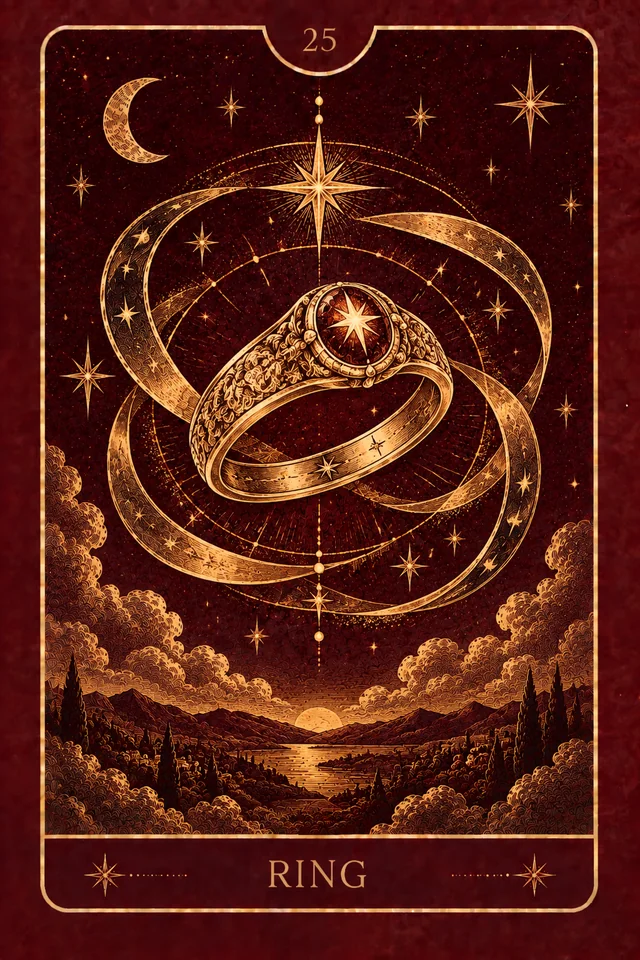
Ring is the deck's word for what binds. A contract, a marriage, a promise, a cycle that keeps going round — the card says something is tied, and says nothing at all about whether the tie is happy.
Core meaning
Ring denotes commitment and agreement in the most literal sense: a signed contract, a marriage, a partnership, a deal, a promise given. Its second meaning, just as traditional, is cycle — a ring has no end, so the card also describes something that repeats or continues. Both readings are neutral about quality. A binding thing can be a loving marriage or a lease you regret, and Ring does not distinguish; the cards around it do. This is why Ring and Heart are never interchangeable. Heart says feeling is present. Ring says an arrangement exists. Plenty of arrangements hold no feeling, and plenty of feeling never becomes an arrangement.
One card is a word, not a sentence
One card here is a word, not a sentence. Ring is the word for binding — and a word cannot tell you whether the bond is a marriage, a lease or an argument going round again. Anyone who reads a whole prediction out of a single Lenormand card is filling in the blanks themselves. The pair is the smallest honest unit of meaning, so treat Ring as the subject and let the combinations below finish the thought.
The image
The card shows a plain ring, usually gold, sometimes set with a stone. A circle with no beginning and no end is one of the oldest emblems of continuity and of the vow, and the deck uses both senses at once. The ring's form gives the cycle meaning; the ring as an object given and worn gives the commitment meaning. There are no people in the picture and nothing being exchanged, so the card describes the bond itself, not the parties to it. The playing-card insert is the Ace of Clubs, which older readers connect to work and enterprise — one reason Ring sits so naturally in business questions as well as romantic ones.
In love and relationships
In love, Ring is the commitment card: a relationship that is official, exclusive, or heading that way. With Heart it is a loving commitment. With Snake it is a commitment with a complication inside it. Alone, it says the bond exists without telling you how it feels to be in it, which makes it a more honest card than people expect — an unhappy marriage is still a Ring. The cycle meaning matters too: Ring can describe a couple going round the same argument again, or an on-off relationship repeating its pattern. For a question about an ex, Ring is genuinely ambiguous: it may mean the old bond is still in place, or that the same cycle would start again. Read the neighbours before calling it a reunion.
In work and career
This is one of the strongest work cards in the deck, because so much of working life is contractual. Ring means an offer becoming a signature, a renewed contract, a partnership agreement, a client tied in, a business relationship formalised. It favours negotiation questions and says the terms will hold. In its cycle sense it describes a role that repeats: the same tasks, the same annual round, a job you have been doing long enough to know by heart. Ring says nothing about whether the terms are good. Fish next to it points to worthwhile money, Fox to terms worth rereading, Mountain to a deal that stalls before signature.
In money questions
In financial questions Ring is the paperwork of money rather than the money itself: loans, mortgages, subscriptions, insurance, anything with recurring terms. It is the card of the standing commitment — a monthly obligation that continues whether or not you look at it. In a question about a purchase or a deal, Ring says you will be bound by what you agree to, so the terms are the real subject. With Mice it warns about a recurring cost quietly draining you. With Fish it points to an agreement that genuinely pays.
As a person
Ring is less a person than a role: the partner, the spouse, the business associate, the person you are tied to by agreement rather than by feeling. When it does describe someone directly it suggests a person who honours their word, or is bound to you in a way that neither of you can simply walk away from. In a Grand Tableau, Ring near the significator often marks the person the querent's life is contractually entangled with, which may or may not be the person they most care about.
Timing
Ring's traditional timing signal is continuation rather than a date: the matter goes on, and keeps going on. Some readers take it as a full year, reading the circle as a completed cycle, and it is commonly used for anniversaries and renewal dates. Because the card is about duration rather than arrival, it is a poor answer to when will it start and a good answer to how long will it last. Pair it with Rider for imminent news of an agreement, Clover for a short window in which to sign, Anchor for something that simply keeps holding.
Position in a spread
Close to the significator, Ring means the commitment is yours and active — your contract, your marriage, your obligation. Further away it describes a binding arrangement that touches your question without being yours: someone else's marriage, a deal being made elsewhere that affects you. The card immediately after Ring is usually read as what the agreement leads into, and the card before it as what brought the agreement about. Between two people cards, Ring is read as the bond between them — one of the clearest position-based readings in the deck.
In the Grand Tableau
As a house, the Ring position governs contracts, commitments and repeating cycles. A card landing in house 25 is being asked about in those terms: Clouds in the Ring house points to an agreement that is unclear or a commitment in doubt, Sun there to a contract going well, Scythe there to an agreement cut short. Coffin in this house is traditionally read as an arrangement coming to an end.
Yes or no
Ring is a conditional yes: yes, it is binding — but check what it is you are binding yourself to. For questions about offers, agreements and official status it reads as a solid yes. For questions about happiness, it is not an answer at all, because the card is silent about how the commitment feels. Where a decisive yes is needed, Key beside Ring provides it.
Common misreadings
The biggest misreading is treating every Ring as a wedding. In most real readings it is a contract, a lease, a work agreement, or a cycle repeating itself, and forcing it into romance distorts the answer. The second is assuming Ring means a good commitment; a binding arrangement can be one you should renegotiate, and this card will not tell you which. Third, the cycle meaning is often dropped, so readers miss the message that the same pattern is coming round again. Finally, with Heart nearby it is tempting to promise a proposal about a specific person — the deck does not name people, and that promise is not yours to make.
Card combinations
Pairs are where Ring becomes readable, and the order carries the meaning. The first card is the noun; the second modifies it. Ring + Letter is an agreement being documented — the bond is the subject. Letter + Ring is a document that binds you — the paperwork is the subject, and the commitment is its effect. Same cards, different answer, so reversed pairs appear separately below wherever the difference matters. A few pairs read in parallel instead, as two facts side by side.
- Ring + Heart — A commitment with real warmth in it. The bond is the subject and affection describes it: a marriage or partnership that is genuinely loving, not merely valid.
- Heart + Ring — Reversed, the feeling is the subject and commitment is what happens to it: affection turning into an agreement. This is the engagement reading; Ring + Heart describes a tie that already exists.
- Ring + Letter — The agreement gets documented: terms written down, a contract drawn up, a promise put on paper. The bond is the subject and the letter records it.
- Letter + Ring — The other direction: a document that binds. Paperwork arrives and signing it commits you — an offer, a lease, terms that take effect once accepted. Read the document first, because here it is the subject.
- Ring + Snake — A complication inside the commitment: terms that are not what they appear, a third party in a relationship, someone keeping the letter of the agreement but not its spirit.
- Snake + Ring — Reversed, the complication is the subject and the commitment is where it shows up — a tangle that ends up expressed as a contract or an obligation, often someone else's interest binding you.
- Ring + Scythe — The agreement is cut: a contract terminated, a separation, a commitment ended cleanly rather than fading out.
- Scythe + Ring — The other way round, a sudden cut that produces a commitment: a decision made abruptly and then formalised, or a separation agreement. The cut is the subject; the ring is its result.
- Ring + Fish — A profitable agreement. A contract that pays, a business partnership with real money in it, a financial commitment working in your favour.
- Ring + Anchor — A commitment that holds for the long term. Read in parallel: binding and lasting, both true. Duration rather than excitement.
- Ring + Key — A certain yes on an agreement. The deal goes through, the commitment is confirmed, the answer is definite.
- Ring + Clouds — An unclear commitment. Terms not yet defined, a relationship whose status nobody has named, doubt about what was actually agreed. Get it in writing before proceeding.
Frequently asked questions
What does the Ring card mean in Lenormand?
Ring means a binding agreement — a contract, a marriage, a partnership, a promise — and also a cycle that repeats. It says something is tied, and the surrounding cards say whether that is good news.
Does the Ring card always mean marriage?
No. Ring is any binding arrangement, and in most readings it is a contract, a lease, a work agreement or a repeating pattern. It means marriage mainly when love cards such as Heart sit beside it.
What is the difference between the Heart and the Ring?
Heart is affection; Ring is commitment. You can have one without the other. Together they describe a loving commitment, which is why Heart + Ring is the classic engagement pairing.
Is the Ring card a yes or a no?
A conditional yes. Yes, the thing binds — but the card says nothing about whether the terms are in your favour. With Key it becomes a firm yes; with Fox or Snake, reread the agreement first.
What does Ring mean for an ex?
It is genuinely ambiguous: it can mean the old bond is still in place, or that the same cycle would repeat. Read the neighbouring cards before treating it as a reunion.
Does the Ring card have a reversed meaning?
No. Traditional Lenormand is read without reversals. Ring's tone comes from its neighbours — Scythe next to it cuts the agreement, Anchor next to it makes it last.
What timing does the Ring card suggest?
Continuation rather than a date: the matter keeps going. Many readers treat it as a full cycle or a year, and it fits renewal and anniversary questions better than questions about when something will start.