Ship (Card 3)
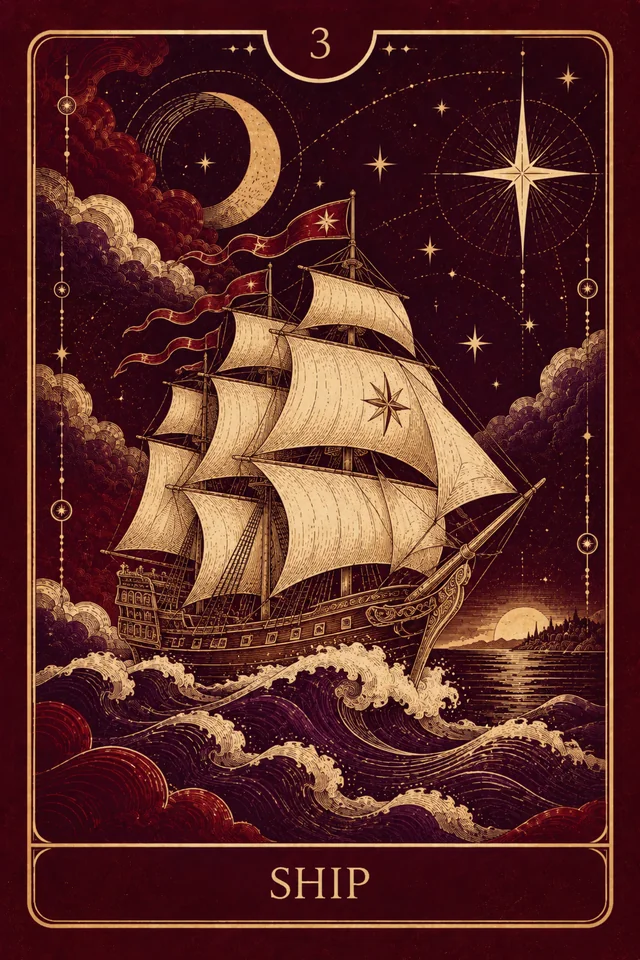
Ship is movement away from where you are: a journey, a distance, a venture that takes time to arrive. It carries a quiet longing for something beyond the horizon, and the card beside it tells you whether that movement is a trip, a move, a business deal or simply a wish to be elsewhere.
Core meaning
Ship denotes departure and distance. Something is leaving the harbour: a person travelling, a plan moving abroad, an idea crossing from one stage of life into another. Traditionally it is also the card of trade and commerce, because ships carried goods and brought money back. Its gift is expansion and new horizons. Its shadow is distance itself — what sails away is not close at hand. Ship + House is a move; Ship + Fish is international business; Heart + Ship is love at a distance. Ship rarely says the journey is quick. It says the direction has changed and the voyage has begun.
One card is a word, not a sentence
Alone, Ship only says “movement, distance, away.” It does not say where, why, or whether the trip is literal. A single Ship drawn for “will things change?” is a gentle yes — something is moving — but the meaning becomes useful only once a partner card names what is moving. Read the combinations below before drawing conclusions.
The image
A sailing ship under full canvas on open water, often with a distant coastline. The sails are filled, so the wind is already working. Nothing in the image is anchored. That is the picture to keep in mind: forward motion, open space and a destination that is not yet in view.
In love and relationships
In love, Ship speaks of distance or longing. It can be a long-distance relationship, a partner who travels, or a connection that is slowly drifting apart. It can also be the hopeful version: a romance met while travelling, or a relationship moving into a new phase. Ship with Heart or Ring tends to the hopeful reading; Ship with Clouds or Scythe asks whether the distance is emotional rather than geographic.
In work and career
At work, Ship is trade, import and export, travel for business, remote work or a change of role that takes you somewhere new. It favours careers that cross borders or involve logistics and movement. For a job question it often points to an opportunity elsewhere — a new city, a new company — rather than progress where you are.
In money questions
Ship is a traditional money-in-motion card: income from trade, overseas payments, investments that take time to mature. It is not a fast-cash card. It suggests funds that travel, so expect delay between sending and receiving. With Fish it is strongly commercial; with Mice it warns that money is draining away in transit.
As a person
As a person, Ship describes a traveller, a foreigner, someone who lives far away, or a restless spirit who is always planning the next move. It can also be a merchant or anyone working in shipping, tourism or international business.
Timing
Ship is slow but moving. It suggests weeks to months rather than days, and the time a journey would take. Some readers link it to the period before a trip or a move; nothing happens instantly, but the process has started.
Position in a spread
In the past position, Ship is a departure that shaped the present — a move or journey already made. In the present, things are in transit. In the future, a change of place or perspective is coming. As an outcome card, it says the answer lies elsewhere, not in staying put.
In the Grand Tableau
In the Grand Tableau, the house of Ship (position 3) shows matters of travel, distance and trade. Cards falling near Ship are in motion; cards far from it are settled. Note which side of the significator Ship falls: some readers treat it ahead of the person as a future journey and behind as a past one.
Yes or no
Ship leans towards yes when the question is about change, travel or expansion. For “will it stay the same?” it is a no. The yes is a slow one — the answer is coming, but it is on its way, not already here.
Common misreadings
The most common mistake is reading every Ship as a literal trip. Often it is a change of mindset, a desire for something new, or emotional distance. Another misreading is treating it as loss: Ship moves things, it does not destroy them. Ask what is travelling before deciding it is gone.
Card combinations
Ship is a card of movement, so ask what is moving. The first card is the noun and the second modifies it. House + Ship is a home that moves — a relocation. Ship + House is a journey that ends at home, or travel to see family. Keep that order and let each partner name what is in transit.
- Ship + House — A journey home, a visit to family, or a trip that ends with settling somewhere.
- House + Ship — Moving house or relocating; the home itself is on the move.
- Ship + Heart — Travel undertaken for love, or a journey that opens the heart.
- Heart + Ship — Love at a distance, or longing for someone far away.
- Ship + Fish — International trade, overseas income, business that crosses borders.
- Ship + Anchor — A journey that ends in settling down; a move made for the long term.
- Anchor + Ship — Stability that starts to shift; a fixed situation preparing to move.
- Ship + Letter — News from far away, travel documents, a booking confirmation.
- Ship + Clouds — Travel plans that are unclear or delayed; uncertain direction.
- Ship + Key — A journey that unlocks an important answer or opportunity.
- Ship + Mice — Money or energy lost along the way; a trip that drains resources.
- Ship + Crossroad — Several possible destinations; a choice about which way to go.
Frequently asked questions
What does the Ship mean in Lenormand?
Ship means travel, distance, departure and trade. It shows that something is moving away from where it was — a person, a plan or a mindset.
Does the Ship always mean a physical trip?
No. It can be a literal journey, but it can also be emotional distance, a change of perspective, or a wish for something new.
Is the Ship a yes or no card?
It leans to yes for questions about change or expansion, but it is a slow yes. For questions about things staying the same, it is a no.
What does Ship mean in love?
Distance or longing: a long-distance relationship, a partner who travels, or a bond that is drifting. Paired with Heart or Ring it is more hopeful.
What does Ship mean for money?
Money in motion — trade, overseas income or investments that take time. With Fish it is strongly commercial.
How fast is the Ship's timing?
Slow but in progress: weeks to months, or however long the journey in question would take.
Which cards change the Ship most?
House (relocation), Anchor (settling), Fish (business) and Clouds (unclear plans) shift its meaning most clearly.