Anchor (Card 35)
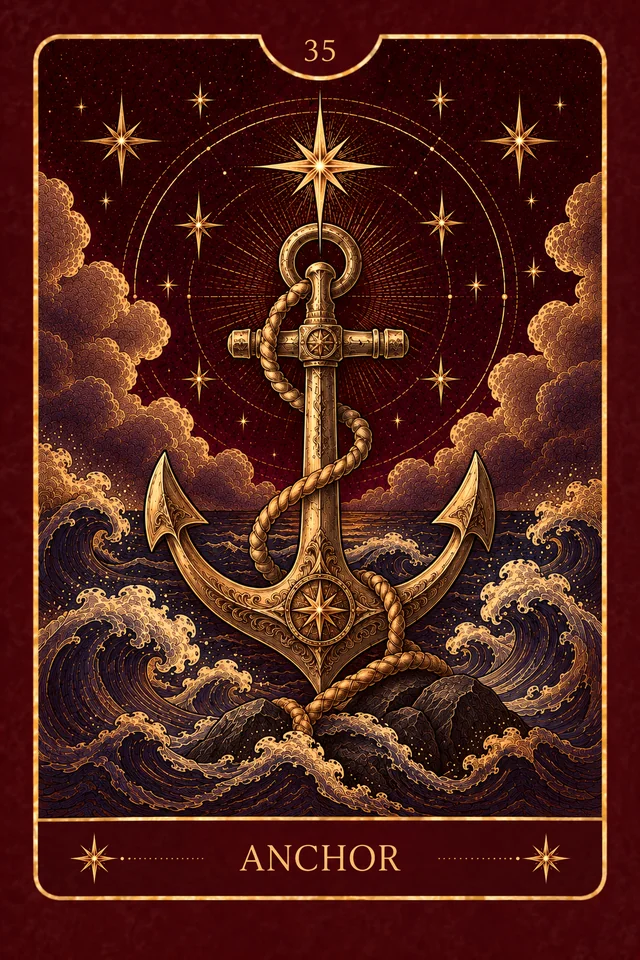
Anchor is what holds: a situation that stays, a commitment that lasts, a job or place you are tied to. It is steady and dependable, but whether that steadiness feels like safety or like being stuck depends on the card beside it.
Core meaning
Anchor denotes duration and holding. Something is fixed in place and is not going to drift: a job, a home base, a relationship pattern, a decision that has settled. In many traditions it is also the card of work, especially steady employment or a long-standing role. Its gift is reliability. Its shadow is inertia, because the same weight that keeps a boat safe in a storm also stops it from leaving the harbour. Heart + Anchor is love that lasts; Anchor + Mountain is being stuck; Anchor + Ship is a settled plan to travel or relocate. The useful question is not only “will this last?” but “is lasting what I want here?”
One card is a word, not a sentence
One card is a word, not a sentence. Anchor says staying, but staying in what, and whether that is comfort or confinement, stays unknown. A single card cannot tell you a relationship is permanent or a job is secure. The honest reading starts with a pair: Ring + Anchor is a commitment that holds, while Anchor + Ring makes the stable situation itself turn into a formal agreement. Those feel close and answer different questions. Treat Anchor as the weight in the sentence, then read the combinations before predicting anything.
The image
The card shows a ship’s anchor, often resting on a shore or lying on the seabed with its chain. It is heavy, still and built to resist movement. Where Ship is the vessel that travels, Anchor is the object that stops the travelling and holds position. The playing-card insert is the Nine of Spades. The image carries two feelings at once: the relief of arriving and holding firm, and the weight of something that cannot easily be lifted. Nothing in the picture says which one you are living; the neighbouring card decides.
In love and relationships
In love Anchor points to stability, loyalty and a connection that stays. It is one of the most reassuring cards for questions about whether something will last. Heart + Anchor is lasting affection; Anchor + Heart says the steady situation has real warmth in it. With Ring it supports long-term commitment. With Mountain or Cross it can describe staying out of duty, habit or fear of change. Anchor does not say a relationship is happy, only that it holds. If the question is “will they stay?”, Anchor leans yes; if the question is “am I content?”, look at the cards around it.
In work and career
At work Anchor is the traditional career card: steady employment, a long-term role, security, a job you are committed to or tied to. Anchor + Key is a confirmed, secure position; Fish + Anchor is stable income from work; Anchor + Clouds is uncertainty around a job that looked settled. It can also describe perseverance, the ability to stay with a task until it is finished. As advice it says hold your position and build on what you have rather than jumping. Paired with Ship or Crossroad, it can show the tension between staying and leaving.
In money questions
In money questions Anchor describes stable, long-term finances: regular income, savings, property, or an arrangement that keeps money steady. Fish + Anchor is secure cash flow; Anchor + Fish makes the stable base itself the source of money. It favours slow, reliable growth over sudden gains. With Mice or Clouds, the stability is being worn down or is less certain than it looks. Anchor does not describe amount; it describes how dependable the money is. Read it as “this is holding” and let Fish, Tree and the surrounding cards say how much.
As a person
As a person, Anchor is someone steady, loyal and dependable: the colleague who has been there for years, the partner who stays, someone rooted in one place. It can also describe a person who resists change or holds on too long. The card is about constancy rather than warmth; Dog adds friendship, Heart adds love, Bear adds authority. When Man or Woman sits beside Anchor, read that person as settled or committed. The quality of their steadiness still comes from the cards next to them.
Timing
Anchor is a long-duration card. It does not speak of soon; it speaks of lasting. For questions about when, it often means the situation will stay as it is for a while, or that an outcome arrives through patience rather than speed. Rider or Clover beside it can bring a quick event into a longer arrangement; Tree beside it makes it slower still; Scythe beside it cuts a long-held situation suddenly. Anchor gives no fixed date. Read it as “this holds,” then check what might move it.
Position in a spread
Anchor’s placement shows where stability sits. Beside the significator, the querent is settled or committed right now, for better or worse. Far away, security exists but is not yet part of their daily life, or it belongs to someone else. In a line, the card before Anchor often names what is being held, and the card after shows what that holding produces. Anchor between Ship and Mountain is a strong sequence: a move that stops, and the stop becomes an obstacle. Reverse the order and the story changes.
In the Grand Tableau
House 35 governs stability, work and what lasts. A card in the Anchor house is something that stays or anchors the querent: Heart there is enduring love, Ship there a journey that ends in settling, Coffin there a long situation finally closing. Anchor close to the significator shows a strong sense of security or commitment; far away it can show that the querent feels unmoored or that stability is still being sought. Read it as the card that holds everything else in place, then check whether that hold is comforting or confining.
Yes or no
Anchor leans yes for questions about stability, lasting, keeping and staying: yes, it holds. It is a slower yes than Sun or Key, more “this will last” than “this will happen now.” For questions about change, moving or ending something, Anchor leans no, because its whole nature is to stay put. Mountain, Cross or Mice beside it qualify the yes; Key and Clover make it clearer. Read the question first, then decide which way the weight falls.
Common misreadings
The commonest mistake is reading Anchor as automatically good. Stability can be comfort or confinement, and the card itself does not choose. The second is treating it as instant: Anchor is slow, lasting and patient. Third, readers forget its traditional work meaning and miss that a question about love may be showing a job. Fourth, order is flattened: Heart + Anchor and Anchor + Heart are close, but one is love that lasts and the other is a stable situation that has warmth. Finally, Anchor does not guarantee happiness, only duration.
Card combinations
Anchor is a card of holding, so ask what is being held. The first card is the noun and the second modifies it. Ring + Anchor is a commitment that lasts — the bond is the subject and Anchor adds duration. Anchor + Ring is a stable situation that becomes formal — the stability is the subject and Ring defines it. Keep that grammar and do not reverse a pair for convenience. Linked cards already have pages; unlinked partners stay plain text until their pages exist.
- Ring + Anchor — A commitment that holds: a lasting agreement, a long-term relationship or a contract meant to endure. The bond is the subject; Anchor adds duration.
- Anchor + Ring — A stable situation becoming formal. The steady ground comes first, and Ring shows it turning into a promise, contract or official arrangement.
- Heart + Anchor — Love that stays. Feeling is the subject and Anchor says it has staying power, loyalty and a steady base.
- Anchor + Heart — A settled situation with real warmth in it. The stability is the subject, and Heart shows it is held together by care, not only habit.
- Fish + Anchor — Steady money: regular income, a reliable business or finances that hold. The money is the subject; Anchor makes it dependable.
- Anchor + Fish — A stable base that produces money: a long-term job, property or investment. The foundation is the subject and Fish names what it yields.
- Key + Anchor — A certain answer that lasts. The confirmation is the subject, and Anchor says the outcome is secure rather than temporary.
- Anchor + Scythe — A long-held situation cut suddenly. What was stable is the subject; Scythe ends it quickly, often a job, arrangement or habit.
- Scythe + Anchor — A clean decision that holds. The cut comes first, and Anchor shows it was final and becomes the new steady ground.
- Snake + Anchor — A complication that will not go away. The entanglement is the subject and Anchor keeps it in place; this asks for patience and clear boundaries.
- Coffin + Anchor — An ending that stays ended, or a long period of rest. Closure is the subject; Anchor makes it lasting rather than a pause.
Frequently asked questions
What does the Anchor card mean in Lenormand?
Anchor means stability, staying power, lasting commitment and, traditionally, work. It shows what holds; the card beside it shows whether that feels safe or stuck.
Is the Anchor card a yes or a no?
Usually yes for questions about lasting, keeping or staying. For questions about moving, changing or ending something, it leans no, because Anchor stays put.
What does Anchor mean in love?
Loyalty, stability and a connection that lasts. With Heart it is enduring love; with Ring, long-term commitment; with Mountain or Cross it can mean staying out of duty rather than joy.
Is Anchor the career card in Lenormand?
Yes, in most traditions Anchor represents work, especially steady employment or a long-term role. Key beside it is a secure position; Clouds beside it is job uncertainty.
What timing does Anchor suggest?
Long duration rather than speed. It often means the situation stays as it is for a while, or the outcome comes through patience. It never gives a fixed date.
Does Anchor have a reversed meaning?
No. Traditional Lenormand has no reversals. Whether Anchor reads as security or as being stuck comes from the surrounding cards and their order.
What is the difference between Anchor and House?
House is the private base: home, family, what is personal and familiar. Anchor is what holds and lasts, often work or long-term commitment. House is where you live; Anchor is what keeps you there.