9 of Swords — Tarot Card Meaning
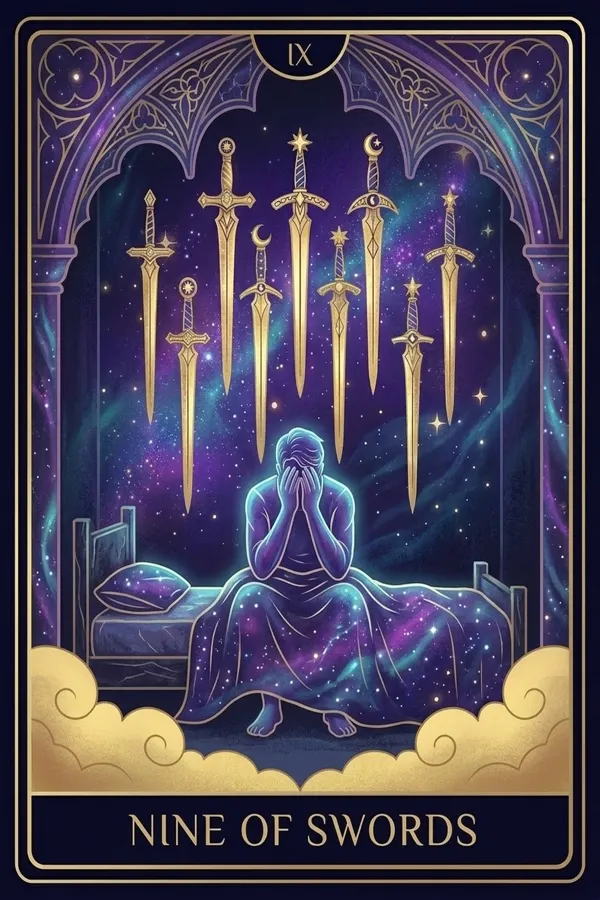
The 9 of Swords is the mind at three in the morning. It describes suffering that is real and largely anticipatory — the dread of a thing rather than the thing itself.
Overview of the Card's Meaning
The 9 of Swords is the card people recognise before they can explain it. Sitting up in the dark, running the same scenario, arguing with a conversation that has not happened — that is its whole territory. It is important to say plainly: what this card describes is genuinely painful. It is not weakness or overreaction. Anxiety at this pitch is exhausting in the body as well as the mind. What the card offers is perspective rather than dismissal. Most of the weight here belongs to anticipation. The situation may well be difficult; the version being rehearsed at 3am is usually harsher, more certain and more final than the one daylight produces.
Symbolism and Imagery
A figure sits upright in bed, face in hands, nine swords hanging on the wall behind them. This is the detail that matters most: not one of the swords is touching them. The blades are mounted, arranged, almost catalogued — thoughts kept rather than thoughts happening. The quilt is embroidered with roses and astrological symbols, ordinary life continuing beneath the distress. The carving on the bed shows one figure apparently defeated by another, an image of an old story replaying. Nothing in the picture is attacking. The room is quiet. The suffering is entirely interior, which does not make it less real — it makes it treatable in a different way.
Upright Meaning
Upright, the 9 of Swords means worry that has outgrown its cause. Sleep goes first, then appetite and patience. The mind, deprived of rest, becomes markedly worse at judging risk, which deepens the loop. It frequently accompanies guilt and self-recrimination — reviewing something already done, sentencing yourself repeatedly for it. There is rarely new information in the tenth review. It can also mark the period just before something is faced. Waiting for a result, a conversation, a diagnosis. The card is unusually accurate about how much of the pain arrives in advance.
Reversed Meaning
Reversed, the 9 of Swords often means the worst of the night is passing. What was unspeakable becomes sayable, and saying it takes a surprising amount of its power away. It can describe the moment help arrives: telling someone, getting the appointment, letting a fear be examined in daylight rather than defended in the dark. Less comfortably, it can show anxiety being suppressed instead of eased — a determined refusal to look at it that works until it does not. The reversal asks which of the two is happening, honestly.
Upright Keywords
Anxiety, Sleeplessness, Rumination, Guilt, Anticipatory dread, Overwhelm
Reversed Keywords
Relief, Speaking it aloud, Recovery beginning, Suppression, Help arriving, Perspective
In Love
If You Are Single
For single readers, this card often describes fear rehearsed as certainty: that it will not happen, that something is wrong with you, that the last ending proved something permanent. Those conclusions feel like insight at night. They are usually just tiredness with a narrative attached. The evidence they rely on rarely survives being written down. It can also point to overthinking a new connection — reading tone in messages, constructing rejection before any has occurred. The kindest available move is usually asking a direct question rather than continuing to interpret.
If You Are in a Relationship
In a relationship, the 9 of Swords commonly shows worry carried privately. One person is awake with something they have not said, often to avoid burdening the other. The card gently disagrees with that strategy. Unspoken fear tends to leak out as distance or irritability, which is harder to respond to than the fear itself. Where there is real trouble — jealousy, illness, money — the card does not pretend otherwise. It suggests that the shared version of the problem is more manageable than the 3am solo version, and that this is usually true even when it does not feel likely.
About an Ex or Getting Back Together
About an ex, this card is often replayed guilt or replayed grievance. The same scene, examined again, with the same outcome. It sometimes indicates dread of contact, or of news arriving — a fear of what you will feel rather than of what will actually be said. The card's suggestion is not to force closure. It is to notice that the review has stopped producing anything new, and that rest, rather than more analysis, is what the mind is actually asking for.
In Career and Work
At work, the 9 of Swords is the Sunday night card. Anticipatory dread, mistakes rehearsed, an email drafted and redrafted at midnight. It can point to a genuinely difficult environment, and it is worth distinguishing between anxiety generated internally and pressure being applied externally. The second needs different action from the first. Practically, it favours getting the feared thing onto paper and into daylight — the actual figures, the actual deadline, the actual conversation. Vague dread is heavier than specific difficulty almost every time.
In Money and Finances
Financially, this card is usually fear of money rather than a statement about money. Avoided statements, unopened letters, sums estimated upward in the dark. Its practical counsel is unglamorous: look at the real number. The known position, however uncomfortable, is nearly always lighter to carry than the imagined one. It can also describe genuine strain. Where that is true, the card still points the same way — toward specifics, and toward telling someone who can help rather than managing it alone.
What This Card Says About How Someone Feels About You
As how someone feels about you, the 9 of Swords suggests someone anxious about it. They may care considerably and be frightened of getting it wrong, or of what caring would cost them. That can look like inconsistency from outside — warmth followed by retreat, driven by rumination rather than indifference. It can also describe guilt about how they have treated you, being reviewed privately without being addressed. Either way, this is not a cold card. It is an uneasy one.
This Card as Advice
Stop deciding things at night. The mind after midnight is a poor judge and an excellent prosecutor, and the conclusions it reaches are not more honest for being painful. Get the fear out of your head and into a specific form — written down, said aloud, told to one person. Vague dread is heavier than named difficulty, reliably. And treat rest as the intervention rather than the reward. Sleep, food, daylight and movement change the quality of thought more than another hour of analysis will. If the distress is persistent, or if you are thinking about harming yourself, please speak to a doctor or a crisis line in your country. A tarot card is a mirror; it is not a substitute for real support, and reaching for that support is not an overreaction.
Is This Card a Yes or a No?
The 9 of Swords is not a clear no, though it is often read as one. It is closer to 'not from here' — the answer arrived at in this state of mind is unlikely to be a good one. Where the question is about a feared outcome, the card more often reflects the fear than the outcome. That is a meaningful distinction and easy to miss. If a decision can wait until you have slept, let it. If it cannot, make it with someone else present rather than alone at 3am.
Combinations With Other Cards
With the Four of Swords, the reading is almost prescriptive: the sleepless mind and the deliberate rest belong together, and the pairing says stop before the cost compounds. People who draw one have often drawn the other recently. Alongside the Eight of Swords, expect fear plus a sense of no options — usually more perceived than real. With the Ten of Swords, the dread has already met its ending, and the ending is generally less absolute than it looked. With the Star or the Sun, the card reads much more hopefully: the night is nearly over. Next to the Moon, projection is doing most of the work, and almost nothing being feared has been verified.
This Card as Your Card of the Day
As a card of the day, the 9 of Swords suggests being careful with your own conclusions. Notice what you are certain of and check when you last slept properly. It is a good day to name one worry out loud, and a poor day to make an irreversible decision. Small physical things help more than they should — water, a walk, an earlier night. Treat that as the day's actual task.
Common Misconceptions
The most damaging misreading is treating the 9 of Swords as a prediction of disaster. It describes a state of mind, not an outcome. Read as prophecy it does real harm, because it confirms the very certainty that is causing the suffering. The second mistake is dismissal — telling someone the swords are not touching them, as though that settles it. The image says the pain is interior; it does not say the pain is imaginary. Anxiety at this pitch is physically exhausting and deserves to be taken seriously. Third, people read it as guilt requiring punishment. Reviewing a mistake for the eleventh time is not accountability. Fourth, it is often read alone when it works best in company: paired with the Four of Swords or the Star, the reading usually points to recovery rather than deeper distress.
Historical Background and Spiritual Depth
In the Swords sequence, the suit that governs mind and language, the nine sits between the paralysis of the Eight and the ending of the Ten. That position is telling — it is the stretch where the thinking has become the problem. Traditionally it has been called the card of nightmares or of cruelty, sometimes read as grief and mourning. Older sources emphasised suffering; contemporary readings emphasise the mechanism, which is more useful, because a mechanism can be interrupted. Read as an inner figure, the 9 of Swords is not an enemy. It is a part of you working very hard, in the dark, with poor information, trying to prevent something. Treated with some kindness it becomes far less frightening — and it responds better to rest and daylight than to argument.
Self-Reflection Questions
Notice what you have concluded recently, and whether you concluded it while tired. Then separate what you actually know from what you are anticipating. Write both columns; they are usually different lengths from what you expected. Finally, consider who you have not told. This card loses a surprising amount of weight the moment it is spoken to someone who does not flinch.
Frequently Asked Questions
Does the 9 of Swords predict something bad happening?
No. It describes a state of mind rather than an outcome — anticipatory dread, rumination and lost sleep. Read as prophecy it does real harm, because it reinforces the very certainty that is causing the distress.
Why are the swords not touching the figure?
Because the suffering in this card is interior. The blades are mounted on the wall like kept thoughts rather than active wounds. That does not mean the pain is imaginary — it means it is being generated and sustained by the mind.
Is the 9 of Swords a yes or no card?
Closer to 'not from here' than to no. A decision made in this state is unlikely to be a good one. Where the question is about a feared outcome, the card usually reflects the fear rather than the outcome itself.
What does the 9 of Swords reversed mean?
Often that the worst of the night is passing: the fear becomes sayable, or help arrives. Less comfortably it can show anxiety being suppressed rather than eased — a refusal to look that works until it stops working.
What does the 9 of Swords mean for feelings?
Someone anxious about you rather than indifferent. They may care a great deal and fear getting it wrong, which from outside can look like warmth followed by retreat. It can also indicate private guilt about how they have behaved.
What should I do when I draw the 9 of Swords?
Stop deciding things at night, get the fear into specific words rather than leaving it vague, and treat rest as the intervention rather than the reward. If the distress is persistent, please speak to a doctor or a crisis line — a card is a mirror, not a substitute for real support.
How does the 9 of Swords relate to the 4 of Swords?
They are natural counterparts: the sleepless mind and the deliberate rest. Drawn together the reading is almost prescriptive — stop before the cost compounds. People who draw one have very often drawn the other recently.
Journaling Prompts
- What exactly am I afraid will happen, in plain and specific words?
- What do I actually know, as distinct from what I am predicting?
- When did I last sleep properly, and how are my conclusions different when I have?
- Who could I tell about this who would not make it worse?
Related Cards
Start a Personal Reading · Today's Card · Explore the Full Library · Career Reading · Yes or No Reading