7 of Swords — Tarot Card Meaning
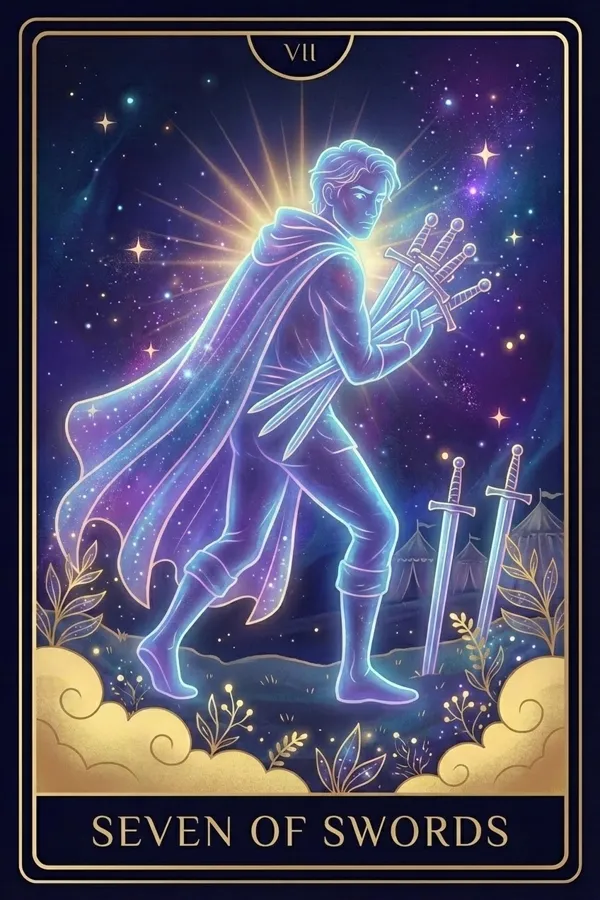
The 7 of Swords is the card of the clever move — strategy, discretion, and the things done quietly. Sometimes the quiet mover is someone around you. Just as often, it is you.
Overview of the Card's Meaning
The 7 of Swords has one of the worst reputations in the deck, and most of it is undeserved. Yes, it can indicate deception — someone being less than honest, information withheld, a situation not quite what it presents itself as. But Swords is the suit of the mind, and this card's core is strategy: thinking around an obstacle rather than through it, choosing the quiet path, keeping your plans to yourself until they are ready. The honest reading always starts with a question of direction. Is someone maneuvering around you — or are you the one maneuvering? The card points to avoidance, indirectness, and self-deception at least as often as it points to another person's lies. The reader who draws this card about a partner should stay with that possibility for a moment before settling on the comfortable one. As an inner mirror, the card asks: where in your life is the direct route available, and why are you not taking it? Sometimes the answer is wisdom. Sometimes it is fear wearing strategy's clothes.
Symbolism and Imagery
In the Rider-Waite-Smith image, a figure tiptoes away from a military camp carrying five swords, leaving two planted behind. In the background, a group of figures gathers, unaware. The thief — if that is what they are — glances back over their shoulder with an expression that is hard to read: part satisfaction, part unease. The tiptoe is the card's signature. Whatever is happening is deliberately quiet. The five taken swords suggest that most of the prize can be carried — but not all. Two remain, which is the card's built-in limit: no clever maneuver gets everything, and every shortcut leaves something behind. The backward glance matters most. It is the look of someone who knows exactly what they are doing and is not entirely at peace with it. That ambivalence is the card's emotional truth — strategy executed with a conscience still attached.
Upright Meaning
Upright, the 7 of Swords speaks first of strategy and discretion. Some goals are best pursued quietly: the job search conducted while still employed, the plan held back until it is ready to survive criticism, the negotiation where you do not show your full hand. None of this is dishonest. It is the intelligent management of timing and information. It also flags avoidance. A conversation being dodged, a confrontation deferred past its usefulness, a responsibility slipped around rather than carried. Avoidance works — briefly, and at interest. The card asks whether the quiet path is actually shorter once you count the debt. And yes, sometimes it indicates that someone around you is being less than straight: withholding, spinning, taking credit, keeping a second agenda. The card supports a calm verification of facts rather than an accusation. Check before you confront; the same card that detects dishonesty warns against the sloppy thinking of paranoia.
Reversed Meaning
Reversed, the 7 of Swords frequently marks the truth surfacing: the secret discovered, the lie confessed, the strategy exposed. If you have been carrying something hidden, the card suggests the cost of concealment is about to exceed the cost of honesty — and that coming clean on your own terms beats being discovered. It can also describe the end of self-deception: the moment you stop managing a story you tell yourself and admit what you actually know. These turns are quietly life-changing, and the card treats them as victories. Occasionally the reversal shows strategy failing or paralysis from overthinking — plans so elaborate they never touch the ground. The remedy is the direct route: one plain conversation, one honest step, taken out loud.
Upright Keywords
Strategy, Discretion, Avoidance, Quiet moves, Hidden information, Indirectness
Reversed Keywords
Truth surfacing, Confession, Coming clean, Exposure, End of self-deception, Directness
In Love
If You Are Single
For single readers, the 7 of Swords counsels two things at once. First, keep your own counsel a little: you do not owe early dates your full history, and a degree of privacy while you assess someone is healthy, not deceptive. Second, verify before you invest. This card appears when someone's story has gaps — the person who is vague about their situation, the match whose accounts do not quite add up. It does not say everyone is lying. It says the card turned up, so do the ordinary diligence: consistency over time, friends met, claims that survive casual questions. It also asks about your own indirectness. Are you hinting instead of stating, testing instead of asking, engineering situations instead of having conversations? The shortcut feels safer and usually costs the connection it was meant to protect.
If You Are in a Relationship
In an established relationship, the 7 of Swords points to something unspoken. It can be small — a purchase hidden, a feeling edited, a resentment managed through silence rather than raised. It can be large. The card itself does not measure; it locates. The most productive first assumption is not betrayal but avoidance: a difficult topic both of you have learned to walk around. Money, family, intimacy, the future. The card suggests the relationship is paying interest on an unhad conversation, and that having it is cheaper than continuing to dodge it. If your fear is specifically that your partner is deceiving you — about fidelity, money, or anything serious — this card supports calm, factual verification over surveillance and accusation. And it asks, with unusual gentleness, whether the suspicion might be partly projection: is there something you are concealing that makes concealment feel everywhere?
About an Ex or Getting Back Together
With an ex, the 7 of Swords often describes the things that were never quite said — the real reason for the ending that one of you kept private, the version of events told to friends that does not match what happened. It can indicate quiet contact or quiet checking: looking at their profile, asking mutual friends, a message drafted and reconsidered. The card does not shame this. It asks what the information is for. When return is the question, the card raises the honesty bar. A reunion built on the same indirectness that ended things will end the same way. If either of you cannot say plainly what happened and what you want, the card's answer is that the foundation is not there yet.
In Career and Work
Professionally, the 7 of Swords is often a genuinely positive card of strategy. Office politics navigated intelligently, a negotiation won by knowing more than you show, a career move planned quietly before it is announced. Some environments reward the direct approach and some punish it; this card trusts you to know which one you are in. It also warns of the workplace version of its shadow: someone taking credit, information being hoarded, a colleague with a second agenda. The card's advice is procedural rather than emotional — document your work, keep receipts, make contributions visible to the people who matter. Sunlight is the quiet counter to quiet maneuvering. And it asks the self-directed question. Are you avoiding the hard conversation with your manager, cutting a corner on quality, job-hunting on company time in a way that sits badly with you? The card's favourite trick is pointing at everyone else's deception while the reader's own shortcut goes unexamined.
In Money and Finances
Financially, the 7 of Swords calls for careful reading of fine print. Fees in the contract, terms that change after the trial, a deal structured to look better than it is. It is not a prediction of being cheated; it is a reminder that in money matters, verification is not distrust — it is hygiene. It can also indicate the reader's own financial quiet moves: the purchase hidden from a partner, the debt nobody knows about, the tax corner being eyed. The card's counsel is that financial secrets compound faster than financial mistakes. Whatever is being hidden, pricing the disclosure usually reveals it to be cheaper than the concealment. Positively, it blesses legitimate strategy: restructuring debt quietly, negotiating, shopping the offer around, keeping a financial plan private until it is executed.
What This Card Says About How Someone Feels About You
Asked how someone feels about you, the 7 of Swords suggests concealed feeling — in either direction. They may be hiding genuine interest behind caution, testing the waters before showing anything real. People who have been hurt often feel fully and reveal partially, and this card can simply describe that self-protection. The less comfortable reading is that they are managing you: telling you what works, keeping options open elsewhere, presenting an edited self. The card does not confirm this; it raises it as worth checking against behaviour over time. Words are cheap under this card; consistency is the test. And the self-directed reading applies here too. If you are the one being strategic — playing it cool, engineering encounters, saying less than you feel — the card asks what the strategy is protecting, and whether it is protecting it from the right thing.
This Card as Advice
First, ask the directional question honestly: in the situation on your mind, who is being indirect — and is it you? The card's value lies in that moment of accuracy. If someone else's dishonesty is the live concern, verify calmly before you act. Facts, documents, consistency over time. Accusation without verification is its own kind of self-deception — the comforting story that you already know. If you are the one taking the quiet route, audit it. Is this legitimate strategy — right thing, right timing — or avoidance with good branding? If the direct path is available and you are not taking it, the card's advice is to take it. One plain conversation usually outperforms three clever maneuvers. And whatever you are carrying in secret, price the honesty. It is almost always on sale.
Is This Card a Yes or a No?
As a yes-or-no card, the 7 of Swords is a cautious maybe — and its real answer is 'not as the situation currently stands'. Something about the question involves hidden information, unclear terms, or an indirect approach, and the card declines to bless it until that is resolved. For questions about whether to proceed with a plan that depends on concealment or corner-cutting, it leans no — or yes-with-consequences, since the card's two abandoned swords remind us no maneuver gets everything. Reversed, it often signals yes after disclosure: once the truth is on the table — yours or theirs — the path clears. The card's deepest answer to most questions is: ask again when nothing is hidden.
Combinations With Other Cards
With The Moon, deception and confusion deepen — trust verifiable facts over impressions, because atmospheres are lying. With the High Priestess, hidden information exists and intuition has already noticed it; the pairing supports quiet investigation. With the Devil, the concealment has become a trap — an affair, an addiction, a scheme — and exposure is close. With Justice, the truth comes out through formal channels: documents, proceedings, accountability. With the Tower, the deception collapses suddenly — painful, clarifying, and ultimately freeing. With Judgement, confession and reckoning lead to a genuine second chance. With the 2 of Swords, avoidance is doubled: a decision being evaded through strategic distraction. With the 8 of Swords, the real prison is a story you are telling yourself. With the Ace of Swords, radical honesty cuts through everything — the healthiest resolution this card can meet.
This Card as Your Card of the Day
As your card of the day, the 7 of Swords suggests a low profile and a clear head. Do your work, keep your plans to yourself a little longer, and do not announce what is not yet ready. Stay alert to the quietly askew: the detail that does not fit, the story with a gap. Note it, verify it later, and do not build a case on a feeling. It is also worth one honest glance at your own day. Is there a shortcut on the schedule you would not want described out loud? That is the card pointing.
Common Misconceptions
The first and most costly misreading is jumping straight to 'someone is cheating on me'. The 7 of Swords covers strategy, privacy, avoidance, and self-deception far more often than betrayal, and a card cannot convict anyone. If a serious fear is live, verify facts — do not let a reading substitute for evidence. The second is reading it as permission for your own dishonesty: the card shows a thief, so a corner-cut feels cosmically endorsed. It is not. The card observes strategy; it does not excuse what you would be ashamed to have described plainly. A third is missing the self-deception reading entirely. The most common deception under this card is the story the reader tells themselves — about a relationship, a habit, a job. And a fourth is treating discretion as deception. Keeping your plans private until they are ready is wisdom, and the card honours it.
Historical Background and Spiritual Depth
Historically, this card's older titles included 'Hope' — an odd fit for its modern reputation, until you read the image as a scout rather than a thief: someone carrying weapons away from the enemy camp to weaken it, a strategist working for the home side. The ambiguity between thief and scout has lived in the card for centuries, and it is the whole point: the same quiet act reads as cunning or betrayal depending entirely on whose side you are standing on. Swords is the suit of air — thought, language, truth — and sevens in tarot test the suit's theme. The 7 of Swords tests the mind's integrity: what thinking is for. It can cut a path to truth or cut around it, and the card refuses to tell you which you are doing. That refusal is its teaching. Read psychologically, it maps onto what is sometimes called strategic self-presentation — the editing everyone does — and onto its shadow, motivated reasoning: the mind's talent for building convincing cases for what it already wants. The card's enduring value is that it makes the reader locate the cleverness, and the cleverness is so often in the chair rather than across the table.
Self-Reflection Questions
Where am I taking the indirect route, and what would the direct one require? What am I avoiding saying, and to whom — including to myself? If I suspect someone of dishonesty, what would verification actually look like? What secret am I carrying, and what is the true monthly cost of carrying it?
Frequently Asked Questions
What does the 7 of Swords mean in tarot?
Strategy, discretion, and indirect action — plans pursued quietly. It can also flag avoidance or hidden information, either in someone around you or in your own approach.
Does the 7 of Swords mean someone is lying to me?
Not necessarily. It covers privacy, strategy, avoidance, and self-deception at least as often as another person's dishonesty. If a serious fear is live, verify facts rather than treating a card as evidence.
Is the 7 of Swords a yes or no card?
A cautious maybe — effectively 'not as things currently stand', because something in the situation involves hidden information or an indirect approach. Reversed, it leans yes once the truth is on the table.
What does the 7 of Swords reversed mean?
Truth surfacing: secrets discovered, confessions made, self-deception ending. It suggests the cost of concealment now exceeds the cost of honesty, and coming clean beats being discovered.
What does the 7 of Swords say about someone's feelings?
Concealed feeling — either cautious self-protection hiding genuine interest, or someone managing what they show you. Behaviour over time is the test; words are cheap under this card.
What does the 7 of Swords mean for career?
Often positive strategy: negotiations handled with a quiet hand, plans made before they are announced. It also advises documenting your work and watching for credit-taking or second agendas.
Is the 7 of Swords a bad card?
No. It honours legitimate discretion and strategy while warning against avoidance and deception — including your own. Its core question is directional: who is being indirect here, and is it me?
Journaling Prompts
- Write about a situation where you are being strategic. Now write the direct version. What makes the direct version feel dangerous?
- List what you currently know but have not admitted to yourself.
- Describe a time someone was dishonest with you. What did you notice first, and did you listen?
- What conversation are you avoiding, and what is the avoidance costing per month?
Related Cards
Start a Personal Reading · Today's Card · Explore the Full Library · Career Reading · Yes or No Reading