Justice — Tarot Card Meaning
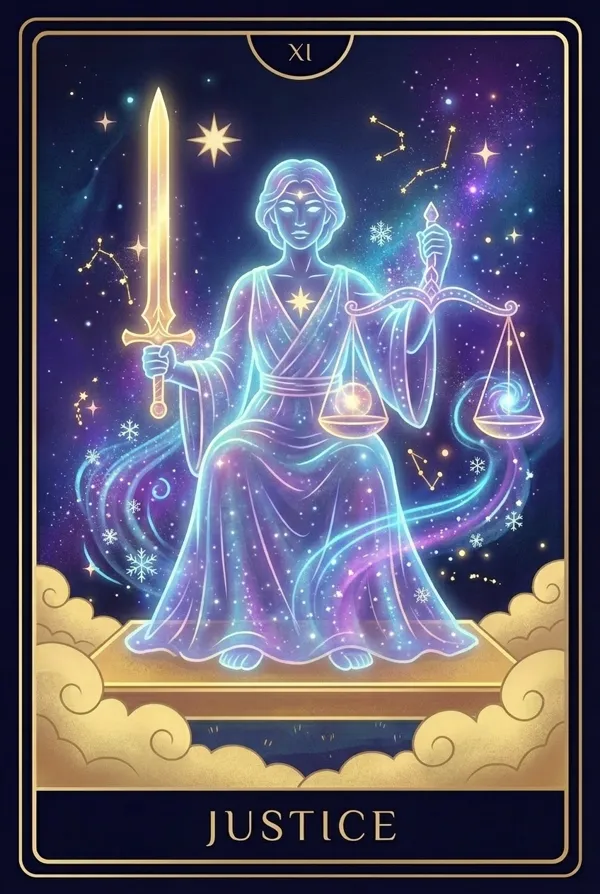
Justice asks for the truth before it offers a verdict. It is less about reward and punishment than about cause, effect, and taking responsibility for your part.
Overview of the Card's Meaning
Justice is the eleventh card of the Major Arcana, and it arrives with a particular kind of clarity: the willingness to see a situation as it actually is, including your own contribution to it. Where earlier cards deal with power, love, and instinct, Justice deals with consequence. Choices have weight. Actions accumulate. What has been done becomes visible. When this card appears, something is being weighed — sometimes formally, in a contract, agreement, or legal matter, and often internally, in a decision that requires honesty rather than comfort. Justice is not a card of revenge or vindication. It does not confirm that you were right, and it does not promise that others will be punished. Its work is more demanding and more useful: it asks you to look at the facts without the story you have built around them, and then to act in a way you could defend calmly.
Symbolism and Imagery
In the Rider-Waite-Smith image, a crowned figure sits between two pillars holding an upraised double-edged sword in one hand and a set of balanced scales in the other. The sword cuts both ways, which is the essential point: the same clarity you apply to others applies to you. It is held upright, in the open, not concealed. The scales suggest measurement rather than mercy, and they are shown level — the assessment is still being made. A red robe indicates that this is active engagement rather than detached contemplation, while a single foot emerging from beneath it hints that reason must eventually meet the ground. A veil hangs between the pillars, marking the boundary between what is known and what remains hidden. The figure's eyes are open, unlike the blindfolded justice of civic statues; here, seeing clearly is the entire task.
Upright Meaning
Upright, Justice supports honesty, accountability, and decisions made on the merits. You may be signing something, resolving a dispute, correcting a record, or simply telling the truth about a situation you have been softening. This card favours doing things properly, even when a shortcut would be easier to justify. It often indicates that consequences are arriving in proportion to what was set in motion. That can be reassuring or uncomfortable depending on your actions. Practically, Justice recommends gathering the facts, documenting the agreement, hearing the other side, and separating what you feel from what you can demonstrate. It also asks about integrity in small matters — whether your daily conduct matches the standard you expect from others. Alignment between values and behaviour is the version of balance this card cares about most.
Reversed Meaning
Reversed, Justice can point to unfairness, avoided accountability, bias, or a decision made on incomplete or distorted information. Someone may be evading responsibility, including you. It can also describe a situation where the outcome genuinely was unjust and you are carrying the cost of something you did not cause. The card frequently appears reversed when self-judgment has replaced honest assessment. Harsh, sweeping verdicts about your own character are not accountability; they are a different way of avoiding the specific, workable truth. Look for where the story has become one-sided in either direction. Reversed Justice may also advise against pressing forward yet — a delay to gather better information, obtain proper advice, or let bias cool can be the more effective route than an immediate confrontation.
Upright Keywords
Truth, Accountability, Fairness, Consequence, Integrity, Contracts, Clear decisions
Reversed Keywords
Unfairness, Avoided responsibility, Bias, Dishonesty, Harsh self-judgment, Missing information
In Love
If You Are Single
If you are single, Justice invites honesty about patterns. Which recurring dynamic in your dating life have you been attributing entirely to other people? What have you tolerated that contradicted your own standards? This is not a card of blame but of accurate accounting, and it tends to arrive when a clear-eyed review would change your choices. It can also describe attraction to fairness itself: someone whose consistency, straightforwardness, and respect for agreements feel genuinely appealing. In practical terms, Justice supports saying what you actually want early rather than discovering a mismatch after significant investment. Clarity may reduce your options in the short term. It usually improves them in the longer one.
If You Are in a Relationship
Within a relationship, Justice concerns fairness and truth. Contributions may need rebalancing — of labour, money, emotional attention, or compromise. The card often surfaces when one person has quietly been carrying more and both have stopped noticing. It supports an honest, unheated conversation in which each person accounts for their own part. Justice also governs agreements. Shared finances, living arrangements, boundaries with family, or the terms of a reconciliation all benefit from being made explicit rather than assumed. In more difficult readings it can point to a breach of trust that must be addressed directly rather than absorbed. What this card does not endorse is keeping score. Fairness here means an honest current balance, not a ledger of past grievances used as leverage.
About an Ex or Getting Back Together
With an ex, Justice usually means facing what actually happened, including your own contribution. That is uncomfortable precisely because it removes the simpler version of the story. Real closure under this card comes from accurate understanding rather than from an apology you may never receive. It can accompany practical resolution: dividing property, settling money, agreeing arrangements around children, or concluding a legal matter. Where reconciliation is being considered, Justice asks whether the imbalance that ended things has genuinely been addressed by changed behaviour, not by intention alone. It does not predict that the other person will be held accountable in a way you get to witness. Consequences are often quiet, delayed, and not staged for your benefit.
In Career and Work
Professionally, Justice covers contracts, negotiations, reviews, ethics, and fair recognition. It supports reading the terms carefully, asking for what your work is worth with evidence rather than emotion, and correcting an inaccurate record. If a dispute is underway, keep documentation and stay measured — your credibility is part of your case. The card also asks about your own conduct. Are your claims accurate? Are you giving proper credit? Is a shortcut being taken that you would not want examined later? Justice tends to reward the professional who is straightforward over the one who is merely persuasive. Where a decision is pending, it favours the option you could explain openly to everyone involved.
In Money and Finances
With money, Justice points to accuracy, obligations, and fair dealing. Taxes, debts, contracts, shared expenses, refunds, insurance, and settlements all fall within its scope. Check the numbers, honour the agreements, and put verbal understandings in writing. It can indicate a financial outcome that reflects earlier decisions arriving now, for better or worse. Where an imbalance exists — an unpaid share, an unfair split, an overlooked entitlement — this card supports addressing it directly and calmly. Where you have been careless, it recommends correction before the cost compounds. Sound record-keeping is unglamorous, and it is exactly what Justice protects.
What This Card Says About How Someone Feels About You
As a description of how someone feels about you, Justice suggests considered, weighed emotions rather than impulsive ones. They may be assessing the connection carefully, thinking about whether it is fair to both of you, or waiting until they can be honest about what they can offer. There can be genuine respect here, and often a strong sense of what is right. This can feel cooler than you might hope. Justice-type feelings are not detached, but they are deliberate — someone reasoning their way toward a position rather than falling into one. The card may also indicate that they are aware of an imbalance between you, or considering their own accountability for something. It does not tell you which way the scales will settle, only that the weighing is real and that the eventual answer is likely to be stated plainly.
This Card as Advice
Justice advises you to establish the facts before deciding anything. Separate what you know from what you have assumed, hear the version you find least comfortable, and notice where your account of events flatters you. Then act in a way you could describe openly without editing. Where something is unbalanced, address the specific imbalance rather than delivering a verdict on the whole relationship or situation. Where you owe something — a correction, an apology, a payment, a boundary you failed to hold — pay it. And where you have been judging yourself sweepingly, replace the verdict with one accountable action. Clarity is the gift of this card; comfort is not.
Is This Card a Yes or a No?
For yes-or-no questions, Justice is best read as neutral until the facts are examined. It answers according to the merits: if your position is sound, your paperwork in order, and your conduct defensible, it leans yes. If the situation rests on something unaddressed or unfair, it leans no. This is worth saying plainly for legal questions, which are among the most common reasons people draw this card. Justice does not promise you will win. It indicates that the outcome is likely to follow the actual evidence rather than the strength of anyone's feelings, and that preparation matters more than conviction. Reversed, it suggests delay, bias, or missing information — wait, gather more, and seek proper advice before proceeding.
Combinations With Other Cards
With Judgement, both cards point to reckoning and honest self-assessment; the pairing often marks a decision made after genuinely reviewing your history. Beside Temperance, the emphasis shifts to fair proportion and a measured, non-combative approach. With The Hierophant, formal structures matter — institutions, contracts, official processes, and doing things by the accepted route. Alongside the Seven of Swords, examine deception, undisclosed information, or a shortcut that will not survive scrutiny. With the Ten of Swords or Five of Pentacles, a consequence may be landing heavily and support becomes necessary. Next to the Two of Swords, a decision has been avoided and the facts are available if you are willing to look. With the Ace of Swords, clarity arrives sharply and can be used well. With The Wheel of Fortune, the outcome depends partly on circumstances beyond your control, which does not remove your responsibility for your own conduct.
This Card as Your Card of the Day
As your card of the day, Justice suggests being scrupulously straight. Read the document before signing, answer the message honestly, correct the small error rather than letting it pass, and give credit where it belongs. If a decision is due, base it on the facts rather than the mood. A useful test through the day: would you be comfortable if this choice were described plainly to everyone involved?
Common Misconceptions
The most common misreading is treating Justice as a guarantee of winning — most often in a legal matter. It is not a victory card. It indicates that outcomes are likely to follow the actual merits and evidence, which is reassuring when your position is genuinely sound and sobering when it is not. Drawing this card is not a substitute for preparation or proper legal advice, and it does not tell you the verdict in advance. A related mistake is reading it as vindication: proof that you were wronged and that the other person will be punished visibly. The double-edged sword points both ways, and consequences frequently arrive privately, slowly, and without an audience. Third, Justice is often confused with harsh self-judgment. Sweeping verdicts about your own worth are not accountability; specific, correctable truth is. Finally, reversed Justice does not automatically mean you have been treated unfairly. It just as often points to information you have not gathered, a bias you have not examined, or responsibility being quietly avoided on your own side.
Historical Background and Spiritual Depth
Justice derives from the cardinal virtue iustitia, which appeared alongside Temperance and Fortitude in medieval and Renaissance moral imagery. Its scales and sword were standard visual shorthand long before tarot existed, which is part of why the card reads so directly. In many early decks Justice was numbered eight and Strength eleven. The Hermetic Order of the Golden Dawn swapped them to align the sequence with astrological attributions, giving Justice the sign Libra and Strength the sign Leo, and the Rider-Waite-Smith deck followed that arrangement. Neither numbering is more authentic; both remain in use. Notably, the tarot figure is unblindfolded, unlike the civic statue of Lady Justice. The distinction is meaningful: this card is not about impartiality achieved by refusing to look, but about judgment reached by seeing clearly.
Self-Reflection Questions
What is the version of this situation I would least like to be true, and how much of it is accurate? Where have I avoided accounting for my own part? What decision could I explain openly, without editing, to everyone it affects?
Frequently Asked Questions
Does Justice mean I will win my court case?
No. Justice indicates that the outcome is likely to follow the actual evidence and merits rather than anyone's conviction. That is encouraging when your position is sound and sobering when it is not, and it is never a substitute for proper legal advice.
Is Justice a yes or no card?
It is neutral until the facts are weighed. It leans yes when your position and conduct are defensible and your preparation is in order, and no when something unaddressed or unfair sits at the centre of the question.
What does Justice reversed mean?
Reversed, it can show unfairness, bias, avoided accountability, or a decision made on incomplete information. It often also points to harsh self-judgment standing in for honest, specific assessment.
What does Justice mean in love?
It concerns fairness and truth: rebalancing contributions, making agreements explicit, and each person accounting for their own part. It supports honest conversation rather than keeping score.
What does Justice mean for someone's feelings?
It suggests weighed, deliberate feelings rather than impulsive ones. They may be assessing what is fair or what they can honestly offer, and their eventual position is likely to be stated plainly.
Does Justice mean karma?
It describes cause and consequence more than cosmic reward or punishment. Results tend to follow what was actually set in motion, though often quietly and on a timeline you do not control.
Why is Justice sometimes numbered eight?
Many early decks numbered Justice eight and Strength eleven. The Golden Dawn swapped them to fit astrological attributions, and the Rider-Waite-Smith deck followed. Both numberings remain valid.
Journaling Prompts
- What part of this situation am I responsible for that I have not fully acknowledged?
- Where in my life is there an imbalance I have been quietly absorbing?
- Which decision am I avoiding because the facts would make it clear?
- Am I holding others to a standard I am not currently meeting myself?
Related Cards
Start a Personal Reading · Today's Card · Explore the Full Library · Career Reading · Yes or No Reading