Ace of Swords — Tarot Card Meaning
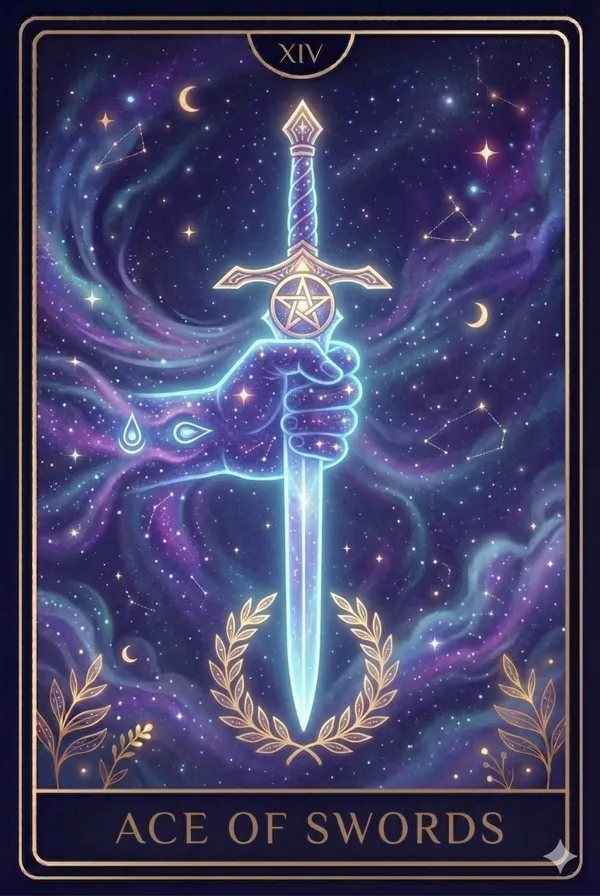
The Ace of Swords is the moment something becomes clear. It is genuine breakthrough — and the truth it delivers is not always the one you were hoping for.
Overview of the Card's Meaning
The Ace of Swords marks the arrival of clarity. A realisation lands, a fog lifts, a sentence you have been avoiding finally forms itself. Something you half-knew becomes something you know, and that changes what you can pretend. Most descriptions of this card stop at how good clarity feels. It is worth being honest that clarity is neutral about your preferences. The insight that arrives may be that you are in the wrong job, that the relationship has been over for a while, or that you have been the unreasonable one. The card is not cruel; it is simply not sentimental. As an inner mirror it asks what you would have to do if you admitted what you already suspect. That is the Ace's real work — not delivering information you lacked, but ending your permission to stay vague about information you had.
Symbolism and Imagery
A single hand emerges from cloud, holding a sword upright. A crown circles the tip, wreathed with olive and palm — victory and peace, both won through the mind rather than by force. The sword is double-edged, which is the whole point. The same faculty that cuts through confusion can cut the people around you, and can cut you. Truth used carelessly does damage that truth used carefully does not. Below, the landscape is bare with jagged peaks in the distance, and six drops fall from the cloud. Nothing softens the image. The Aces are seeds rather than harvests, so this is the beginning of understanding — a first clean thought, not the finished conclusion drawn from it.
Upright Meaning
Upright, the Ace of Swords brings mental clarity and honest speech. Decisions that felt impossible become straightforward, not because the situation improved but because you can finally see its shape. Confusion resolves into a single sentence. It often accompanies truth being spoken — by you, or to you. Diagnoses, disclosures, plain answers, the meeting where someone finally says what everyone knew. Relief and discomfort usually arrive together. It also marks new ideas with real cutting power: the concept that reframes a problem, the argument that holds, the piece of writing that says the thing exactly. Whatever you do with your mind, this card says the conditions are unusually good.
Reversed Meaning
Reversed, the Ace of Swords describes clarity that has not landed. Confusion, muddled communication, arguing at cross purposes, or a decision made on information that turned out to be wrong. Everyone is being reasonable about different facts. It can also show truth used as a weapon — honesty deployed to wound, or a point made so sharply that the relationship absorbs more damage than the point was worth. The double edge, held badly. Sometimes it marks a realisation being resisted. You know, and you are working hard not to know, because knowing would require something of you. That effort is usually more tiring than the change it is avoiding.
Upright Keywords
Clarity, Breakthrough, Truth, Mental focus, New idea, Decisive speech
Reversed Keywords
Confusion, Miscommunication, Harsh words, Resisted insight, Faulty information, Cross purposes
In Love
If You Are Single
For single readers, this Ace tends to bring an honest assessment of what you actually want, as opposed to what you have been accepting. Sometimes that is a clean decision to stop pursuing someone who has been ambiguous for months. It favours direct communication. Asking where this is going, saying you are interested, stating that you are looking for something serious. The card suggests the plain version rather than the hint. It can also be the moment you see a pattern in your own choices. That is uncomfortable and genuinely valuable — insight into your own part in something is the only part you can actually change.
If You Are in a Relationship
In a relationship, the Ace of Swords is the honest conversation and its aftermath. Something gets named. It might be a need, a resentment, a decision, or the simple fact that you are unhappy and have not said so. Where the relationship is sound, this card is a genuine repair: clarity removes the guessing that quietly generates most resentment. Where it is not, the same clarity may reveal that the two of you want different lives. The Ace's advice for the conversation is precision without cruelty. Say what is true and only what is true — not the accumulated case for the prosecution. A double-edged sword is a poor tool for winning and an excellent one for understanding.
About an Ex or Getting Back Together
About an ex, the Ace of Swords usually means seeing it clearly at last — without the highlight reel or the villain edit. Often the realisation is that you had been in love with a possibility rather than with the relationship as it actually was. It can also indicate a plain conversation that closes things, or a piece of information that settles a question you had been turning over. Not always welcome information, but definite. If you are asking whether they will return, the Ace does not answer with hope. It answers with clarity about your own position: what you would need, whether it was ever available, and what you are willing to accept.
In Career and Work
At work, this is one of the best cards for anything mental: strategy, writing, analysis, contracts, teaching, law, diagnosis, engineering, negotiation. A concept lands, or you articulate something the whole team has been circling. It often marks the moment of speaking up — naming the flaw, asking the direct question, putting the honest assessment in writing. The Ace supports being clear over being comfortable. It can also mean receiving unvarnished feedback, or a decision being made and communicated plainly. If a truth about your role becomes obvious under this card, the useful response is to act on it while the clarity is fresh rather than letting it blur again.
In Money and Finances
Financially, the Ace of Swords means seeing your actual position. You open the spreadsheet, read the statement properly, understand the terms of the loan. Numbers stop being a feeling and become facts. It favours cutting: cancelling what you do not use, ending the arrangement that never worked, renegotiating from a clear understanding of your worth. Decisive rather than gradual. What it does not do is guarantee the facts are pleasant. Sometimes the clarity is that you have been spending more than you earn. That is still better than the fog, because a known number can be worked with.
What This Card Says About How Someone Feels About You
As how someone feels about you, the Ace of Swords suggests someone who has arrived at a clear view and is likely to state it. There is little ambiguity here — for better or otherwise, you are about to know. It can indicate a decisive shift in their thinking: a realisation about how much they care, or an equally clear conclusion that this is not what they want. The card marks the clarity, not its direction. If they have been vague until now, this is usually the end of the vagueness. Asking a direct question under this card tends to produce a direct answer.
This Card as Advice
Say the clear sentence. Not the paragraph, not the hint — the one sentence that names the thing. Most of what is heavy about your situation is the effort of holding something known and unsaid. Get the facts before you act on the feeling. Read the contract, check the number, ask the question whose answer you have been guessing at. This card rewards verified information over confident assumption. And hold the sword carefully. Being right is easy under this influence; being right kindly is the actual skill. Before you speak, ask whether this is meant to be understood or meant to land. Both edges cut.
Is This Card a Yes or a No?
The Ace of Swords is a yes — a clear, decisive one. Where the question is whether to speak, decide, cut something loose or act on what you now see, it says yes. The honest caveat is that it says yes to clarity rather than to comfort. It will not confirm that the outcome you want is the true one; it will confirm that you are about to know which is which. On matters requiring patience, warmth or the slow settling of feelings, it is less suited. Swords move fast, and some situations should not.
Combinations With Other Cards
With the Two of Swords, the stalemate breaks and the decision gets made. Alongside Justice, expect a formal or legal clarity — terms established, fairness applied. With the Three of Swords, the truth that arrives is painful but clean; grief follows knowing rather than confusion. Paired with the Moon, the Ace is the fog lifting — projections replaced by facts. With the Queen of Swords, honesty is spoken by someone with the experience to do it well. Next to the Tower, the realisation is sudden and structural. With the Ten of Swords, it often marks the clarity that lets an ending finally be an ending rather than a slow drain.
This Card as Your Card of the Day
As a card of the day, the Ace of Swords asks for one clear action taken on one clear thought. Write the difficult message. Ask the plain question. Make the decision you have been circling. Mental work will go unusually well: focus is available, and the sentence you have been failing to write may arrive intact. Take notes; insight under this card is easy to lose. The caution is tone. Sharp thinking pairs easily with sharp speech, and a remark that felt merely accurate can land as a cut. Say the true thing, then be gentle about it.
Common Misconceptions
The main misreading is treating this card as purely positive — a triumphant breakthrough with no downside. Clarity is genuinely valuable, and it is also indifferent to what you were hoping for. The Ace can just as easily reveal that a relationship is finished, that a plan will not work, or that you have been avoiding something obvious. Presenting it as good news only leaves readers unprepared for the honest version. The second mistake is reading it as proof that you are right in a dispute. It marks clarity arriving, not a verdict in your favour. Sometimes what becomes clear is your own contribution to the problem. Third, people treat the insight as the whole job. Aces are seeds. A realisation that is not acted on within a few days tends to blur back into fog. And fourth, the double edge is routinely ignored — truth spoken without care does real damage, and this card is the one most often used to justify that.
Historical Background and Spiritual Depth
The Aces represent pure elemental beginnings, and in the suit of Swords that element is mind: thought, language, discernment, truth. Nothing about this Ace is emotional or material yet. It is the first clean idea, before anyone has done anything with it. The crown at the sword's tip, wreathed with olive and palm, is worth sitting with. It suggests that mastery of the mind produces both victory and peace — but the peace comes after the cut, not instead of it. Older sources associated the card with the exercise of righteous authority, which is a fairly dangerous idea if you forget the second edge. Read in a modern frame, the Ace of Swords describes the specific relief of no longer being confused, together with the responsibility that relief carries. Once you know, you have to choose. That is why the card so often feels like a threshold rather than a reward, and why 'the truth will set you free' has always been a more complicated promise than it sounds.
Self-Reflection Questions
Ask what you already know and have been declining to finish the sentence about. Then ask what acting on it would actually require. That is usually the real reason the knowledge has been kept vague. And consider how you tend to deliver truth to other people — whether your honesty leaves room for a reply, or arrives as a verdict.
Frequently Asked Questions
Is the Ace of Swords a positive card?
It is a clarifying card rather than a purely positive one. Clarity is valuable, and it is indifferent to what you were hoping for — the truth that arrives may be that a plan will not work or a relationship is finished. Honest, but not always comfortable.
Is the Ace of Swords a yes or no card?
A clear yes, particularly to speaking, deciding, cutting something loose or acting on what you now see. The caveat is that it says yes to clarity rather than to a preferred outcome, and it suits fast decisions better than tender ones.
What does the Ace of Swords reversed mean?
Clarity that has not landed: muddled communication, arguing at cross purposes, or decisions made on wrong information. It can also mean truth used as a weapon, or a realisation being actively resisted because acting on it would require something of you.
What does the Ace of Swords mean for feelings?
Someone who has reached a clear view and is likely to say it. The card marks the arrival of clarity rather than its direction — it may be a realisation of how much they care, or an equally clear conclusion that this is not what they want.
Does the Ace of Swords mean I am right?
Not necessarily. It means something is becoming clear, not that a dispute has been settled in your favour. Sometimes what becomes clear is your own part in the problem, which is less satisfying and considerably more useful.
What does the Ace of Swords mean for career?
Strong conditions for anything mental: strategy, writing, analysis, contracts, negotiation, teaching. It often marks speaking up — naming the flaw or putting an honest assessment in writing — and acting on the insight while it is still fresh.
What advice does the Ace of Swords give?
Say the one clear sentence rather than hinting, verify the facts before acting on the feeling, and hold the sword carefully. Being right comes easily under this card; being right kindly is the actual skill, since both edges cut.
Journaling Prompts
- What have I recently understood that I have not yet said out loud?
- If I acted on what I already know, what would have to change this month?
- Where have I used being right as a substitute for being kind?
- What one fact could I verify this week instead of continuing to guess?
Related Cards
Start a Personal Reading · Today's Card · Explore the Full Library · Career Reading · Yes or No Reading