Queen of Swords — Tarot Card Meaning
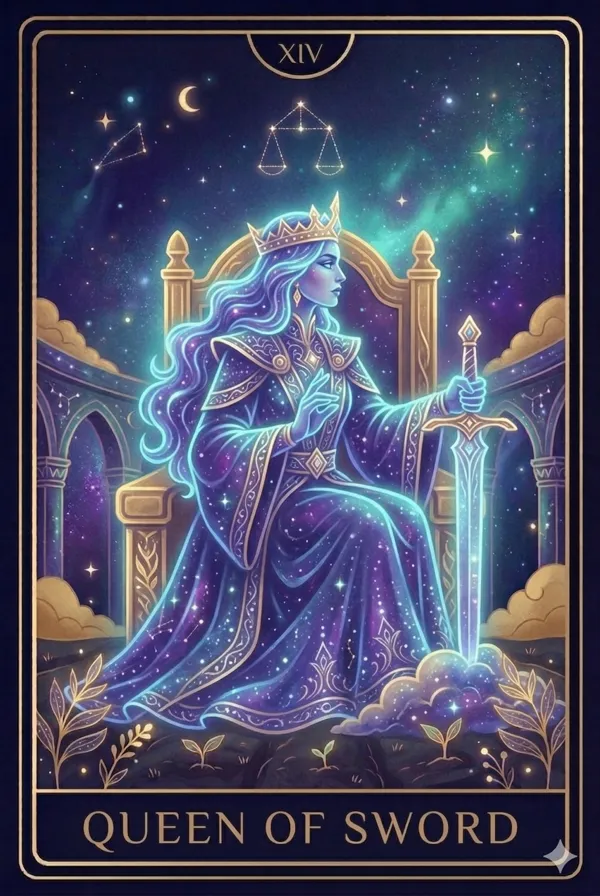
The Queen of Swords is clarity that came at a cost. She sees accurately, speaks plainly and holds her boundaries without apologising for them — which is not the same thing as coldness.
Overview of the Card's Meaning
The Queen of Swords describes a particular kind of intelligence: the sort that has been through something and drew a conclusion from it. She is not naturally suspicious. She simply stopped needing to pretend she cannot see what she can see. When she appears, the reading is usually asking for honesty — with someone else, or more often with yourself. She is the part of you that already knows what the situation is and has been softening the language around it. Her arrival tends to feel like relief and discomfort at once. As an inner mirror, she asks a plain question: what would you say about this if you were not managing anyone's feelings about your answer? The clarity she offers is not harsh. It is simply unpadded, and people who are used to padding often mistake the absence of it for hostility.
Symbolism and Imagery
She sits on a stone throne carved with butterflies and a sylph, holding a sword upright in her right hand and extending her left as though inviting someone to speak. The sword points to the sky rather than at anyone — this is discernment, not attack. Her open hand matters. She is not closed off. She is willing to listen, and she is not willing to be lied to, and those two things live comfortably together in her. Clouds gather below her throne while the sky above is clear, an image of someone who has climbed out of the weather rather than someone who never had any. A single bird flies overhead; her cloak is patterned with clouds, as if she is still wearing what she came through. The butterflies say transformation, and the tassel at her wrist suggests a mind kept tied to something steady.
Upright Meaning
Upright, this Queen brings perceptiveness and straight speech. She reads situations quickly, notices what does not add up, and says so without a long preamble. Where other cards suggest waiting for more information, she suggests naming what is already obvious. She also represents independence that is comfortable rather than defensive. She can be alone without it being a wound, which is often the very quality that makes people uneasy around her — she cannot be managed with approval. In practical terms she favours honest conversations, clear terms, well-worded emails, fair judgement and decisions made with the head consulted rather than overruled. Her compassion is real; it just does not include lying to you to keep the room comfortable.
Reversed Meaning
Reversed, the Queen's clarity can turn inward and sour. Discernment hardens into suspicion, and honesty loses its warmth — accuracy used as a weapon rather than a light. If that lands, the question is not whether you are right but what being right is costing you. She can also describe the opposite: someone who has muted their own perception to keep the peace. The reversal often shows a person who knows something clearly and has agreed, socially, not to know it. That produces a very specific fatigue. Sometimes she points to receiving criticism that felt sharper than it needed to be, or to being spoken about coldly. Where that is happening, the reversal invites you to separate the accurate part of what was said from the unkind way it arrived.
Upright Keywords
Clarity, Honesty, Discernment, Boundaries, Independence, Perceptiveness
Reversed Keywords
Coldness, Suspicion, Harsh words, Muted perception, Bitterness, Isolation
In Love
If You Are Single
For single readers, the Queen of Swords rarely arrives to say you are too much or too closed. More often she says your standards are functioning correctly. You notice inconsistency early; you are unwilling to talk yourself out of what you observed. That is not a fault to be corrected. She does ask whether the discernment has quietly become a wall. There is a difference between not tolerating dishonesty and requiring proof of safety before any warmth is allowed. The first protects you; the second keeps out the very thing you want. She often accompanies a season of choosing yourself on purpose — enjoying your own company, dating with clear eyes, ending things early and kindly rather than late and painfully. That season tends to precede a much better relationship, not replace it.
If You Are in a Relationship
In a relationship, this Queen calls for the honest conversation you have both been circling. Not an argument — a plain statement of what is actually true for you. She is the card of saying the difficult sentence in an ordinary voice. She can describe a partnership where thinking has become more available than feeling: efficient logistics, less tenderness. If so, the repair is not less clarity but more warmth alongside it. Her open hand is part of her. Where real problems exist, she declines to soften them into vagueness. If a boundary has been crossed repeatedly, she will name the pattern rather than the incident. That is uncomfortable, and it is usually the thing that lets a relationship either change or end honestly.
About an Ex or Getting Back Together
About an ex, the Queen of Swords is frequently misread as bitterness — hers, or yours. What she actually describes is the point at which you can see the relationship accurately: what was genuinely good, what was never going to work, and what you agreed to overlook. That clarity often arrives after the grief rather than instead of it. She is not the card of pretending you never cared. She is the card of no longer editing the story in either direction — neither the highlight reel nor the villain edit. If you are hoping she confirms that they regret it, she does not do that. What she offers is more useful in the long run: an honest inventory, a clean boundary, and the ability to speak about it without your voice shaking.
In Career and Work
At work, the Queen of Swords is excellent company. She favours precision, fair assessment, well-argued cases and communication that leaves no room for convenient misunderstanding. Contracts, reviews, negotiations, legal and editorial work all sit comfortably under her. She often marks a moment to say the thing in the meeting — to point out the flaw in the plan, ask what is being avoided, or state your terms without softening them into a question. She suggests writing it down and being specific about what you need. She can also represent a senior woman or a direct colleague whose feedback is blunt and, on inspection, correct. If that describes someone in your work life, the card gently suggests taking the content seriously even if the delivery was not gentle.
In Money and Finances
Financially, this Queen means looking at the real numbers with the emotion set to one side for an hour. She reads the terms, notices the fee structure, and asks the awkward question before signing rather than afterwards. She often appears around money that is entangled with a relationship — shared accounts, a divorce, an inheritance, a loan to family. Her counsel is to be kind in tone and exact in substance. Vagueness in money matters is rarely generosity; it usually just delays the conflict. She also supports independence: your own account, your own understanding of your position, your own ability to explain your finances without checking with anyone. That is not distrust. It is competence.
What This Card Says About How Someone Feels About You
As how someone feels about you, the Queen of Swords describes a person who has thought about it and is not going to gush. Their regard shows up as honesty, attention to detail and a refusal to say more than they mean. If they tell you something, they mean it. They may be assessing whether you are consistent — not testing you unkindly, but declining to invest in someone whose words and behaviour do not match. Once satisfied, they are notably loyal. It can also indicate someone protecting themselves after being hurt. The reserve is not indifference; it is a door left ajar rather than flung open. Plain, non-performative honesty from you is what opens it further.
This Card as Advice
Say the true thing, once, clearly, and without a paragraph of cushioning around it. Most of the difficulty in the situation you are asking about comes from something known and unsaid, not from something unknown. Write it down before you speak it. The Queen of Swords is at her best when the thought has been organised — one sentence for what happened, one for how it affected you, one for what you need. Then let the silence after it exist without rushing to fill it. And extend the same honesty inward. If you already know the answer and have been asking the question to postpone acting on it, she notices. Her kindness is that she does not shame you for it; she just declines to join the pretence.
Is This Card a Yes or a No?
The Queen of Swords is a conditional yes. Yes, if the matter is handled honestly and with clear terms. She supports decisions made with open eyes and rarely supports ones that require you to not look closely. Where the question depends on someone being straight with you, she says get it in plain language before you commit. Where it depends on you being straight with yourself, she says you already have your answer. On matters of fairness, agreements and speaking up, she leans yes. On matters that need warmth, patience or waiting for feelings to settle, she is less enthusiastic — not because she is against them, but because that is not the register she works in.
Combinations With Other Cards
With the Three of Swords, she is the clarity that follows heartbreak — grief metabolised into understanding rather than into a grudge. With Justice, the two together strongly favour formal fairness: contracts, mediation, an honest reckoning. Alongside the King of Swords, expect a decisive, unsentimental conversation between equals. With the Queen of Cups, the reading asks for both registers at once — say the true thing, and say it with care. With the Two of Swords, she is the card that ends the stalling: the decision you have been holding at arm's length gets made. Paired with the Ten of Cups or the Two of Cups, she is far from a threat to the relationship; she is the honest conversation that makes it durable. Next to the Moon, she cuts through the projections and asks what you actually know.
This Card as Your Card of the Day
As a card of the day, the Queen of Swords asks you to be accurate. Notice where you soften language to avoid discomfort, and choose one place to be plain instead. It might be a reply, a boundary, or an answer that is simply no. It is a good day for anything requiring a clear head: difficult emails, reviewing terms, editing your own work, having the conversation you have rehearsed too many times. Precision will feel unusually available. Watch the tone, though. Under this card, sharpness can slip out where directness was intended. The test is simple — is this said to be understood, or to land a point?
Common Misconceptions
The most persistent misreading is that the Queen of Swords is a cold, bitter or vengeful woman, usually cast as an ex or a rival. This is lazy interpretation and it misses her entirely. Her quality is clarity earned through experience: honesty, discernment, and boundaries held without apology. Being unwilling to be lied to is not bitterness, and a woman who does not perform warmth on demand is not therefore hostile. The second mistake is treating her as unfeeling. Her cloak is patterned with the clouds she came through — she feels a great deal and has decided not to let feeling override her judgement. Those are different from having no feelings. Third, people read her arrival in a love question as an accusation, as though a third person must be interfering. Far more often she is the reader themselves, or the honest conversation the relationship needs. And fourth, she is not permission to be cruel. Accuracy without warmth is her reversal, not her upright meaning.
Historical Background and Spiritual Depth
In the traditional structure of the suits, Swords govern the mind: thought, language, judgement, truth and the trouble each of them can cause. The Queen holds that element inwardly rather than outwardly — she understands it, where the King directs it. Historically she has been read as a widow or a woman who has known loss, and that reading has often been used to diminish her: sorrowful, therefore embittered. A fairer reading of the same image is a woman whose insight is not theoretical. She knows what she knows because she lived it, and she is not going to unknow it for anyone's comfort. Modern readings increasingly treat her as an ideal rather than a warning: the capacity to be both kind and unflinching. That combination is rare enough to be mistaken for hardness by people who have only met one half of it. Read as an inner figure rather than an outer one, she is the voice that tells you the truth and stays in the room afterwards.
Self-Reflection Questions
Sit with where you already know the answer and have been asking anyway. That is usually where this Queen is pointing. Then consider the tone of your own honesty. Do you say difficult things in a way that invites a response, or in a way that closes the conversation? Her open hand is not decoration. Finally, notice who in your life you allow to speak plainly to you, and whether you extend the same permission to yourself.
Frequently Asked Questions
Is the Queen of Swords a cold or bitter card?
No — that is the most common misreading of her. She is clarity earned through experience: honest, discerning and unwilling to be lied to. Refusing to soften the truth for comfort is not bitterness, and not performing warmth on demand is not hostility.
Does the Queen of Swords mean another woman in a love reading?
Rarely. Far more often she is you, or the honest conversation the relationship needs. Reading her as a rival or an ex flattens a card about discernment and boundaries into gossip, and it usually leads the reading away from what is actually happening.
Is the Queen of Swords a yes or no card?
A conditional yes — yes if the matter is handled honestly and with clear terms. She supports decisions made with open eyes, and she is unenthusiastic about anything that depends on you not looking too closely at the details.
What does the Queen of Swords reversed mean?
Usually clarity that has hardened: accuracy used as a weapon, or discernment curdling into suspicion. It can also mean the opposite — someone muting their own perception to keep the peace, which produces a very particular kind of tiredness.
What does the Queen of Swords mean for feelings?
Someone who has thought about it and will not overstate it. Their regard shows as honesty, attention and meaning exactly what they say. Reserve here is often self-protection rather than indifference, and plain honesty from you tends to open the door further.
What does the Queen of Swords say about work?
She favours precision and straight speech: making your case clearly, naming the flaw in the plan, stating your terms without turning them into a question. Contracts, reviews, negotiation, editing and legal matters all sit well under her.
What advice does the Queen of Swords give?
Say the true thing once, clearly, without a paragraph of cushioning — then let the silence exist. Organise the thought first: what happened, how it affected you, what you need. And apply the same honesty inward about answers you already have.
Journaling Prompts
- What do I already know about this situation that I have been phrasing carefully to avoid?
- Where have I called my own clarity 'being difficult' in order to keep the peace?
- What boundary would I set if I did not have to justify it to anyone?
- Who speaks to me honestly, and how do I usually receive it?
Related Cards
Start a Personal Reading · Today's Card · Explore the Full Library · Career Reading · Yes or No Reading