Strength — Tarot Card Meaning
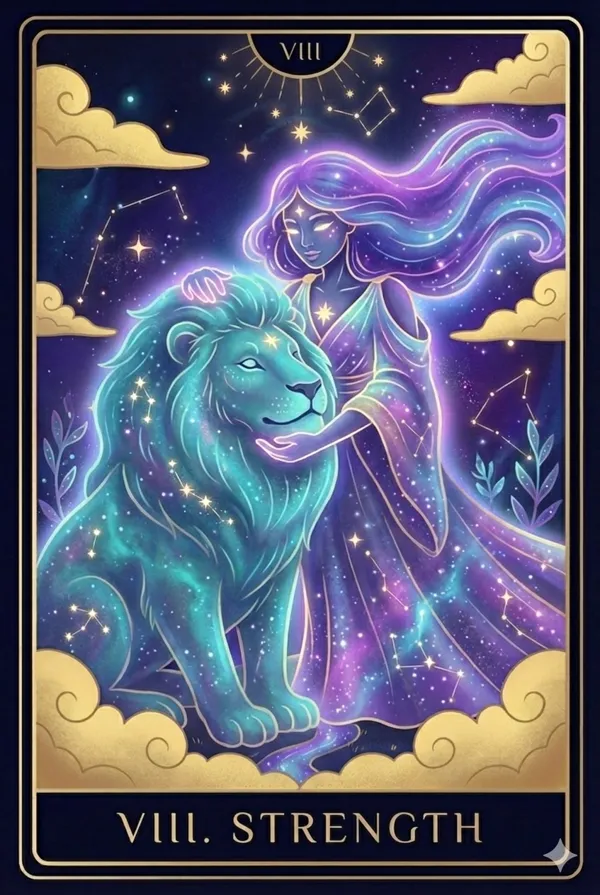
A woman calms a lion with her bare hands, not by force but by presence. Strength reminds you that real power can be patient, compassionate, and quietly brave.
Overview of the Card's Meaning
Strength is the eighth card of the Major Arcana in the Rider-Waite-Smith sequence. It often appears when you feel provoked, exhausted, or tempted to fight force with force, and it gently suggests another way. The card is not about pretending fear, anger, or desire do not exist. It is about meeting those instincts closely enough that they no longer make every decision for you. This is courage expressed through relationship rather than conquest: a willingness to understand what is wild in you instead of shaming or suppressing it. You may be standing at the edge of your patience, wondering whether to push harder or soften. Strength tends to answer: soften, but do not disappear. Kindness and boundaries can coexist. Calm does not require passivity.
Symbolism and Imagery
In the Rider-Waite-Smith image, a woman in a flowing white dress gently holds a lion's jaws. She is not wrestling the animal; her touch is light, and her expression is calm. Above her head floats the same lemniscate, or infinity symbol, that crowns The Magician, suggesting a renewable inner resource. Flowers link woman and lion, implying that instinct can be integrated rather than defeated. The lion has long represented courage, appetite, pride, and untamed will in European art and heraldry. Here that force is neither killed nor caged. The open landscape and distant mountain make the encounter feel intimate rather than theatrical: this is a private act of self-mastery. The image asks whether you can remain near your strongest feelings without becoming frightened of them or ruled by them.
Upright Meaning
Upright, Strength speaks to courage that does not need to shout. It appears when you are being asked to hold your ground with grace through a difficult conversation, an emotional challenge, or a temptation to react impulsively. This is patience with teeth. It does not mean accepting poor treatment; it means choosing your response instead of handing control to the loudest feeling in the room. The card may also recognize progress with an old pattern — anger, anxiety, craving, shame, or a wound that used to dictate your choices. Change may be happening through small repeated acts rather than one heroic breakthrough. Strength values the person who keeps showing up honestly and gently, especially when nobody else sees the effort.
Reversed Meaning
Reversed, Strength can point to depleted confidence, emotional reactivity, or an attempt to control everything because uncertainty feels intolerable. You may be white-knuckling your way through a situation, performing calm while quietly burning out. It can also describe harsh self-talk: demanding perfect composure from yourself and treating ordinary vulnerability as failure. The opposite imbalance is possible too. You may be suppressing anger, desire, or needs so thoroughly that they emerge sideways as resentment, fatigue, or sudden outbursts. The invitation is not more force. It is a compassionate return to the underlying feeling, along with whatever support or boundary would make honest regulation possible.
Upright Keywords
Courage, Patience, Compassion, Self-control, Resilience, Gentle power
Reversed Keywords
Self-doubt, Burnout, Reactivity, Suppressed emotion, Insecurity, Overcontrol
In Love
If You Are Single
If you are single, Strength suggests dating from quiet self-assurance rather than urgency. It can describe healing from anxious or reactive connections and learning that attraction does not need chaos to feel alive. There is a gentle magnetism here: people may be drawn to the steadiness you carry, especially when it is genuine rather than performed. If vulnerability has felt risky, let confidence grow through small honest choices. You do not need to become invulnerable before love arrives. The more useful question is whether you can stay connected to yourself while getting close to someone else, rather than abandoning your needs to secure affection.
If You Are in a Relationship
Within a relationship, Strength often appears around a specific tension — jealousy, a short temper, mismatched needs, or an old wound being triggered. It asks both people to stay present without escalating. Naming a hard feeling before acting it out, taking a pause without withdrawing as punishment, and holding a boundary without contempt are all expressions of this card. It can also show one partner supporting the other through illness, grief, stress, or recovery with steady, undramatic devotion. The caution is to avoid making one person permanently responsible for regulating the other. Compassion is strongest when it includes mutual accountability and room for both people to be human.
About an Ex or Getting Back Together
With an ex, Strength suggests that reconciliation would require emotional maturity rather than chemistry alone. If the relationship struggled with volatility, control, or unprocessed hurt, ask whether those patterns have genuinely changed in both people, or whether they would simply return beneath a calmer beginning. Patience can reveal more than an impulsive reunion. Strength can equally describe letting someone go without bitterness, even when part of you remains tender. Sometimes the powerful move is neither reaching out nor withholding contact to provoke a response. It is releasing the need to control the ending and choosing the boundary that protects your peace.
In Career and Work
In career questions, Strength favors composed, principled leadership over aggressive tactics. It can describe handling a difficult colleague or client without losing yourself, advocating for your work without hostility, or keeping a team steady when pressure rises. Your emotional intelligence may matter more than a dramatic display of authority. This card also supports endurance: a long project, a slow-building business, rehabilitation after burnout, or a skill that takes years to master. It does not promise an overnight win. It suggests that consistent effort and the ability to recover after setbacks are meaningful professional assets.
In Money and Finances
Financially, Strength favors restraint over reactive decisions. It may point to resisting a purchase made from stress, avoiding a risky move driven by fear of missing out, or following a patient debt-repayment plan. When money feels threatening, slowing your nervous system before making a decision can be as important as reviewing the numbers. The card also asks you to replace financial shame with honest responsibility. Shame often makes people avoid statements, budgets, or conversations; compassionate discipline makes it easier to look clearly and act. Small sustainable changes are more aligned with Strength than dramatic rules you cannot maintain.
What This Card Says About How Someone Feels About You
If you ask how someone feels about you, Strength suggests genuine but measured affection. They may experience you as calming, grounding, or emotionally safe, and may admire your resilience. Their feelings can be stronger than their behavior shows because they are trying to proceed carefully, manage vulnerability, or avoid acting from impulse. As how someone sees you, Strength often means dependable, composed, warm, and quietly magnetic. They may think you can handle more than you feel able to carry, so notice whether their admiration has turned into an expectation that you will always be the strong one. If tension exists, this card generally describes a wish to handle it maturely rather than a guarantee of reconciliation or commitment.
This Card as Advice
As advice, Strength says to meet this moment with patience rather than force. Respond instead of reacting. Ask what a calm, self-respecting version of you would do, including where that version would say no. Gentle does not mean endlessly accommodating. Offer yourself the same patience you might offer someone you love. Rest, asking for help, and admitting fear can all be acts of strength. You do not have to wrestle every difficulty alone, and you do not need to punish yourself into changing.
Is This Card a Yes or a No?
As a yes-or-no card, Strength leans yes, but it is a patient yes. The outcome is more favorable when you act with consistency, restraint, and emotional honesty rather than forcing a quick result. If the question involves conflict, Strength supports the calmer approach. If it involves tolerating harm, the card does not ask you to endure indefinitely; the courageous answer may be a firm boundary.
Combinations With Other Cards
With The Chariot, Strength combines inner regulation with outward momentum: success is more likely when discipline directs ambition. Beside the 9 of Wands, it describes resilience after a long strain, while warning against mistaking permanent defensiveness for courage. With the 5 of Wands, it favors de-escalation and confident participation without needing to dominate. Alongside The Devil, Strength highlights the difference between compassionate self-mastery and shame-based control, often in relation to attachment or habit. With The Star, it suggests gradual healing through renewed trust. Beside The Empress, gentleness, embodiment, and care become central. Reversed with The Tower, it can show a nervous system overwhelmed by sudden change and a need to stabilize before making major choices.
This Card as Your Card of the Day
If Strength is your card of the day, notice where you feel tested and experiment with response instead of reflex. A sharp comment, a craving, a moment of self-doubt, or a small confrontation may offer practice. Meet it as the woman meets the lion: close enough to understand it, calm enough not to be controlled by it. Choose one act of gentle courage. Have the honest conversation without making it a battle, complete the task you have avoided, or rest before exhaustion chooses for you. If you slip into an old pattern, notice and begin again without turning the mistake into evidence against yourself.
Common Misconceptions
A common misconception is that Strength means physical power, dominance, or winning through superior will. Its image argues for the opposite: relationship with instinct rather than conquest. Another is that the card asks you to suppress emotion and remain pleasant under any pressure. The woman is engaged with the lion, not pretending it is absent. Strength reversed is also sometimes reduced to weakness. More often it identifies a temporary imbalance — too much control, too little regulation, burnout, or confidence worn thin. Naming that state is not condemnation; it is the first step toward restoring capacity.
Historical Background and Spiritual Depth
Strength was numbered XI in many older Tarot de Marseille decks. Arthur Edward Waite placed it at VIII in the 1909 Rider-Waite-Smith deck, exchanging positions with Justice to align the Major Arcana with the Golden Dawn's astrological sequence and Strength's association with Leo. The change reminds us that tarot symbolism has evolved rather than arriving as one fixed system. The card also echoes Fortitude, one of the four classical cardinal virtues. In European art, Fortitude was often shown with a lion or a broken column, expressing steadiness under pressure. Pamela Colman Smith transformed that moral allegory into a psychologically intimate scene. Read through a modern lens, it becomes a picture of integrating instinct with consciousness — not prophecy, but a mirror for the courage practiced in ordinary difficult moments.
Self-Reflection Questions
Where am I trying to force something that might respond better to patience? Which emotion have I been treating as an enemy rather than useful information? Where does gentleness support a healthy boundary, and where have I confused being gentle with making myself small?
Frequently Asked Questions
What does the Strength tarot card mean?
Strength represents courage, patience, and self-mastery achieved through gentleness rather than force. It suggests that calm resilience and compassion can help you meet a difficult situation without being ruled by it.
Is Strength a yes or no card?
Strength generally leans yes, but it is a patient yes. It favors progress through composure and steady effort rather than aggression, pressure, or a quick fix.
What does Strength reversed mean in love?
Reversed in love, Strength can point to insecurity, jealousy, emotional exhaustion, or feelings being suppressed to keep the peace. It invites honest regulation and mutual care rather than more control.
Does Strength mean someone has feelings for me?
It can suggest calm, genuine, and carefully managed affection. The person may feel grounded around you or admire your resilience, although the card alone cannot guarantee what they will choose to do.
How does someone see you when Strength appears?
They may see you as composed, dependable, warm, and quietly powerful. They may also assume you can carry more than you should, so notice whether admiration comes with an unfair expectation that you always stay strong.
What is the difference between Strength and The Chariot?
Both concern willpower, but The Chariot directs opposing forces toward an external goal, while Strength develops an inner relationship with instinct and emotion through patience.
Why is Strength numbered VIII in some tarot decks and XI in others?
Many Marseille decks number Strength XI. Waite placed it at VIII in the Rider-Waite-Smith deck to align it with Leo and the Golden Dawn's astrological sequence.
Journaling Prompts
- Describe a recent moment when you felt provoked. What did your first impulse want, and what did your wiser self need?
- Where are you using force or relentless willpower when patience might serve you better?
- What feeling or habit have you been fighting? Write what it may be trying to protect.
- Who expects you to be the strong one, and what support would help you carry that role more honestly?
Related Cards
Start a Personal Reading · Today's Card · Explore the Full Library · Career Reading · Yes or No Reading