The Chariot — Tarot Card Meaning
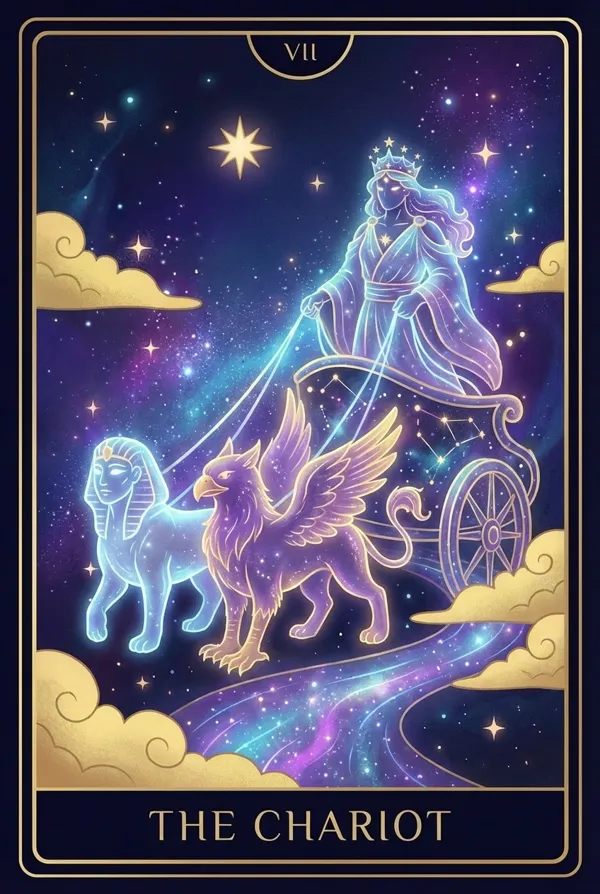
The Chariot is momentum that has been given a direction. Its strength is not force but steering — holding opposing pulls together long enough to actually get somewhere.
Overview of the Card's Meaning
The Chariot arrives when something in you has stopped debating and started moving. It is the card of assembled will: the moment scattered intentions line up behind one decision and the machinery finally rolls forward. What makes it powerful is not speed. It is the fact that the driver has chosen a direction and is prepared to keep choosing it when the pull to swerve arrives. As an inner mirror, the Chariot asks a plain question: what are you actually driving towards? Most stalled situations are not short of energy. They are short of a single agreed destination, and the energy is being spent holding two of them at once.
Symbolism and Imagery
A crowned figure stands in a stone chariot drawn by two sphinxes, one black and one white, pulling in different temperaments. There are no reins. The figure directs them by presence and attention rather than by rope. That detail carries the whole card. Control here is internal — the opposing forces are not eliminated, they are held. The canopy of stars above says the direction was chosen with something larger in view than convenience. The square on the driver's chest suggests stability; the crescent moons at the shoulders suggest instinct still travelling alongside intellect. The city walls behind indicate a departure: something familiar has been left in order to go.
Upright Meaning
Upright, the Chariot means forward movement earned through focus. Plans start to convert into progress, and obstacles that looked structural turn out to have been indecision wearing a costume. It often marks the practical stretch of a journey rather than its inspiration — the training, the applications, the daily discipline that makes an ambition credible. Willpower here is unglamorous and effective. It can also describe travel, relocation or the successful navigation of a competitive situation. What it does not promise is an unopposed road. It promises that you are equipped to steer the one you have.
Reversed Meaning
Reversed, the Chariot usually means the forces are no longer held. Either the momentum has drained away and the vehicle is sitting still, or it is moving fast in a direction nobody chose. It can describe scattered effort — several goals pursued at once, each one starved of the attention it needed. The remedy is rarely more determination; it is subtraction. Sometimes it points to control that has tipped into forcing: pushing a situation that needs consent, or driving over your own exhaustion. The reversal invites you to check whether you are steering or simply refusing to stop.
Upright Keywords
Willpower, Direction, Momentum, Focus, Self-command, Travel
Reversed Keywords
Scattered effort, Loss of direction, Forcing, Stalling, Recklessness, Burnout
In Love
If You Are Single
For single readers, the Chariot suggests intention. You know roughly what you are looking for and are willing to act on it rather than wait to be found. That clarity tends to change results quickly. It can also indicate someone entering your life with real drive — attractive energy, and worth watching for whether their direction includes anyone else. The card's gentle caution is about treating dating as a campaign. Momentum is useful; a schedule is not the same as a connection. Keep the destination human rather than merely achieved.
If You Are in a Relationship
In a relationship, the Chariot points to a shared direction being agreed or tested. Moving in together, relocating, deciding about children, building something joint — these are its territory. It reads well when both people are pulling roughly the same way. The two sphinxes are not identical, and the card does not require sameness; it requires a common heading. Where the relationship is strained, it may show one partner driving and the other being driven. That arrangement moves fast and rarely lasts. The repair is a conversation about the destination, not about the pace.
About an Ex or Getting Back Together
About an ex, the Chariot is more often about your motion than theirs. It commonly appears when you have decided to move on and are actually doing it, rather than announcing it. It can indicate contact that requires a firm hand — being civil while holding your direction, not being pulled back by nostalgia arriving at a convenient moment. If you are hoping for a return, the card is honest: it favours whoever is willing to move deliberately. Sometimes that produces reconciliation on much clearer terms. Sometimes it simply produces distance you no longer regret.
In Career and Work
At work, the Chariot is one of the more encouraging cards. It supports ambition pursued methodically: applying for the role, driving the project, taking the lead on something nobody else has claimed. It often accompanies competitive situations — pitches, interviews, tenders — where the advantage goes to whoever prepared and stayed composed rather than whoever wanted it most. It also asks about focus. If you are carrying several half-projects, the card suggests choosing one to finish. Progress becomes visible surprisingly fast once the effort stops being divided.
In Money and Finances
Financially, the Chariot favours a plan you can actually follow. It is the card of directed money: a savings target, a debt cleared in order, a purchase made deliberately rather than impulsively. It reads well for negotiating and for taking a considered risk — one where you have looked at the numbers and can name what you are aiming for. Its warning is about momentum for its own sake: increasing income while increasing spending at the same rate, or driving hard financially without knowing what the money is for.
What This Card Says About How Someone Feels About You
As how someone feels about you, the Chariot suggests interest that has become a decision. They are not idly curious; they have concluded something and are moving accordingly. That often shows as directness — plans made, initiative taken, attention that does not need to be prompted. It can feel intense simply because it is unambiguous. Less happily, it can describe someone pursuing you as an objective rather than meeting you as a person. The distinction is visible in whether they are curious about what you want, or only about arriving.
This Card as Advice
Choose the direction and stop renegotiating it every morning. Most of the fatigue in your situation is coming from the debate rather than from the work. Then reduce what you are carrying. The Chariot moves because everything in it is pointed the same way. One clear aim for the next stretch will outperform four hopeful ones. And steer rather than force. Hold the opposing pulls — the doubt, the counter-argument, the part of you that wants comfort — without pretending they are gone. They travel with you; they do not have to drive.
Is This Card a Yes or a No?
The Chariot is a yes, with the condition that you do the driving. It rarely describes something that resolves while you wait. On questions of progress, travel, competition and commitment it leans clearly positive. Where the question depends on someone else changing their mind, it is less reliable — it governs your movement, not theirs. If the matter needs rest, receptivity or letting things settle, treat the yes as premature rather than false.
Combinations With Other Cards
With the Eight of Wands, expect fast, well-aimed movement — news or travel arriving quickly. Alongside Strength, the reading is about steady inner command rather than pressure. With the Seven of Cups, the Chariot cuts through the options and picks one, which is usually exactly what that pairing needs. Next to the Two of Swords it ends a stalemate. With the Four of Swords the two cards argue gently: drive, and rest. Read together they usually mean move after you have recovered, not instead of. Paired with the Tower, momentum meets sudden disruption — the direction may hold while the route changes entirely.
This Card as Your Card of the Day
As a card of the day, the Chariot suggests picking one thing and driving it to a visible point. Momentum will be available if you spend it narrowly. It is a good day for travel, for starting the difficult task early, for anything competitive that rewards composure. Watch for impatience with people who are moving slower than you. Steering includes the passengers.
Common Misconceptions
The most common misreading is that the Chariot guarantees victory. It does not. It describes capability and direction — the equipment for the journey, not a promised outcome. Read as a guarantee, it encourages people to stop steering at exactly the point steering matters. The second mistake is treating it as aggressive domination. There are no reins in the image for a reason: the sphinxes are directed, not subdued. Control in this card is self-command, and readings that turn it into conquest lose most of its usefulness. Third, people read it as pure speed and ignore the destination. Movement without a chosen heading is the reversal, not the upright. And fourth, it is sometimes read as needing to suppress the difficult half of yourself. The black sphinx pulls too, and it is part of what gets you there.
Historical Background and Spiritual Depth
The Chariot is the seventh Major Arcana card, arriving after The Lovers. That sequence is worth noticing: a choice is made, and then the Chariot is what carrying out the choice actually looks like. In older esoteric readings it was associated with triumph and with the soul's vehicle — the idea that the personality is something one drives rather than something one is. That framing is unusually practical for a Major card. Modern readings tend to emphasise integration. The two sphinxes are commonly read as conscious and unconscious, or discipline and desire, and the card's achievement is holding both without either taking the wheel. Read as an inner figure, the Chariot is the part of you that can want something and still keep to the road.
Self-Reflection Questions
Ask what you are actually driving towards, in plain words, without the professional phrasing. Then ask what is pulling in the other direction, and whether you have been trying to eliminate it rather than carry it. Finally, notice whether your current effort is steering or simply refusing to stop. They feel similar from the inside and produce very different journeys.
Frequently Asked Questions
Does The Chariot guarantee success?
No. It describes capability, focus and forward movement — the equipment for the journey rather than a promised destination. Read as a guarantee it tends to make people stop steering at exactly the point where steering matters most.
Is The Chariot a yes or no card?
A yes, conditional on you doing the driving. It rarely describes something that resolves while you wait, and it is less reliable when the answer depends on someone else changing their mind.
What does The Chariot reversed mean?
Usually that the forces are no longer held: momentum drained away, effort scattered across too many goals, or fast movement in a direction nobody chose. The remedy is generally subtraction rather than more determination.
What does The Chariot mean in a love reading?
A shared direction being agreed or tested — moving in together, relocating, building something joint. For single readers it points to acting on what you want rather than waiting, while cautioning against treating dating as a campaign.
What does The Chariot mean for feelings?
Interest that has become a decision. They have concluded something and are acting on it, which often shows as directness and initiative. Occasionally it describes someone pursuing you as an objective rather than meeting you as a person.
Does The Chariot mean travel?
Often, yes — literal journeys, relocation or commuting changes all sit under it. Even when the travel is not physical, the card describes leaving something familiar in order to get somewhere chosen.
What advice does The Chariot give?
Choose the direction and stop renegotiating it daily, reduce what you are carrying, and steer rather than force. Hold the doubt and the counter-argument as passengers instead of pretending they have gone.
Journaling Prompts
- If I had to name one destination for the next three months, what would it be?
- What am I carrying that is pulling against that direction?
- Where am I forcing something that actually needs agreement?
- What would finishing one thing free up in me?
Related Cards
Start a Personal Reading · Today's Card · Explore the Full Library · Career Reading · Yes or No Reading