The Emperor — Tarot Card Meaning
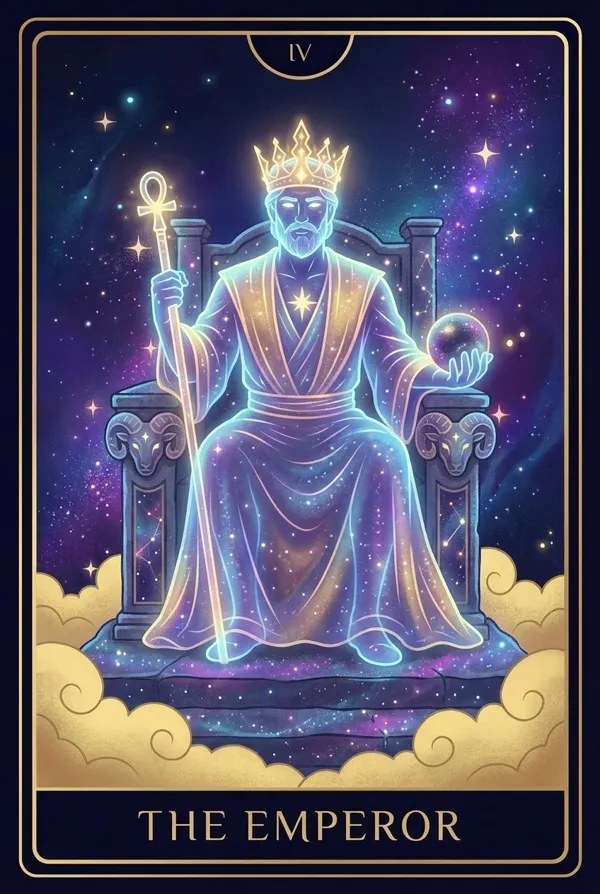
The Emperor is structure in service of something. His authority is not about dominance but about holding a shape steady enough for other things to grow inside it.
Overview of the Card's Meaning
The Emperor appears when a situation needs form. Boundaries, agreements, a schedule, a decision that stops being revisited — the unglamorous scaffolding that turns intention into something that lasts. He is often read as a person: a father, a boss, an institution. Read as an inner figure he is more interesting. He is the part of you capable of saying what the rules are and then keeping to them. As a mirror, he asks where your life is short of structure and where it has too much. Both are common, and they frequently coexist — rigid about the wrong things, formless about the ones that matter.
Symbolism and Imagery
He sits on a stone throne set with four ram's heads, holding an ankh sceptre and a globe. The rams belong to Aries: initiative, will, the drive to begin. The throne is stone rather than fabric — unmoving by design. Beneath his robes he wears armour, which says something quieter about authority: it is often carried by someone who has learned not to be undefended. Barren mountains stand behind him, a landscape that will not soften on request. His grey beard indicates experience rather than force. The ankh in his hand is a symbol of life, a reminder that the structure exists to protect something living.
Upright Meaning
Upright, the Emperor means order established. Plans get a framework, responsibilities get named, and something previously drifting acquires a spine. He favours discipline, follow-through and clear terms. Where other cards ask you to feel into a situation, he asks what the arrangement actually is and whether anyone has written it down. He can also indicate protection — someone using their position on your behalf, or you using yours for someone else. Authority in its upright form is a service rather than a status.
Reversed Meaning
Reversed, the Emperor tips into rigidity or control. Rules kept past their usefulness, a refusal to be questioned, structure defended because changing it would mean having been wrong. He can equally describe the absence of structure: no boundaries, nothing decided, a situation where everyone is waiting for someone to take responsibility and nobody does. The reversal often surfaces around difficult authority — a domineering parent or manager, or your own inner critic wearing their voice. The question it asks is whether the rules you are following are still yours.
Upright Keywords
Structure, Authority, Boundaries, Discipline, Protection, Commitment
Reversed Keywords
Rigidity, Control, Domination, No boundaries, Stubbornness, Abdicated responsibility
In Love
If You Are Single
For single readers, the Emperor points to clarity about terms. Knowing what you will and will not accept, and stating it early rather than discovering it three months in. He can describe attraction to stability, or to someone established and self-contained. That is a legitimate preference; the card only asks whether stability is being confused with control. It sometimes shows a season of building your own foundations first — work, home, finances — with the honest observation that a life with structure is easier to invite someone into.
If You Are in a Relationship
In a relationship, the Emperor concerns commitment and its architecture. Who does what, what has been promised, how decisions are actually made. He reads well for formalising things: moving in, marriage, shared finances, a plan you both keep to. Structure here is not the opposite of romance; it is what allows romance to stop being anxious. Where the relationship is strained, he can indicate one partner running the whole thing, or emotional expression squeezed out by practicality. The repair is not to abandon the structure but to make room inside it.
About an Ex or Getting Back Together
About an ex, the Emperor often means boundaries rather than reunion. Clear terms about contact, or a formal separation of shared things. He can describe a former partner who was controlling, or one who provided stability you now miss. It is worth being honest about which — the two can be tangled in the same memory. If reconciliation is in question, this card asks what structure would need to be different. Returning to the same arrangement generally reproduces the same ending.
In Career and Work
At work, the Emperor is strong. He supports leadership, systems, long-range planning and the kind of authority that comes from competence rather than volume. He often marks a promotion, a formal agreement, or the moment you are asked to own something properly. He also supports founding things: a business, a department, a structure that outlasts your attention. His caution is against managing by control. The Emperor at his best sets the frame and lets capable people work inside it; at his worst he inspects everything and slows the whole thing down.
In Money and Finances
Financially, this is one of the most practical cards in the deck. Budgets, contracts, tax, property, long-term planning — all his territory. He favours building slowly and defensibly: reserves rather than bets, terms in writing, obligations known rather than estimated. He can also indicate money connected to authority — an institution, a father, a legal settlement. Where that is the case, his advice is to be precise and unhurried about the paperwork.
What This Card Says About How Someone Feels About You
As how someone feels about you, the Emperor suggests serious, considered regard. They are unlikely to be effusive, and they are likely to show it in what they do — reliability, provision, showing up on time. They may want the situation defined. Ambiguity is uncomfortable for this figure; he would rather know what this is and act accordingly. It can also indicate someone guarded — the armour under the robes. Warmth is present but disciplined, and it tends to reveal itself through commitment rather than declaration.
This Card as Advice
Decide, write it down, and stop reopening it. A structure you keep renegotiating provides none of the benefit of a structure. Then check the boundaries. Where in this situation have you left the terms vague to avoid seeming difficult? Vagueness of that kind almost always costs more later than plain words would now. And hold the authority lightly. The ankh matters: the point of the structure is the life inside it. If your rules are starting to work against the thing they were built to protect, the rules are what needs revising.
Is This Card a Yes or a No?
The Emperor is a yes for anything requiring structure, commitment or formal agreement. He is less favourable where the question needs flexibility, spontaneity or emotional openness — not because he opposes those, but because he does not supply them. On practical matters — contracts, property, work, long-term plans — read him as a solid yes, provided the terms are actually clear.
Combinations With Other Cards
With the Empress, the reading balances structure and nourishment — one of the more complete pairings in the deck. Alongside Justice, expect formal fairness: agreements, legal process, decisions on principle. With the King of Swords, judgement and authority reinforce each other; expect a decision made and held. Next to the Fool, the two cards argue usefully about how much freedom the plan should allow. With the Devil or the Eight of Swords, watch for structure that has become a cage. Paired with the Four of Wands, he reads domestically: a home, a commitment, something built to stay.
This Card as Your Card of the Day
As a card of the day, the Emperor suggests doing the structural task you have been postponing. The admin, the contract, the difficult decision that only needs to be made once. It is a good day for anything requiring authority in your own voice: setting a boundary, stating a fee, giving a clear instruction. Watch for stubbornness. Under this card, being firm and being immovable feel identical from the inside.
Common Misconceptions
The most common misreading turns the Emperor into a domineering patriarch and stops there. Control is his reversal, not his meaning. Upright he is protective structure — the frame that keeps a situation from collapsing on the people inside it. The second mistake is reading him as unfeeling. The armour indicates someone who learned to be defended, which is a different thing from someone who does not care. His affection is expressed through reliability rather than declaration, and that is easy to overlook if you are listening for words. Third, people treat him as necessarily male, or necessarily someone else. He is very often the reader's own capacity for authority. And fourth, he is read as opposed to emotion. He is not; he simply provides the container. The Empress and the Cups do the rest.
Historical Background and Spiritual Depth
The Emperor is the fourth Major Arcana card, following the Empress. The sequence is deliberate: creation first, then the form that protects it. His association with Aries links him to initiative and will, which sits interestingly against his stone throne. He is not passive tradition; he is decisive energy that has chosen to hold still. Historically he has represented worldly power, the state, the father. Modern readings have worked to separate the function from the stereotype — authority as responsibility rather than entitlement. Read as an inner figure, the Emperor is the part of you that can make a rule for yourself and honour it without needing anyone to enforce it.
Self-Reflection Questions
Ask where your life is short of structure, and be specific — money, time, boundaries, sleep. Then ask where the structure has outlived its purpose, and whether you are defending it out of usefulness or out of habit. Finally, consider whose voice your rules are spoken in. Some of them will turn out to be inherited rather than chosen, and those are the ones worth examining.
Frequently Asked Questions
Is The Emperor a controlling card?
Control is his reversal rather than his meaning. Upright he is protective structure — boundaries, clear terms and the frame that keeps a situation from collapsing on the people inside it. The ankh in his hand is a reminder that the structure exists to protect something living.
Does The Emperor always represent a man?
No. He is very often the reader's own capacity for authority, and when he does describe a person, gender is not the point. What matters is the function: someone who sets the terms and keeps to them.
Is The Emperor a yes or no card?
A yes for anything needing structure, commitment or a formal agreement, provided the terms are genuinely clear. He is weaker where the question requires flexibility, spontaneity or emotional openness, since he does not supply those.
What does The Emperor reversed mean?
Either rigidity — rules kept past their usefulness, a refusal to be questioned — or the absence of structure entirely, where nothing is decided and nobody takes responsibility. It often surfaces around difficult authority figures or an inner critic in their voice.
What does The Emperor mean for feelings?
Serious, considered regard shown through actions rather than words: reliability, provision, turning up. They usually want the situation defined, and their warmth tends to be disciplined rather than effusive.
What does The Emperor mean in a love reading?
Commitment and its architecture — who does what, what has been promised, how decisions get made. He reads well for formalising a relationship, and cautions against one partner running the whole thing.
What advice does The Emperor give?
Decide, write it down, and stop reopening it; make the vague boundaries plain; and hold your authority lightly. If your rules are working against the thing they were built to protect, revise the rules.
Journaling Prompts
- Where in my life do I need a clearer rule for myself?
- Which of my rules are actually inherited rather than chosen?
- What boundary have I left vague in order not to seem difficult?
- Where am I holding on because changing would mean admitting I was wrong?
Related Cards
Start a Personal Reading · Today's Card · Explore the Full Library · Career Reading · Yes or No Reading