Clover (Card 2)
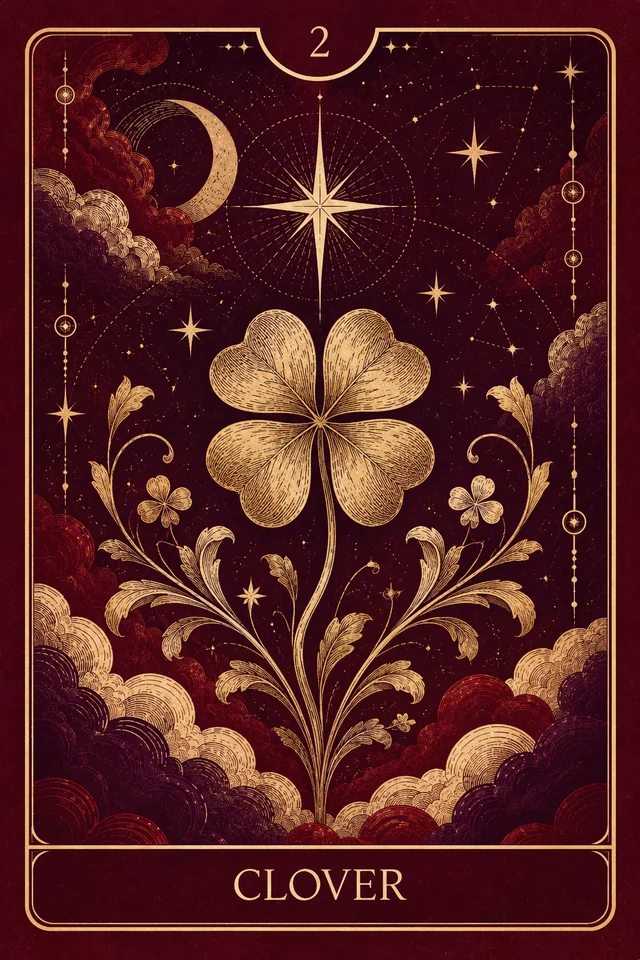
Clover is small luck with a short shelf life. A lucky break, a chance opening, a good moment — real, welcome, and not built to last. The card's whole instruction is: take it now.
Core meaning
Clover denotes luck on a small scale: a fortunate coincidence, a minor opportunity, a piece of good news that arrives without being worked for. The size is the meaning. This is not the Sun's broad success or Key's certainty — it is a brief window, and the card's traditional advice is speed, because the window closes. Its second sense is lightness: relief after strain, a good mood, something that costs nothing and lifts the day. Older readings also give it a hint of gambling and risk, in the sense that a Clover chance is taken rather than planned. The card is positive without being substantial, and reading it as more than it is sets people up for disappointment.
One card is a word, not a sentence
One card is a word, not a sentence — and Clover is a particularly small word: luck, briefly. On its own it cannot tell you luck in what, or what to do about it, and a reader who builds a windfall story out of one card is inventing the interesting part. Meaning arrives with the second card, so treat Clover as the subject and read the pairs below, which is where the useful instruction lives.
The image
A four-leaf clover sits alone on the card, usually small in the frame. Its scale in the picture is the point: a tiny plant, easy to miss, lucky precisely because it is rare and found by accident. Four-leaf clovers are a folk emblem of chance rather than of reward — nobody earns one. The plant is also short-lived once picked, which is where the card's narrow-window quality comes from. The playing-card insert is the Six of Diamonds, a modest material card, and that modesty is consistent: Clover promises a small good thing, honestly.
In love and relationships
In love, Clover is a light, lucky moment: a happy chance meeting, a flirtation, a good day in a relationship, an unexpectedly easy conversation. It is genuinely pleasant and genuinely small. With Heart it describes a brief, lovely piece of affection — delightful, and not on its way to becoming a marriage by itself. For questions about whether something will last, Clover is an honest no in that specific sense: it says enjoy this rather than build on this. When Ring or Anchor sit beside it, the picture changes and something lucky may indeed become lasting. Alone, the kind reading and the accurate reading are the same: a good moment, worth having, not a promise.
In work and career
At work Clover is the lucky break: an opening that appears unexpectedly, a helpful coincidence, a small win, a problem that turns out to be easier than feared. It frequently marks a short application window or a chance that has to be taken this week rather than next month. As advice it says move quickly and do not overthink a small opportunity. It rarely describes a promotion or a structural change — those belong to Stork, Sun or Ring. With Mountain it says the lucky opening exists despite the obstacle; with Snake, that it is a way around a complication.
In money questions
In money questions Clover is a small, welcome amount: an unexpected payment, a refund, a discount, a minor win, a bill that comes in lower than expected. It is not a card of financial transformation, and reading it as one is the most common way people get hurt by it — particularly in gambling questions, where the card's chance quality tempts an over-read. Fish is the card of income and quantity. Clover is the pleasant surprise that improves the week. With Fish beside it, a brief window of real gain; with Mice, a small gain that a leak quietly cancels.
As a person
As a person, Clover is someone light, cheerful and lucky to be around — the friend who lifts the mood, the contact who happens to know someone, a person who turns up at exactly the right moment. Often a brief acquaintance rather than a fixture. Clover people are not unreliable so much as transient: they help, and then they are somewhere else. For someone dependable, readers look to Dog or Anchor instead.
Timing
Clover is one of the clearest timing cards in the deck, and its signal is very soon and very briefly. The traditional reading is a matter of days — often no more than a few — and the emphasis is on the window rather than the event. Where other cards say when something arrives, Clover says how long you have. It is the card readers reach for when the practical question is whether to act now, and the answer it gives is almost always yes, immediately, because waiting is how a Clover opportunity is lost.
Position in a spread
Clover beside the significator means the luck is yours and available right now — within reach, and time-limited. Further away it describes a fortunate circumstance in the wider situation that may not reach you before it passes. Because the card is about a narrow window, readers pay particular attention to what follows it: the card after Clover is read as what the opportunity leads to, and a heavy card there suggests the luck is genuinely brief. Clover beside a difficult card is traditionally read as a small mercy inside a hard situation — not a rescue, but a real one.
In the Grand Tableau
As a house, the Clover position governs luck, chance and small openings. A card landing in house 2 is being read as brief and fortunate: Fish in the Clover house suggests a short window of gain, Heart there a lovely passing affection, Mountain there an obstacle that luck moves more easily than effort would. Cards in this house are read as time-limited.
Yes or no
Clover is a small yes, and an honest one: yes, and briefly. For questions about whether something can happen soon, it is a clear yes. For questions about whether something will last, it is closer to a no — not a refusal, but the card saying this is not that size. Where Anchor or Ring sit beside it, the small yes can become a durable one.
Common misreadings
The main misreading is inflating Clover into major good fortune. It is small by design, and treating it as a jackpot — especially in money and gambling questions — turns a modest, useful card into a false promise. Second, its narrow window is often ignored, so people wait, and the reading is judged wrong when in fact the advice was speed. Third, Clover next to a hard card is sometimes read as cancelling the difficulty; it does not, it eases it. Finally, it is not luck you can rely on twice. For anything that needs to hold, read Anchor.
Card combinations
A small card needs its neighbour, and the order tells you which way to read it. The first card is the noun, the second modifies it: Clover + Rider is a lucky piece of news, while Rider + Clover is news that arrives quickly and happens to be fortunate. One is about the luck, the other about the message. Reversed pairs appear separately where the difference is real; some pairs read in parallel, as two facts at once.
- Clover + Fish — Luck is the subject and money is its area: a small fortunate gain, an unexpected payment, a brief chance to earn.
- Fish + Clover — The other direction: the money is the subject and luck describes how it comes — income that arrives by chance rather than by plan, and only for a short window.
- Clover + Heart — A lucky turn whose subject matter is affection: a happy chance meeting, a flirtation, an easy good day with someone.
- Heart + Clover — Reversed, the affection is the subject and luck qualifies it: real feeling that is light and brief. Lovely, and not built to last on its own.
- Clover + Ring — A short window to commit: a lucky agreement that has to be taken now, or a brief arrangement rather than a lasting one.
- Clover + Key — A lucky door opening, and this one is certain. The small chance turns out to be the real solution.
- Key + Clover — The other way round, certainty is the subject and luck describes it: a definite yes that arrives by a fortunate route, and needs taking while it is there.
- Clover + Rider — A lucky piece of news. The luck is the subject; the rider is how it reaches you — a welcome message, a small unexpected offer.
- Rider + Clover — Reversed, the news is the subject and luck describes its arrival: something turns up sooner and more easily than expected. Fast, and with a short shelf life.
- Clover + Mountain — A lucky way past an obstacle. The blockage is real, and a narrow opening exists anyway. Move while it is there.
- Clover + Mice — A small gain quietly cancelled by a leak. The luck is real and something is eating it — worth finding the drain rather than chasing the next chance.
- Clover + Sun — Luck and success together: a small opening that leads somewhere genuinely good, out in the open. Read in parallel — Clover at its most substantial.
Frequently asked questions
What does the Clover card mean in Lenormand?
Clover means small, short-lived luck: a lucky break, a minor opportunity, unexpected good news. The scale and the brevity are both part of the meaning — the card's advice is to act now.
Is the Clover card a yes or a no?
A small yes. Yes, and briefly. For whether something can happen soon it is clearly positive; for whether something will last it is closer to a no, unless Anchor or Ring sits beside it.
How long does the Clover card's luck last?
Traditionally a matter of days. Clover describes a window rather than an event, and the window closes — which is why waiting is the usual way a Clover opportunity is lost.
Does Clover mean I will win money or a lottery?
It means a small, pleasant financial surprise: a refund, a discount, a minor win, a bill lower than expected. Reading it as a jackpot is the most common way people are disappointed by this card. Fish is the card of real income.
What does Clover mean in a love reading?
A light, lucky moment: a happy chance meeting, a flirtation, a good day in a relationship. Genuinely pleasant and genuinely small — enjoy it rather than building on it, unless Ring or Anchor appears beside it.
Does the Clover card have a reversed meaning?
No. Traditional Lenormand has no reversals. Some readers treat a Clover surrounded by heavy cards as luck that is harder to reach, but the card itself is read the same way up.
What is the difference between Clover and the Sun?
Both are positive, at different scales. Clover is small, brief and lucky. Sun is broad success, energy and visibility. Clover asks you to act fast; Sun says things are simply going well.