Key (Card 33)
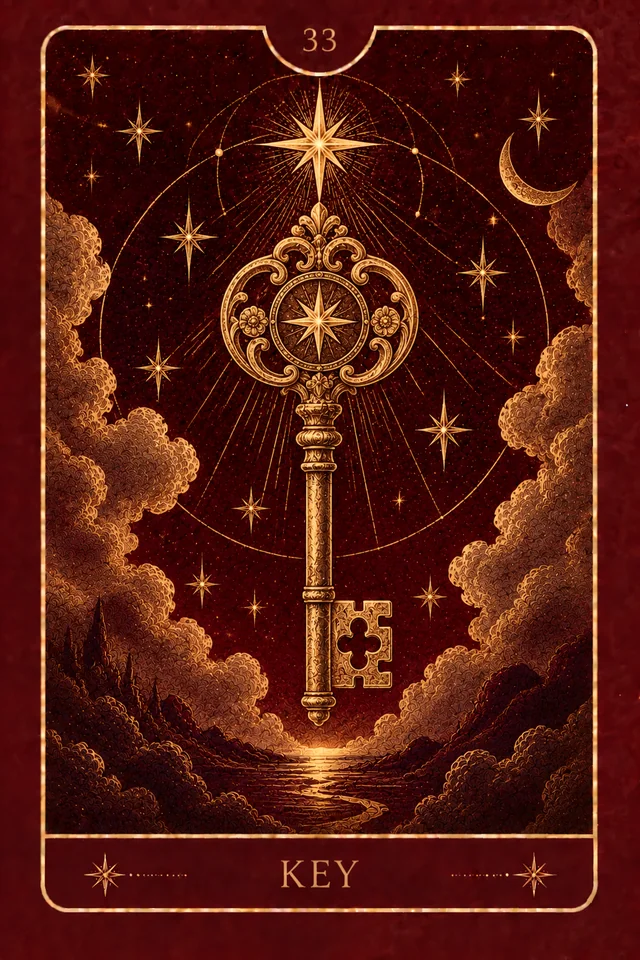
Key is the deck's plainest yes. It means the door opens, the solution exists, and the matter is settled rather than hoped for — which is why experienced readers treat it as the card that confirms other cards.
Core meaning
Key denotes certainty, access and solution. Something that was closed opens: permission is granted, a method is found, a question gets a definite answer. Where most Lenormand cards describe conditions, Key describes a settled outcome, and that is why it carries so much weight beside a hopeful card — it turns a maybe into a yes. Its second sense is the means to something: not the outcome itself but the way in, the piece of information or access that makes the rest possible. In older readings Key also signals importance, marking the matter as significant rather than trivial. It is the deck's most straightforwardly positive card after the Sun.
One card is a word, not a sentence
Worth saying plainly: one card is a word, not a sentence. Key says yes, certainty, access — and a word cannot tell you yes to what, opened by whom, or at what cost. A reader who spins a detailed prophecy from a single Lenormand card is guessing, however confident it sounds. Meaning is completed by the next card, so treat Key as the subject and read the pairs below for the actual answer.
The image
A single key lies on the card, sometimes ornate, sometimes plain. A key is a small object whose entire meaning is what it gives access to, and the deck uses that exactly: the card is not the room, it is the way in. Nothing is locked in the picture and no door is shown — the emphasis is on possession of the means. Old emblem books used the key for authority and for solved mysteries, both of which survive in the reading. The playing-card insert is the Eight of Diamonds, a practical, resource-linked card, which keeps Key grounded: it tends to describe real openings rather than symbolic breakthroughs.
In love and relationships
In love, Key is confirmation. Beside Heart it is a clear yes about affection; beside Ring, a commitment that goes through; on its own, certainty about whatever the question asked. It can mark the moment a relationship stops being ambiguous — a conversation that settles the status, or a door reopening after a period of distance. What Key does not do is name a person, which matters in questions about a specific individual: it says the answer is a yes, but a reading cannot tell you that a particular human being will walk through the door. With Snake it says the solution exists but comes by the indirect route. With Clouds it says the certainty is not available yet.
In work and career
At work Key means access and resolution: a job offer confirmed, an approval granted, a stuck project unblocked, the piece of information that makes the problem solvable. In negotiations it says yes, the terms are settled. In career questions it is one of the strongest cards you can draw, particularly beside Ring for a contract or Fish for money. It also stands for the specific skill, credential or contact that opens a door — Key plus Book often means the qualification, the training, the thing you need to learn to get in.
In money questions
In money questions Key confirms: the payment comes, the loan is approved, the funds become accessible. It is not a card of amount — Fish speaks to how much — but of access, which is often the real question. Key with Fish is a strong financial yes. Key with Mountain says the money exists behind an obstacle that can be cleared. Key with Mice says the solution works but something is still leaking, so fix the drain as well as the door.
As a person
As a person, Key is someone reliable and direct — a person who says what they mean, keeps their word, and can actually open the door in question. Often the decision-maker, the one with the authority to say yes: a manager who signs off, an official who approves, a friend whose introduction gets you in. Key people are plain-speaking rather than charming, and where Fox and Snake describe motives you have to read, Key describes someone whose position and intention are visible.
Timing
Key is the deck's card of the certain and the imminent. Traditionally it signals now, or very soon, with a sense of settled rather than pending. It carries no month or season of its own, and readers generally take it as confirming the timing of the card beside it rather than setting its own: Rider plus Key is news arriving for certain and soon; Anchor plus Key is a long arrangement that is definitely going ahead; Mountain plus Key is a delay that will be cleared rather than one that stands.
Position in a spread
Key beside the significator means the opening is yours and available now — you hold the means. Further away it describes a solution that exists elsewhere in the situation, often in someone else's hands, and part of the reading becomes how to reach it. Because Key confirms, the card it sits next to matters more than usual: whichever card Key touches is the one being made certain. Readers pay attention to what comes immediately after Key, since that is traditionally read as what the opened door leads to.
In the Grand Tableau
As a house, the Key position governs certainty, solutions and access. A card landing in house 33 is being confirmed: Heart in the Key house is affection made certain, Fish there is money that becomes accessible, Snake there is a complication that is definite rather than imagined. Cards in this house are read as settled rather than pending.
Yes or no
Key is the clearest yes in the deck along with the Sun, and the one readers rely on for straight questions. It is a yes about the event, not only about the feeling, which is what separates it from Heart. A Key next to a difficult card does not erase the difficulty, but it does say the matter resolves. The only common qualifications: with Clouds, not yet; with Snake, yes but by another route.
Common misreadings
The main misreading is treating Key as a promise about a named person — that a specific ex will return, or a specific employer will call. The card confirms an answer; it does not choose the human being who delivers it. Second, Key is sometimes read as effortless, when what it really describes is having the means: a door that opens still has to be walked through. Third, readers occasionally use Key to overrule every other card in the spread; it confirms, but Mountain still means a delay, and Mice still means a leak. Finally, Key is not permanence — for how long something lasts, read Anchor.
Card combinations
Key is a confirming card, which makes word order especially important: the first card is the noun and the second modifies it. Key + Letter is certainty that arrives as a document — the answer is the subject. Letter + Key is a document that unlocks something, where the paperwork is the subject and access is its effect. Both directions are given below where the reading genuinely changes. A few pairs read in parallel, as two facts standing together.
- Key + Heart — Certainty is the subject and love is its area: a definite yes in the emotional question, or a door reopening in a relationship that had closed.
- Heart + Key — Reversed, the feeling is the subject and certainty describes it: affection that becomes sure of itself. Less about a door opening than about doubt ending.
- Key + Ring — A commitment confirmed. The contract goes through, the agreement is signed, the relationship becomes official.
- Key + Fish — Access whose subject matter is money: a payment released, funding approved, resources unlocked.
- Fish + Key — The other direction: the money is the subject and access qualifies it. Income that exists and now becomes reachable — the answer to will I actually be paid.
- Key + Snake — The solution exists and the route is indirect. Work around the complication rather than forcing the straight path.
- Snake + Key — Reversed, the complication is the subject and the solution follows it: a tangle that turns out to have a way through. Read as the tangle resolving rather than as an easy yes.
- Key + Letter — Written confirmation: the approval comes on paper, the document settles the matter. Certainty is the subject; the letter is how it arrives.
- Letter + Key — The document is the subject and it is what opens the door — a form, an application, a piece of paperwork that grants access once it is dealt with.
- Key + Mountain — The obstacle can be cleared. Not gone yet, but the means exists and the delay is temporary rather than final.
- Key + Clouds — The certainty is not available yet. The answer exists but the picture is unclear; wait before acting on a yes you cannot see.
- Key + Sun — Success confirmed, out in the open. Read in parallel: certain and going well, both at once — as unambiguous as Lenormand gets.
Frequently asked questions
What does the Key card mean in Lenormand?
Key means certainty, access and solution: a definite yes, a door opening, the means to get what the question is about. It settles matters rather than describing conditions.
Is the Key card a yes or a no?
A yes — the clearest in the deck alongside the Sun, and a yes about the event rather than only about feeling. With Clouds it becomes not yet; with Snake, yes but by an indirect route.
What is the difference between the Key and the Sun?
Both are strongly positive. Key is certainty and access — the door opens. Sun is success and visibility — things go well in the open. Together they are about as unambiguous as Lenormand gets.
Does Key mean a specific person will come back?
No. Key confirms an answer; it does not name the person who delivers it. A reading cannot tell you that one particular human being will walk through the door, and any reader promising that is guessing.
What timing does the Key card suggest?
Now, or very soon, with a settled feeling rather than a pending one. It carries no season of its own and generally confirms the timing of the card beside it.
Does the Key card have a reversed meaning?
No. Traditional Lenormand has no reversals. Key's tone is adjusted by neighbours — Clouds delays the certainty, Snake redirects it, Sun reinforces it.
What does Key mean in a work reading?
Access and resolution: an offer confirmed, an approval granted, a blocked project unblocked, or the specific skill or contact that opens the door. With Ring it points to a contract going through.