10 of Wands — Tarot Card Meaning
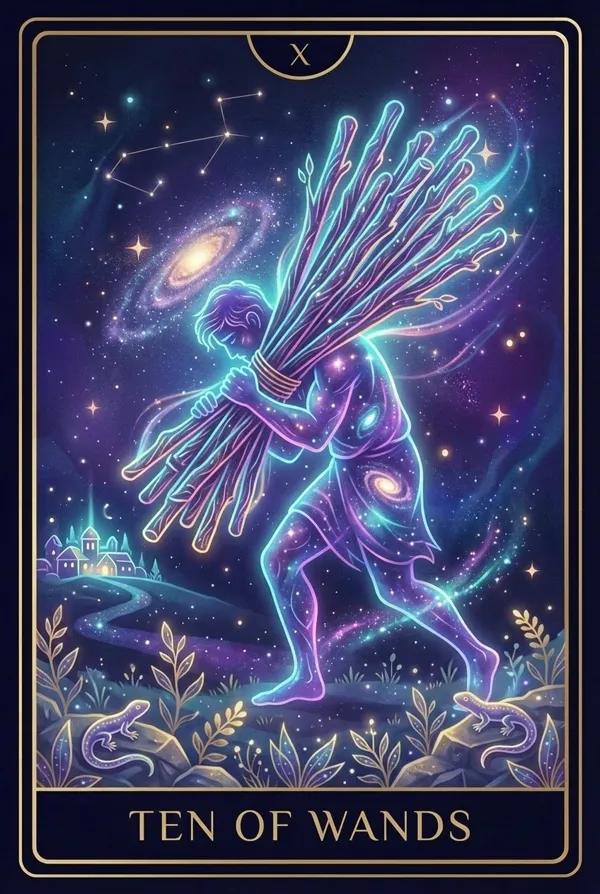
The 10 of Wands is the card of carrying more than one person was meant to carry. The load is real and much of it was chosen, which is exactly why it is so hard to set down.
Overview of the Card's Meaning
The 10 of Wands appears when effort has quietly accumulated into burden. Each thing you are carrying made sense when you picked it up — a responsibility accepted, a favour agreed to, a standard you set for yourself. The card rarely marks one big problem. It marks the total weight of many reasonable commitments arriving at once. This is the final card of the Wands suit, and it shows what happens to fire when nothing is allowed to finish. All the energy, ambition, and willingness of the suit is present, but it has been converted into hauling rather than creating. You are still moving, which can make it hard to notice that you have stopped thriving. As an inner mirror, the card asks a plain question: what are you carrying that is not yours, or no longer needs to be carried at all? Most people discover the honest answer embarrasses them a little — not because the load is imaginary, but because some of it has been kept for reasons that no longer apply.
Symbolism and Imagery
In the Rider-Waite-Smith image, a figure walks away from us toward a town in the distance, bent under the weight of ten tall staffs held in both arms. The staffs cross in front of their face, blocking the view ahead. That obscured view is the card's most precise detail. The problem is not only the weight; it is that the weight has made forward vision impossible. The person can no longer see where they are going, only the next step. Long-term thinking, which the earlier Wands cards celebrated, has been entirely crowded out by the load. The town is close. This matters too. The 10 of Wands is typically a card of the final stretch rather than the endless road — the burden is nearly delivered. The tragedy the card warns against is not that the destination is unreachable, but that people collapse within sight of it, or arrive having damaged the very thing the effort was meant to serve.
Upright Meaning
Upright, the 10 of Wands describes overload that is largely self-assigned. You have said yes repeatedly, held yourself to a high standard, and absorbed work that others let slide. None of this is a character flaw — it is often the same reliability that built your reputation. But the card marks the point where reliability has begun to cost more than it earns. It frequently appears near the end of a demanding chapter: the last weeks of a project, the final year of a degree, the home stretch of a renovation or a case. The message is not to quit. It is to distinguish what must be carried to the finish from what was picked up out of habit and can be put down today. It can also describe the burden of competence itself. When you are the person who copes, more is quietly routed to you. The card does not ask you to become unreliable. It asks you to notice that carrying everything is a choice you are making, and that choices can be renegotiated.
Reversed Meaning
Reversed, the 10 of Wands often marks the moment the load becomes unsustainable — exhaustion breaking through, health complaining, resentment surfacing toward people who seem to carry less. The card treats this not as weakness but as information that was overdue. It can also describe the release of burdens: delegating at last, handing a responsibility back, admitting a commitment was a mistake and ending it. This is usually experienced as failure and is usually wisdom. Dropping one staff deliberately is better than dropping all ten by collapse. Occasionally the reversal points to a subtler pattern: carrying burdens that were never assigned to you at all. Other people's emotions, other people's unfinished business, expectations absorbed from family or culture without ever being examined. Here the work is not rest but audit — asking whose weight this actually is.
Upright Keywords
Burden, Overload, Responsibility, Hard work, Final stretch, Carrying too much
Reversed Keywords
Release, Burnout, Delegation, Letting go, Unsustainable pace, Boundaries
In Love
If You Are Single
For single readers, the 10 of Wands often explains why dating has stalled: there is no room. When every day is consumed by obligations, romance becomes one more task on an impossible list, and promising connections are allowed to fade because the effort feels like weight. It can also describe carrying old burdens into new possibilities — the residue of a difficult past relationship, a family situation, a demanding life that leaves little to offer. The card is not saying you are too damaged to date. It is saying that what you are carrying deserves to be acknowledged and, where possible, lightened, before you ask a new person to share the road. If someone new has appeared and everything feels heavy anyway, the card gently asks whether the heaviness is really about them, or whether you have simply run out of capacity.
If You Are in a Relationship
In an established relationship, the 10 of Wands frequently marks an unequal or unspoken distribution of load. One partner carries the planning, the remembering, the worrying, the earning — sometimes by mutual habit rather than anyone's decision. The card suggests the pattern has quietly become heavy enough to need naming. It can also describe a couple carrying a genuinely heavy season together: financial pressure, caring for relatives, a demanding launch or build. Shared burden is one of the strongest bonds there is, provided both people can see the other's load and the end is actually in view. The warning is romance buried under logistics. When every conversation is about tasks, the relationship starts to feel like another responsibility rather than a refuge from them. This card asks for even one hour protected from the carrying — not as an indulgence, but as maintenance of the thing all the effort is supposedly for.
About an Ex or Getting Back Together
With an ex, the 10 of Wands often indicates that you are still carrying the relationship long after it ended — replaying it, managing its emotional aftermath, keeping its weight on your back as though it were still your responsibility. It can also explain the ending itself: the relationship collapsed under accumulated burden, and one or both people were too exhausted to address what was actually wrong. Read this way, the failure was of capacity more than of love. When return is the question, the card asks what would be different. Reuniting into the same distribution of weight produces the same collapse. If reconnection is genuinely considered, this card says the conversation about who carries what is the whole conversation.
In Career and Work
This is one of the most important career cards in the deck, because it describes the reality of modern work more precisely than almost any other: the reliable person carrying an ever-growing load, praised for coping, promoted into more of it. Upright, it often marks the final push of something large — a launch, a deadline, a season of covering for absent colleagues. The card supports finishing. It does not support pretending the pace is sustainable, and it asks you to be honest with whoever manages you about capacity before quality starts failing. It also invites a structural look. List what you actually carry: projects, roles, emotional labour, other people's dropped work. Most people who do this exercise find between a quarter and a third could be delegated, declined, automated, or deliberately done to a lower standard. The card's message is not that you are weak for struggling. It is that no role was designed for this volume, and the design needs correcting. If you run your own business, the 10 of Wands often marks the growth stage where the founder is still doing everything. It asks what only you can do, and what you are keeping because letting go feels like a small death of control.
In Money and Finances
Financially, the 10 of Wands speaks to money that has become heavy — debts being serviced, dependants supported, a lifestyle whose fixed costs require constant effort to sustain. The burden is being met, which is worth honouring, and the card asks whether the structure can be changed rather than merely endured. It can indicate income that costs too much to earn: overtime as a permanent fixture, a second job, work whose stress leaks into health and relationships. Money gained this way has a hidden exchange rate. The constructive reading is consolidation. Refinancing, renegotiating, selling something you maintain out of obligation, simplifying. The card favours any move that permanently lowers the monthly weight, even at the cost of pride.
What This Card Says About How Someone Feels About You
Asked how someone feels about you, the 10 of Wands suggests their feelings are real but buried under load. They may be exhausted by circumstances that have nothing to do with you — work, family, their own standards — and their emotional availability is what remains after the carrying. It can also indicate that the connection itself has become heavy for them: something they value that currently feels like effort. This is not necessarily about you doing anything wrong. Sometimes a relationship asks for energy at the exact moment a person has none. The honest caveat: if someone consistently describes you as one more demand on their overloaded life, that is information about readiness rather than depth. Feelings that can never surface through the weight are real but not yet usable, and you are allowed to notice the difference.
This Card as Advice
Put something down this week. Not everything — one specific thing. Name a responsibility you are carrying out of habit, obligation, or pride, and release it, delegate it, or deliberately lower the standard you hold it to. The card's central teaching is that burdens are usually released by decision, not by rescue. Then tell one person the truth about your load. Burdens thrive on the appearance of coping. The moment the weight is spoken, options appear that were invisible while you pretended to be fine. And protect the finish line. If you are in the final stretch of something, the strategy is not more endurance — it is stripping away everything that is not the finish, so the remaining effort actually reaches it.
Is This Card a Yes or a No?
As a yes-or-no card, the 10 of Wands leans toward not yet, or yes at too high a cost. It rarely forbids; it asks what the yes would add to a load that is already at the edge. For questions about taking on something new — another project, another commitment, another responsibility — the honest answer is no, or only if something else is put down first. The card protects you from the yes that breaks the back. For questions about whether a current struggle will end, it is quietly positive: the town is close. The answer is yes, it ends — especially if you put down what does not need to finish the journey with you.
Combinations With Other Cards
With the 4 of Swords, the message is emphatic: rest is not optional, it is the next task. With the 10 of Cups, the burden is in service of family or a shared dream, and the question is whether that service is still balanced. With the 6 of Swords, the card suggests moving away from the heavy situation entirely rather than managing it better. With The Devil, overwork has become a cage — obligation, guilt, or addiction to being needed is doing the carrying, and naming that is the release. With Strength, endurance is present but must be paired with gentleness toward yourself. With The Star, recovery follows the heavy period; the dawn is real. With the 2 of Pentacles, you are juggling rather than carrying, and the difference matters — one can be rebalanced quickly, the other cannot. With the 8 of Pentacles, hard work is productive but at risk of tipping into grind. With the 4 of Cups, exhaustion has flattened into apathy, and rest matters more than motivation.
This Card as Your Card of the Day
As your card of the day, the 10 of Wands suggests auditing the day's load before it begins. Cross one thing off the list that does not truly need doing today, and notice how little consequence follows. Watch for the moment someone hands you something that is theirs. The day's practice is a polite return of weight to its owner. If everything feels heavy by evening, that is the card making the invisible visible. Let it inform tomorrow's choices rather than tonight's self-judgement.
Common Misconceptions
The first misreading is treating the 10 of Wands as a simple instruction to work harder or endure more. It is nearly the opposite: a card about the limits of endurance appearing precisely when endurance has been overused. The second is reading it as punishment or proof that you have failed. The burden is usually the price of real virtues — reliability, ambition, care — and the card asks for redistribution, not self-criticism. A third is assuming the load is entirely imposed by others. Most of it, on honest inspection, is self-assigned or self-maintained, which is uncomfortable and also empowering, because what you picked up you can put down. And a fourth is missing the nearness of the town. This card often marks the last stretch of a long effort; the accurate reading is usually lighten and finish, not abandon.
Historical Background and Spiritual Depth
Numerologically, tens complete a suit's journey and seed the next cycle. In Wands — the suit of fire, drive, and enterprise — completion arrives as the discovery that pure will, unregulated, converts itself into burden. The suit's gift becomes its cost, which is the characteristic wisdom of the tens: every strength, pushed to its conclusion, shows its shadow. The imagery draws on an everyday medieval reality: the labourer hauling faggots to market or fuel to the manor. Pamela Colman Smith's figure is not a slave or a prisoner; they are a worker within sight of delivery. That ordinary dignity is the card's moral centre — the burden is not a cosmic punishment, it is the predictable result of saying yes in a world that rewards saying yes. Read psychologically, the card maps onto what modern research calls allostatic load: the cumulative physiological cost of sustained demand, which accumulates invisibly until it does not. The 10 of Wands is, in this sense, one of the deck's most contemporary cards — a picture of burnout drawn a century before the word existed.
Self-Reflection Questions
What am I carrying that nobody asked me to carry? Which burdens are nearly delivered — and which have no destination at all? What would I put down this week if I believed the world would not collapse? Whose weight have I absorbed, and what would returning it look like in practice?
Frequently Asked Questions
What does the 10 of Wands mean in tarot?
It represents carrying a heavy load of responsibilities — many of them self-assigned — usually near the end of a demanding chapter. It asks what can be put down rather than endured.
Is the 10 of Wands a yes or no card?
It leans toward not yet, or yes at too high a cost — especially for taking on anything new. For whether a current struggle will end, it is quietly positive: the finish is near.
Does the 10 of Wands mean burnout?
It is one of the deck's clearest burnout signals: sustained overload that is still being coped with. It asks for redistribution and rest before the coping fails, not after.
What does the 10 of Wands mean for career?
Usually the reliable person carrying too much, often in the final push of something big. Its advice is to lighten deliberately — delegate, decline, or renegotiate — so the effort actually reaches the finish.
What does the 10 of Wands reversed mean?
Often the load becoming unsustainable, or the deliberate release of burdens through delegation and honest limits. It can also reveal weight that was never yours to carry.
What does the 10 of Wands say about someone's feelings?
Their feelings are likely real but buried under exhaustion. Emotional availability may be what remains after the carrying — information about capacity rather than depth.
Is the 10 of Wands a bad card?
No. It honours real effort and usually marks the final stretch, with the destination close. Its warning is specific: lighten the load so you actually arrive, rather than collapsing within sight of the town.
Journaling Prompts
- List everything you are currently carrying — tasks, roles, worries, other people's needs. Mark each: mine, shared, or not mine.
- Write about a burden you once put down. What actually happened?
- Where did you learn that coping silently is a virtue? Whose voice is that?
- Describe what your week would look like with one-third of the load removed. What is the first small step toward it?
Related Cards
Start a Personal Reading · Today's Card · Explore the Full Library · Career Reading · Yes or No Reading