Five of Swords — Tarot Card Meaning
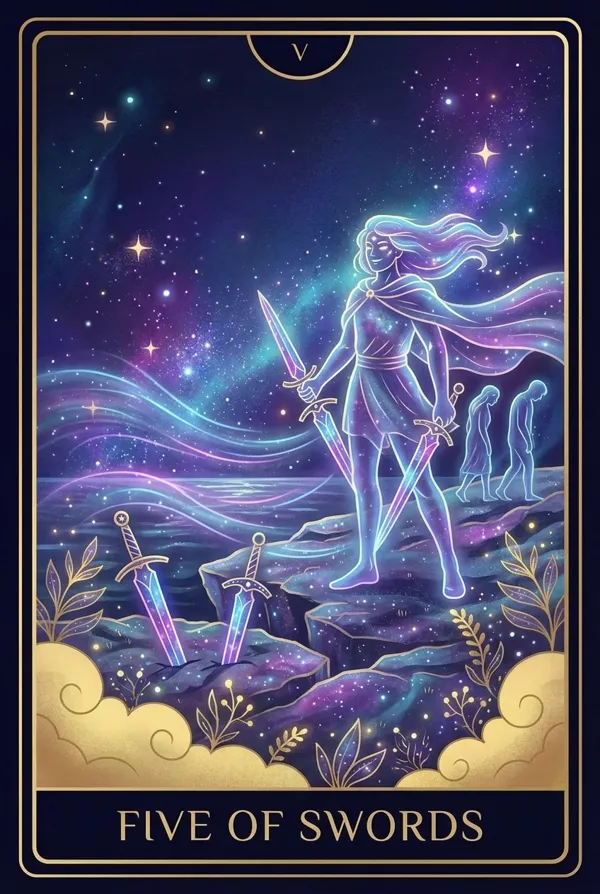
The Five of Swords shows someone collecting swords after a fight while the others walk away. He won — but at what cost? It is the card of conflicts where being right is not the same as being well.
Overview of the Card's Meaning
The Five of Swords (5 of Swords) represents conflict, tension, defeat, and victories that cost more than they are worth. It often appears after arguments, competitive situations, or power struggles where someone wins and someone loses — and the relationship suffers either way.
When the Five of Swords appears, it asks whether this fight is worth it. You may be in a dispute where pride is driving decisions, or you may have been on the losing side of someone else's win. The card does not judge; it shows the aftermath and invites you to choose your battles wisely, repair where possible, and walk away from conflicts that only drain you.
Symbolism and Imagery
In the Rider-Waite-Smith image, a man with a smug expression gathers swords on a shoreline. He holds three swords, while two lie on the ground. In the background, two figures walk away towards the water, heads down, defeated or disheartened.
The sky is filled with jagged, broken clouds, suggesting a storm that has just passed or tension that lingers. The man's victory looks hollow: he has the swords but no company. The image captures the loneliness of winning an argument and losing a connection.
Upright Meaning
Upright, the Five of Swords signals conflict, competition, tension, or a win at someone else's expense. You may be in an argument, a workplace rivalry, or a situation where people are acting out of self-interest. Communication may be hostile or manipulative.
The card asks you to consider the cost. Is winning this argument worth damaging trust? Sometimes the strongest move is to step back, compromise, or let go. If someone else is behaving unfairly, it may be wise to protect yourself and walk away rather than escalate.
The Five of Swords can also describe the feeling of defeat. If you lost a battle, it may hurt your pride, but it can also free you from a fight that was never worth having.
Reversed Meaning
Reversed, the Five of Swords often signals reconciliation, making amends, or the end of a conflict. You may be ready to let go of resentment, apologise, or move on from a dispute.
It can also describe lingering resentment or regret after a fight. In some cases, it shows conflict escalating if pride is not set aside. The reversed Five asks you to seek peace where possible and to learn from what happened.
Upright Keywords
Conflict, Hollow victory, Tension, Competition, Defeat, Self-interest, Hostility
Reversed Keywords
Reconciliation, Making amends, Letting go, Regret, Lingering resentment, Ending conflict
In Love
If You Are Single
If you are single, the Five of Swords may describe tension or game-playing in dating, or lingering bitterness from a past relationship. You may feel guarded or competitive, or you may encounter people who are not acting in good faith.
The card encourages you to avoid connections that feel like battles. Look for people who communicate respectfully. If you notice yourself trying to win or control, ask what you are protecting. Love is not a contest.
It can also point to a dating culture that feels competitive or cynical — mixed signals, ghosting, or people keeping score. You do not have to play. Opting out of games often attracts people who are equally tired of them.
If You Are in a Relationship
In a relationship, the Five of Swords can describe arguments, power struggles, or one partner trying to win at the other's expense. Communication may be sharp, defensive, or hurtful.
The card asks both partners to prioritise the relationship over being right. Take breaks during heated moments, apologise sincerely, and focus on understanding. If conflicts involve manipulation or disrespect, it may be time to seek outside help or reassess the relationship.
A useful rule during heated moments is to argue about the issue, not the person. Replace 'you always' with 'I felt' and agree on a time-out signal either of you can use when things escalate. Returning to the conversation calmly an hour later often achieves what shouting never could.
About an Ex or Getting Back Together
With an ex, the Five of Swords often reflects a breakup marked by conflict, bitterness, or a sense that someone won and someone lost. There may be lingering resentment.
It rarely supports reconciliation unless both people have genuinely moved past the conflict. More often, it encourages letting go of the need to be right and moving on with dignity.
In Career and Work
Professionally, the Five of Swords can describe workplace conflict, competition, office politics, or a situation where someone takes credit or acts unethically. You may face a rival or a hostile environment.
Choose your battles carefully. Stand up for yourself where necessary, but avoid escalating conflicts that harm your reputation. Document issues, communicate professionally, and consider whether the environment is worth staying in.
If you have been the one taking shortcuts or credit, the card is a quiet warning: short-term wins built on others' losses tend to damage trust, and trust is what careers run on over the long term.
In Money and Finances
With money, the Five of Swords can warn of disputes, unfair deals, or financial loss through conflict. Be careful with agreements and read the fine print.
Avoid aggressive financial competition or schemes that benefit you at others' expense. Seek qualified advice for disputes or major decisions.
What This Card Says About How Someone Feels About You
When the Five of Swords describes how someone feels about you, it may show tension, resentment, defensiveness, or hurt pride. They may feel they lost something or that you are in conflict.
It can also show someone who regrets how a conflict unfolded. Honest, calm communication may help, but only if both sides are willing to put pride aside.
If the conflict was recent, emotions may still be raw. Give the situation a little time before trying to resolve it, and approach with curiosity rather than a list of grievances. A single honest sentence — 'I don't want us to be on opposite sides' — can soften a lot.
This Card as Advice
The Five of Swords advises you to choose your battles wisely. Ask whether this conflict is worth the cost. Sometimes letting go is the strongest choice.
If you have hurt someone, consider making amends. If someone has hurt you, protect yourself and set boundaries. Focus on long-term peace and integrity rather than short-term victory.
If you won a recent argument, consider whether a small gesture of goodwill would restore the relationship. Being gracious in victory costs little and preserves a great deal.
Is This Card a Yes or a No?
For yes-or-no questions, the Five of Swords usually leans no. It suggests conflict, loss, or a win that is not worth it.
Reversed, it can lean towards yes if the question involves reconciliation or ending a dispute.
Combinations With Other Cards
With the Five of Wands, competition and conflict are heightened. Beside the Seven of Swords, deception or underhanded tactics are involved. With the Three of Swords, conflict causes heartbreak.
Paired with Justice, fairness is needed to resolve a dispute. With the Two of Cups, reconciliation and repair are possible. Beside the Ten of Swords, a conflict reaches its painful end. With Temperance, compromise restores balance. With The Tower, a conflict causes a dramatic break.
This Card as Your Card of the Day
As your card of the day, the Five of Swords invites you to let one argument go. Choose peace over being right, or step away from a conflict that is draining your energy.
Common Misconceptions
One mistake is reading the Five of Swords only as betrayal. It describes conflict and hollow victories, not always deception. Another is assuming you are the loser; you might be the one who needs to let go of winning.
People also overlook the reversed meaning of reconciliation and repair.
Another subtle mistake is assuming the card asks you to avoid all conflict. Healthy disagreement is part of every close relationship and every good team. The Five of Swords warns against fights fought for ego or domination, not against honest, respectful disagreement.
Historical Background and Spiritual Depth
In the Golden Dawn tradition, the Five of Swords is called the Lord of Defeat. Pamela Colman Smith's 1909 design emphasises the isolation of the victor, a powerful image of conflict's cost.
Astrologically, it is associated with Venus in Aquarius: relationships tested by detachment, pride, and ideology.
Self-Reflection Questions
What conflict am I in, and what would it cost to win? Where am I prioritising being right over being connected? What would peace require of me?
Frequently Asked Questions
Is the Five of Swords a yes or no card?
It usually leans no, suggesting conflict or a win that is not worth it. Reversed, it can lean yes for reconciliation.
What does the Five of Swords mean in love?
It can describe arguments, power struggles, or game-playing. It encourages prioritising the relationship over being right.
What does the Five of Swords mean for someone's feelings?
It may show tension, resentment, or hurt pride, or regret about a conflict.
What does the Five of Swords reversed mean?
Reversed, it often signals reconciliation, making amends, or ending a conflict, though resentment may linger.
Does the Five of Swords mean betrayal?
Not always. It describes conflict and hollow victories; betrayal is possible but not the core meaning.
What does the Five of Swords mean for career?
It points to workplace conflict, competition, or office politics, and advises choosing battles wisely.
What does the Five of Swords mean for an ex?
It reflects a breakup marked by conflict or bitterness and usually encourages letting go.
Journaling Prompts
- Which argument is costing me more than it is worth?
- Where does pride drive my choices?
- Who do I need to make amends with?
- What boundary would protect me from unfair conflict?
Related Cards
Start a Personal Reading · Today's Card · Explore the Full Library · Career Reading · Yes or No Reading