Page of Swords — Tarot Card Meaning
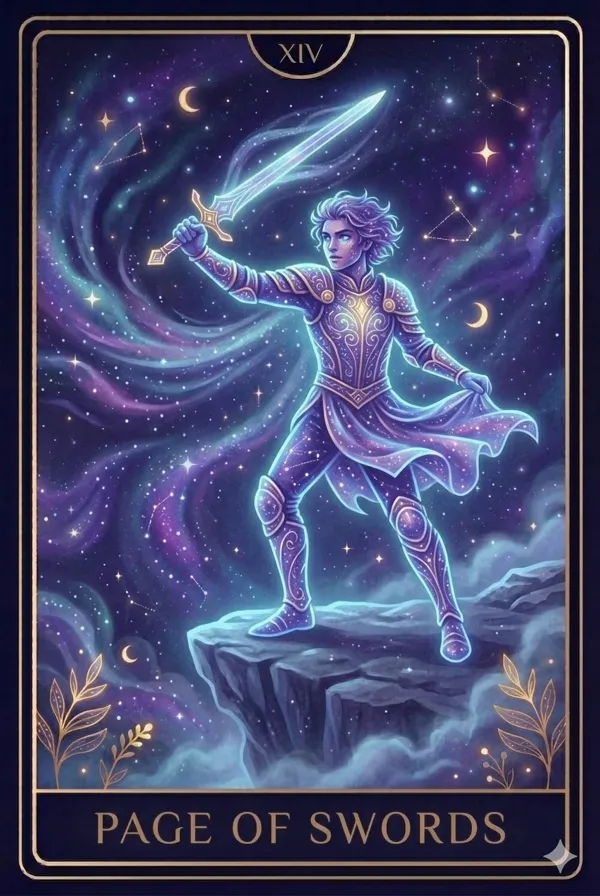
The Page of Swords is a mind that has just woken up. Curious, quick, alert, asking questions faster than it can evaluate the answers.
Overview of the Card's Meaning
The Page of Swords is intellectual appetite without much experience attached. It wants to know things, test things, argue a little, and find out what happens if you say the unsaid thing out loud. At its best this is genuine curiosity — the willingness to ask the obvious question everyone else is too polished to ask. That is more valuable than it looks, and it is how most understanding starts. As an inner mirror, the card asks what you are trying to find out, and whether you want the truth or the confirmation. Those feel identical from the inside and lead to very different places.
Symbolism and Imagery
A young figure stands on uneven ground holding a sword upright in both hands, glancing sideways rather than ahead. The sky behind is full of moving clouds and the wind is clearly blowing — the hair, the grass and the trees are all in motion. The two-handed grip is telling. The sword is not yet comfortable; it takes effort and full attention to hold. Sharp intellect at this stage is impressive and not fully controlled. Birds gather overhead — scattered thoughts, or messages in transit. The sideways glance is the card's ambiguity: watchfulness that can be alertness or suspicion, depending on what is behind it.
Upright Meaning
Upright, the Page of Swords means new information, active learning and questions being asked. Research, study, a conversation that opens something up, or an idea in its early enthusiastic phase. It often signals mental restlessness in a productive form — reading widely, taking a course, investigating a situation properly instead of accepting the summary. It can also indicate a message or a piece of news, typically something that changes how you understand a situation rather than something that resolves it. Pages bring beginnings, not conclusions.
Reversed Meaning
Reversed, the Page of Swords usually points to curiosity gone sideways. Gossip, snooping, arguing to win rather than to understand, or scattered thinking that starts many enquiries and finishes none. It can describe speaking before you have the facts — a sharp comment made confidently and regretted later — or information used as a small weapon. It may also mean the opposite: a question you are not asking, held back out of fear of the answer. The reversed Page sometimes describes a mind that has gone quiet precisely where it should be alert.
Upright Keywords
curiosity, new information, alertness, study, sharp questions, messages
Reversed Keywords
gossip, snooping, scattered thinking, speaking too soon, suspicion, unasked questions
In Love
If You Are Single
For single readers, this card is early-stage interest and lively conversation. Talking late, texting a lot, wanting to know everything about someone quickly. It is genuinely fun and genuinely unproven. The Page describes attraction built largely on mental spark, which is a real form of chemistry and not yet evidence of compatibility. Its caution is investigating instead of asking. Reading old posts, assembling a picture from fragments, arriving at conclusions the person was never given a chance to answer. Directness works far better here than research.
If You Are in a Relationship
In a relationship, the Page of Swords often marks a period of questions. Something needs to be talked about and the conversation has started, sometimes clumsily. At its best it brings renewed interest — genuine curiosity about a person you had begun to assume you knew. That is one of the healthiest things this card can indicate. At its worst it is suspicion looking for evidence. Checking, testing, small interrogations. If that is the dynamic, the card suggests naming the insecurity directly rather than gathering material.
About an Ex or Getting Back Together
About an ex, the Page of Swords frequently describes watching. Looking at their activity, hearing things through mutual friends, reconstructing what they are doing now from small signals. That is extremely common and rarely helpful, and the card treats it without much judgement — just an observation that the information gathered this way tends to hurt more than it explains. It can also indicate contact opening with a question, or a conversation that clarifies something you had been guessing about. Where communication happens directly, the card reads considerably better.
In Career and Work
At work, the Page of Swords supports learning, research and asking better questions. It fits new roles, unfamiliar subjects, and situations where the useful contribution is noticing what does not add up. It can also describe communication tasks — writing, analysis, gathering information, or being the person who has to find out what is actually going on. Its caution is credibility. Enthusiastic half-knowledge is easy to spot, and workplace information travels. Check before you assert, and be careful what you repeat.
In Money and Finances
Financially, this card is the research phase. Comparing options, reading terms properly, learning how something works before committing money to it. It supports gathering information and is less supportive of acting on it immediately. The Page knows enough to be interested and not enough to be confident. It can also warn against acting on a tip or a trend picked up second-hand. Verify the source before you fund it.
What This Card Says About How Someone Feels About You
As how someone feels about you, the Page of Swords suggests active curiosity. You are on their mind and they are trying to work you out, often by asking questions or paying close attention. It tends to describe interest that is genuine but early and unsettled. They may not have decided what they think, and they may talk about it before they know. Less comfortably, it can indicate someone gathering information about you indirectly, or discussing the situation with other people more than with you.
This Card as Advice
Ask the question directly. The Page's whole difficulty is the gap between wanting to know and being willing to enquire openly, and closing that gap solves most of what this card complains about. Then check before you conclude. Sharp minds build convincing pictures from very little, and the conviction arrives well before the evidence does. And stay a beginner a little longer. Not knowing is uncomfortable and it is also the condition under which learning happens. There is no need to have an opinion yet.
Is This Card a Yes or a No?
The Page of Swords is a maybe leaning yes — yes to enquiry, yes to starting, but not a confirmation of outcome. On questions about study, information and conversations it reads positively. On questions about commitment, stability or whether something will last, it is inconclusive by nature. If your question needs certainty, this card is telling you that you do not yet have enough information to be asking it.
Combinations With Other Cards
With the Ace of Swords, the reading sharpens considerably — curiosity meets genuine clarity and something is understood properly. Alongside the Knight of Swords, expect speed and possibly rashness. With the Three of Swords, information arriving is likely to be painful; with the Queen of Swords, the advice is to bring your questions to someone with more experience than you. Next to the Moon, the card warns strongly against building conclusions from ambiguous evidence — that pairing is projection looking for proof. With the Eight of Wands, messages and news are genuinely in motion.
This Card as Your Card of the Day
As a card of the day, the Page of Swords suggests a day of questions, reading and quick conversations. Learning something is likely; concluding something is less so. It is a good day to investigate properly and a poor one to announce your findings prematurely. Watch the impulse to repeat something interesting you heard about someone else.
Common Misconceptions
The most common misreading is "someone is watching you" or "people are talking about you behind your back." The card can involve gossip, but reading it that way tends to feed anxiety rather than inform it, and it usually says more about the reader's fears than about anyone's behaviour. If it points at surveillance at all, it points at least as often at the reader's own watching. A second mistake is treating the Page as a childish or unserious card. Beginners' questions are frequently the ones that matter, and dismissing them costs organisations and relationships a great deal. It is also read too often as a warning about a specific person's dishonesty. The Page is unformed rather than deceitful; the Seven of Swords is the card for concealment. And it is mistaken for a conclusion. Pages open subjects. Expecting an answer from this card is asking it to do work that belongs to the Kings and Queens.
Historical Background and Spiritual Depth
In the court of Swords, the Page is the beginning of the suit's relationship with truth — the stage where thinking is fast, honest and largely untested. The Knight rushes, the Queen discerns, the King judges. The Page enquires. Historically the page was a messenger and an apprentice, someone entrusted with information but not with decisions. That double role explains why the card carries both news and unreliability. Associated with air in its earthy, restless expression, it describes mind in motion — alert, mobile and easily distracted. The wind in the image is not decorative; nothing in this card is settled. What makes the Page of Swords likeable is the honesty of its ignorance. It does not pretend to know. In a deck full of authority figures, a card that simply wants to find out has real value.
Self-Reflection Questions
Ask what you actually want to know, and who could tell you if you asked plainly. Then ask whether you are researching or avoiding. Gathering information can be a genuine step or a way of postponing a conversation, and only you can tell which it is. And notice where you have already decided. The Page's characteristic error is looking for evidence of a conclusion it reached in the first five minutes.
Frequently Asked Questions
What does the Page of Swords mean in tarot?
It represents curiosity, alertness and new information — a quick, questioning mind at an early stage of understanding. It opens subjects rather than resolving them.
Does the Page of Swords mean someone is talking about me?
It can involve gossip, but reading it as surveillance usually feeds anxiety rather than informing you. It just as often describes your own watching of a situation as anyone else's watching of you.
What does the Page of Swords mean in love?
Early interest built on conversation and mental spark — lively, genuine and unproven. Its main caution is investigating someone indirectly instead of asking them things directly.
What does the Page of Swords reversed mean?
It can indicate gossip, snooping, arguing to win, or scattered enquiries that never finish. It can also mean a question you are avoiding because you fear the answer.
Is the Page of Swords a yes or no card?
It is a maybe leaning yes — supportive of enquiry, study and starting conversations, but inconclusive on questions about commitment or lasting outcomes.
Does the Page of Swords mean a message is coming?
It often indicates news or information arriving, typically something that changes how you understand a situation rather than something that settles it.
How is the Page of Swords different from the Knight of Swords?
The Page asks questions and gathers information; the Knight has already decided and is moving fast. The Page is curious, the Knight is convinced.
Journaling Prompts
- What question am I circling rather than asking directly, and who should I ask?
- Where have I built a conclusion out of fragments rather than facts?
- What am I genuinely curious about that I could start learning this month?
- Is my watching of a particular situation informing me or unsettling me?
Related Cards
Start a Personal Reading · Today's Card · Explore the Full Library · Career Reading · Yes or No Reading