King of Swords — Tarot Card Meaning
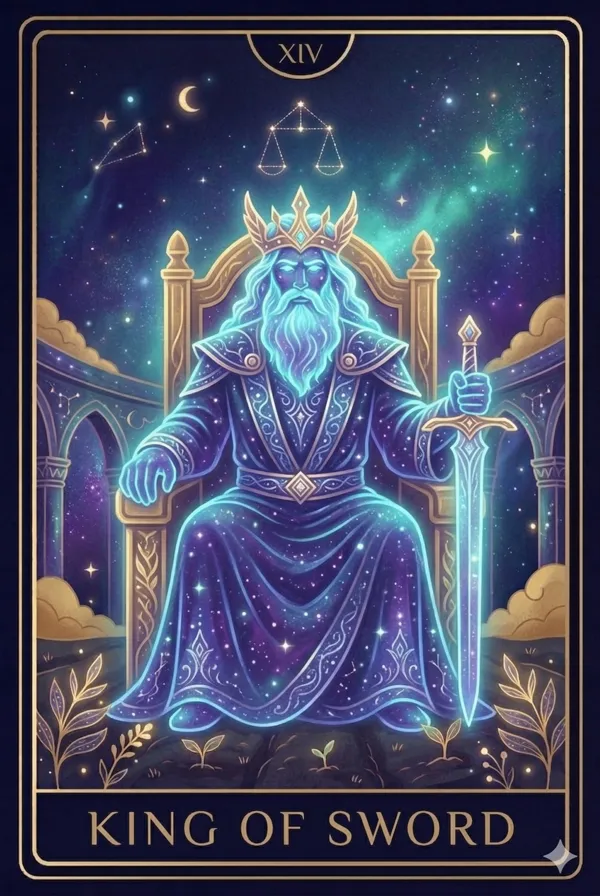
The King of Swords is judgement. His quality is deciding clearly under pressure and saying the difficult true thing without cruelty — which is a very different card from cold logic.
Overview of the Card's Meaning
The King of Swords describes the ability to hold a principle and act on it when acting is inconvenient. He is not the cleverest figure in the deck; he is the one whose conclusions can be trusted. His intelligence is applied rather than admired. He listens, weighs, decides, and then stands behind the decision — including the parts that cost him something. As a mirror, he asks what you actually think, stripped of who might be displeased by it. His arrival often means a situation has waited long enough for someone to make the call, and that someone is probably you.
Symbolism and Imagery
He sits on a stone throne carved with butterflies and a crescent moon, holding his sword upright and tilted slightly to the right, as though mid-consideration rather than mid-strike. The blade is raised but not aimed. That is the whole distinction of this card: capability held in reserve. Nothing here is threatening anyone. His blue robe indicates thought, his red cloak the will to act on it. The sky behind him is clear with a few clouds gathering at the edge — a mind that has weather but is not ruled by it. The butterflies, as with the Queen, suggest transformation through understanding.
Upright Meaning
Upright, the King of Swords means clear judgement. Decisions get made on their merits, arguments get assessed rather than won, and the truth gets stated in a way that leaves the other person their dignity. He favours structure in thought: evidence, precedent, principle. He is excellent for legal matters, contracts, analysis, and any situation where sentiment has been doing work that facts should be doing. He also represents honest counsel — someone who tells you what they actually think when you ask. That is rarer than it sounds and worth taking seriously when it appears.
Reversed Meaning
Reversed, judgement tips into coldness. Intellect used as a weapon: the accurate point made to wound, the argument constructed to dominate rather than to clarify. He can describe manipulation through reasoning — being talked out of what you know by someone more articulate than you. He can also mean judgement withheld or corrupted: a decision avoided, a principle abandoned for convenience, or authority applied unevenly. The reversal asks whether your thinking is serving the truth or serving your position.
Upright Keywords
Judgement, Clarity, Principle, Honest counsel, Authority, Fairness
Reversed Keywords
Coldness, Intellect as weapon, Manipulation, Harsh judgement, Avoided decisions, Rigidity
In Love
If You Are Single
For single readers, this King often means applying honest standards. Not a checklist of demands, but the ability to see clearly and act on what you see rather than on what you hoped. He can describe attraction to someone measured and articulate, or the arrival of advice you did not enjoy and later found accurate. His caution is against thinking your way through romance entirely. Analysis protects you from obvious mistakes and cannot produce connection. Both are needed, and only one is his specialty.
If You Are in a Relationship
In a relationship, the King of Swords calls for the honest, well-considered conversation. Not the outburst — the version you have thought about and can say fairly. He reads well for making a joint decision, resolving something long-standing, or agreeing terms about how you will treat each other. Where the relationship is strained, he can indicate one person always winning the argument. That dynamic looks like reasonableness and functions as control. His upright form does not need to win.
About an Ex or Getting Back Together
About an ex, this King usually means clear-eyed assessment. What actually happened, without either the flattering or the vengeful edit. He often accompanies formal separation — legal matters, dividing what was shared, agreements about children. He supports handling that fairly rather than advantageously. If you want to know whether they will return, he does not speculate. He offers something more useful: an honest reading of whether the reasons it ended have changed.
In Career and Work
At work, the King of Swords is a strong card. He signals sound decisions, credible authority, and communication precise enough that it cannot be conveniently misread. He supports law, analysis, consulting, editing, medicine, management — any work where being right matters more than being liked, and where judgement is the actual product. He often marks a moment to give your honest professional assessment even though a softer version would be more welcome. Delivered without contempt, that assessment is usually what earns real standing.
In Money and Finances
Financially, this King means decisions made on evidence. Read the document, model the outcome, take the advice of someone qualified rather than someone confident. He supports formal matters: contracts, tax, wills, settlements, restructuring debt. He is unsentimental about money in a way that tends to save it. His warning is against believing your own analysis too completely. Rigour includes checking whether you have looked for the evidence that would change your mind.
What This Card Says About How Someone Feels About You
As how someone feels about you, the King of Swords suggests considered, stable regard. They have thought about it properly and are unlikely to say more than they mean. Expression comes through honesty and consistency rather than romance. Being told the truth by this figure is a form of respect, even when the truth is unwelcome. It can also indicate someone keeping feeling under management — present, disciplined, waiting for evidence that openness is safe. Straightforwardness from you tends to accelerate that more than intensity does.
This Card as Advice
Decide on the merits. Set aside, for one hour, who will be pleased and who will be inconvenienced, and ask what the fair conclusion actually is. Then say it plainly and without contempt. The difficult true sentence is not made kinder by being vague, and it is made cruel by being sharpened. Aim for clear and warm at once — that combination is the whole card. And hold your principle when it costs you. This King is defined less by his reasoning than by whether he keeps to it under pressure.
Is This Card a Yes or a No?
The King of Swords is a yes when the matter is sound on its merits, and a firm no when it is not. He is one of the more genuinely decisive cards for yes-or-no work. His answer usually depends on facts you already have access to. If the case is clear and fair, read yes. If it relies on optimism, read no. On matters of law, agreements, professional judgement and honest dealing, he is reliable. On matters of feeling and timing, he is less at home.
Combinations With Other Cards
With Justice, the reading strongly favours formal fairness — legal process, mediation, an outcome decided on principle. Alongside the Queen of Swords, expect a candid conversation between equals with no padding. With the Ace of Swords, a truth is established and acted on. Next to the Knight of Swords, the pairing distinguishes judgement from conviction, which is often the point of the reading. With the Queen or King of Cups, the reading asks for both registers: decide clearly, deliver kindly. Paired with the Devil or the 5 of Swords, watch for reasoning used to justify something that principle would not support.
This Card as Your Card of the Day
As a card of the day, the King of Swords suggests making the decision you have been gathering opinions about. You likely have enough information already. It is a good day for documents, difficult feedback, professional judgement and saying exactly what you mean in as few words as possible. Watch the temperature. Under this card, precise can slide into severe without you noticing, and the content will be forgotten before the tone is.
Common Misconceptions
The most common misreading flattens this King into cold, unfeeling logic or a harsh authority figure. That is his reversal. Upright, his defining quality is judgement — deciding clearly under pressure, holding a principle, and saying the difficult true thing without cruelty. His sword is raised, not aimed. The second mistake is assuming his honesty must be uncomfortable to be honest. Bluntness and truth are not the same thing, and using accuracy to wound is exactly where the card tips over. Third, people read him only as an external figure — a lawyer, a boss, a father. He is very often the reader's own capacity for fair judgement. And fourth, he is read as opposed to emotion. He is not; he is emotion that has been considered rather than acted out.
Historical Background and Spiritual Depth
As the King of the Swords suit, he holds air at its most directed: thought turned into decision and decision turned into responsibility. Where the Queen understands, the King rules on it. Traditionally he has been associated with law, government, medicine and counsel — the professions where a wrong judgement is expensive to someone else. That association explains his seriousness better than any stereotype about coldness does. Modern readings increasingly frame him as an ethical figure rather than merely a clever one. Intelligence in this card is not impressive by itself; it becomes valuable when it is fair. Read as an inner figure, he is the part of you that can tell someone the truth and remain someone they would come back to.
Self-Reflection Questions
Ask what you would decide if nobody's approval were involved. Then examine how you deliver difficult truths — whether the sharpness is doing work, or just doing damage. Finally, notice which of your convictions you have never tested against a good counter-argument. This King has no fear of that exercise.
Frequently Asked Questions
Is the King of Swords cold and unfeeling?
That is his reversal, not his meaning. Upright he is judgement: deciding clearly under pressure, holding a principle, and saying the difficult true thing without cruelty. His sword is raised in consideration rather than aimed at anyone.
Is the King of Swords a yes or no card?
One of the more decisive cards — yes when the matter is sound on its merits, no when it relies on optimism. His answer usually rests on facts you already have access to.
What does the King of Swords reversed mean?
Judgement tipping into coldness: intellect used as a weapon, accurate points made to wound, or reasoning used to talk you out of what you know. It can also mean a decision avoided or a principle abandoned for convenience.
What does the King of Swords mean for feelings?
Considered, stable regard expressed through honesty and consistency rather than romance. Being told the truth by this figure is a form of respect. Sometimes it shows someone keeping feeling under management until openness looks safe.
What does the King of Swords mean in a love reading?
The honest, well-considered conversation rather than the outburst. He supports joint decisions and agreed terms, and he warns against a dynamic where one person always wins the argument — that looks like reasonableness and works like control.
What does the King of Swords mean for work?
Sound decisions and credible authority: law, analysis, consulting, editing, medicine, management. He often marks the moment to give your honest professional assessment even when a softer version would be more welcome.
What advice does the King of Swords give?
Decide on the merits, say it plainly and without contempt, and hold the principle when it costs you. The difficult sentence is not kinder for being vague, and it becomes cruel when it is sharpened.
Journaling Prompts
- What is the fair conclusion here, setting aside who will be inconvenienced by it?
- Where have I used being right as a way of not being kind?
- Which of my firm opinions have I never seriously argued against?
- What principle am I holding, and what has it cost me lately?
Related Cards
Start a Personal Reading · Today's Card · Explore the Full Library · Career Reading · Yes or No Reading