Scythe (Card 10)
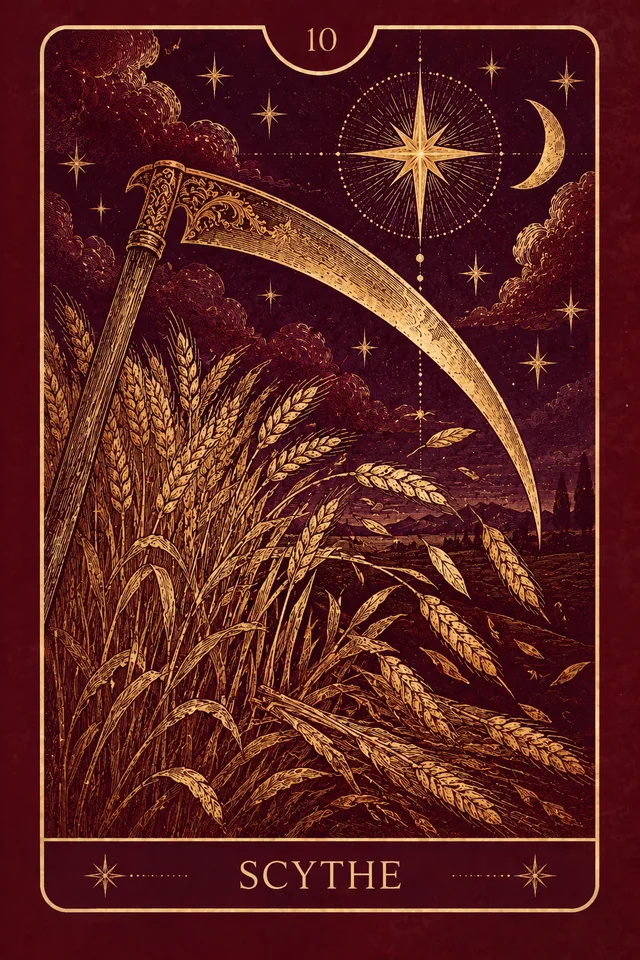
Scythe is the quick cut: a decision made, something removed, an event that arrives fast and changes the picture. It can sound harsh, but many of its cuts are clearings, and the card beside it tells you what is being cut and why.
Core meaning
Scythe denotes suddenness and separation. Something is cut away, decided or brought to an end quickly, with little warning. In older readings it was also a card of caution, a reminder to take care with sharp edges, rushed choices and risky moves. It is not the same as Coffin: Coffin is a slow ending or a closing phase, while Scythe is the moment of the cut itself. Many of its meanings are practical rather than frightening: a firm decision, a harvest, removing what no longer serves. Heart + Scythe is a sudden break in feeling; Scythe + Key is a decisive answer. The helpful question is “what needs to be cut, and what is freed when it is?”
One card is a word, not a sentence
One card is a word, not a sentence. Scythe says cut, but a cut of what, by whom and with what result stays unknown. A single card cannot tell you a relationship is over or that something bad will happen. The honest reading starts with a pair: Ring + Scythe is a commitment that is cut, while Scythe + Ring is a sudden decision that becomes an agreement. One is a breaking, the other a quick yes. Treat Scythe as the sharp verb in the sentence and go to the combinations before predicting anything.
The image
The card shows a scythe, the long curved blade used for harvesting grain, often lying in a field or leaning against a stook of wheat. It is a working tool before it is anything else: its purpose is to bring in the harvest by cutting. The playing-card insert is the Jack of Diamonds. The image holds both edges of the meaning: the danger of a sharp blade and the relief of work finished and gathered in. Nothing in the picture says which you are facing; the neighbouring card decides.
In love and relationships
In love Scythe often marks a sudden change: a decision to end, a quick break, an argument that cuts deep, or a moment when one person makes up their mind. It can also be a clearing, cutting away what was stopping something better. Heart + Scythe is a sudden cut in feeling; Scythe + Heart is a quick decision in favour of love. With Ring it can mean a commitment broken or a fast engagement, depending on order. With Clover it may be a brief shock that passes. Read it calmly: Scythe describes speed and decisiveness, not cruelty, and it does not say who holds the blade.
In work and career
At work Scythe brings quick decisions, cuts, restructuring, a sudden change of plan or the end of a project. It can also be the harvest: work completed and results gathered in. Anchor + Scythe is a long-held job or arrangement ending suddenly; Scythe + Key is a firm, final decision; Scythe + Letter is an abrupt message or notice. As advice it says decide cleanly and remove what is draining your effort. Treat it as a card about timing and clarity rather than a verdict on your worth.
In money questions
In money questions Scythe points to cuts: reduced spending, a sudden cost, a loss, or a firm decision about finances. Fish + Scythe is money cut or lost quickly; Scythe + Fish is a sharp decision that improves cash flow, such as cutting a bad expense. It can also mean a harvest, getting paid for work already done. With Mice it warns of erosion made worse by haste. Scythe does not describe amount; it describes speed and decisiveness. Pause before rushed financial choices, then act clearly.
As a person
As a person, Scythe is someone decisive, direct, sometimes sharp: a person who cuts to the point, makes quick choices or ends things without long discussion. It can describe a surgeon, a critic or anyone whose role involves cutting or deciding. It can also be someone who arrives suddenly and changes things. Dog softens it into honest loyalty; Snake sharpens it into something to be careful with. When Man or Woman sits beside Scythe, read that person as making or facing a quick decision.
Timing
Scythe is one of the fastest cards in the deck: sudden, now, often without warning. Traditionally it is also associated with harvest, so late summer or early autumn in some systems. For questions about when, it says the event will be quick and may come sooner than expected. Tree or Anchor beside it hold the moment back; Rider or Clover make it faster still. Scythe gives no fixed date. Read it as “this happens quickly” and let the partner card say what happens.
Position in a spread
Scythe’s placement shows where the cut falls. Beside the significator, the decision or sudden change is personal and immediate. Far away, it touches the situation but not the querent directly, or is still some distance off. In a line, the card before Scythe often names what is being cut and the card after shows what is left. Scythe pointing toward a card in decks that use facing is traditionally read as the blade falling on that card. Reverse the order of a pair and a breaking can become a clearing.
In the Grand Tableau
House 10 governs decisions, cuts and sudden events. A card in the Scythe house is something being decided or ended quickly: Heart there is an emotional decision, Ship there a trip cancelled or suddenly booked, Mountain there an obstacle cleared. Scythe close to the significator suggests a decisive moment is near; far away, the change is further off or affects others first. Read it as the card that separates before and after, then follow the neighbouring cards to see what that separation opens.
Yes or no
Scythe gives a quick, decisive answer, and the question decides the direction. For “should I end this?” or “will it be decided soon?”, it leans yes, and fast. For “will this continue?” it leans no. It can also be a caution: slow down, check the details, don’t act in haste. Key, Sun and Clover beside it make the outcome clearer or lighter; Coffin, Cross and Snake make it heavier or more complicated. Read the question carefully before reading the blade.
Common misreadings
The commonest mistake is reading Scythe as danger or disaster. It is a sharp card, not a doom card, and many of its cuts are necessary. The second is confusing it with Coffin: Scythe is the sudden moment; Coffin is the slow ending. Third, readers ignore the harvest, so a card about gathering results reads only as loss. Fourth, order is flattened: Heart + Scythe and Scythe + Heart point in opposite emotional directions. Finally, Scythe does not say who makes the cut; that comes from the significators and surrounding cards.
Card combinations
Scythe is a cutting card, so the key question is what is being cut. The first card is the noun and the second modifies it. Heart + Scythe is feeling that is cut — love is the subject and Scythe breaks it. Scythe + Heart is a sudden decision coloured by love — the decision is the subject and Heart says it favours feeling. Keep that grammar and never reverse a pair for convenience. Linked cards already have pages; unlinked partners stay plain text until their pages exist.
- Heart + Scythe — A sudden cut in feeling: a quick break, a painful decision or an emotional shock. Love is the subject and Scythe breaks or wounds it.
- Scythe + Heart — A quick decision in favour of love. The decision is the subject, and Heart shows it is made from feeling, often a fast yes.
- Ring + Scythe — A commitment cut: a broken agreement, cancelled contract or a relationship ending suddenly. The bond is the subject; Scythe ends it.
- Scythe + Ring — A sudden decision that becomes a commitment: a fast engagement, a quick contract, an agreement made on the spot.
- Scythe + Key — A decisive, final answer. The cut is the subject and Key confirms it: this is settled and will not be reopened.
- Snake + Scythe — A complication removed quickly: cutting out a difficult person, detour or tangled situation. The problem comes first; Scythe clears it.
- Scythe + Snake — A sharp decision that brings a complication with it. The cut is real, but it creates a detour, a condition or a reaction to handle carefully.
- Letter + Scythe — A message cut short, or written communication that ends something: a notice, a cancellation, a final email.
- Scythe + Coffin — A sudden cut that leads to a full ending. The quick decision comes first, then Coffin shows a phase closing completely.
- Anchor + Scythe — A long-held situation ended suddenly. What was stable is the subject, often a job or long arrangement, and Scythe cuts it.
- Scythe + Anchor — A clean decision that holds. The cut is the subject, and Anchor says it is final and becomes the new stable ground.
- Clover + Scythe — A small, quick opportunity seized or lost in a moment. Luck is the subject; Scythe says act fast or the window closes.
Frequently asked questions
What does the Scythe card mean in Lenormand?
Scythe means a sudden cut, a quick decision, an abrupt ending or a warning to take care. It can also be a harvest: gathering results of work already done.
Is the Scythe card bad?
Not by itself. It is sharp and fast, but many of its cuts are necessary clearings. The cards beside it show whether the cut is painful, freeing or simply practical.
Is the Scythe card a yes or a no?
It gives a quick, decisive answer. For questions about ending or deciding, yes and soon; for questions about something continuing, it leans no.
What does Scythe mean in love?
A sudden change: a quick decision, a break, a sharp argument, or a fast commitment when it follows Ring. Heart + Scythe is a cut in feeling; Scythe + Heart is a decision in favour of love.
What is the difference between Scythe and Coffin?
Scythe is the sudden moment of the cut; Coffin is the slower ending or closing phase. Scythe + Coffin is a quick decision that leads to a complete ending.
Does Scythe have a reversed meaning?
No. Traditional Lenormand has no reversals. The surrounding cards and their order decide whether Scythe reads as a break, a clearing or a harvest.
What timing does Scythe suggest?
Sudden and fast, often sooner than expected. Some traditions link it to harvest season. It never gives a fixed date on its own.