Coffin (Card 8)
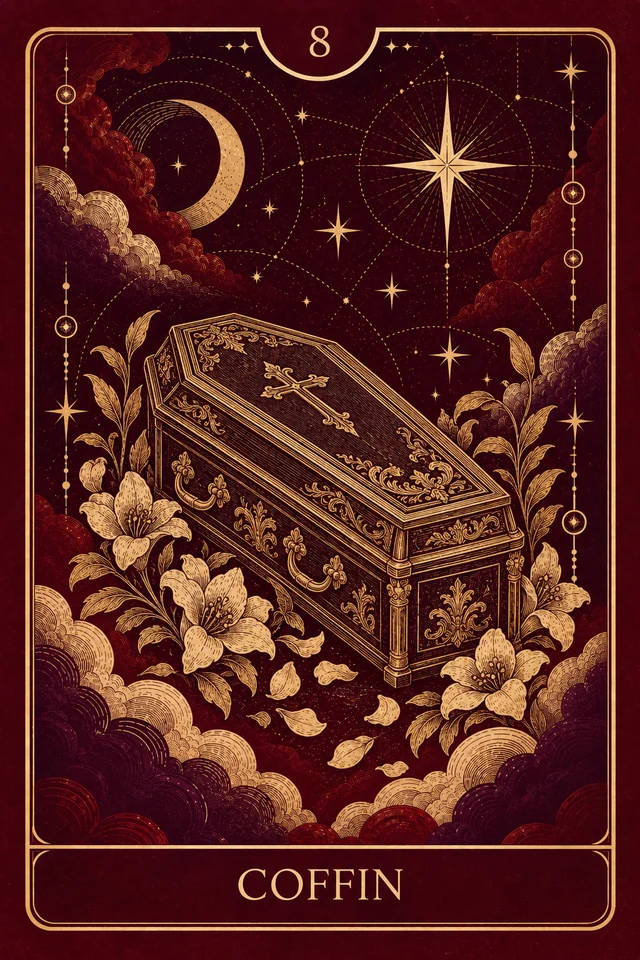
Coffin marks a stop: an ending, a pause, a phase that has run its course. It is not a prediction of death and it does not turn difficulty into disaster. Its useful question is simpler: what is finished, resting or ready to be released?
Core meaning
Coffin denotes closure, inactivity and the end of a phase. A job can finish, a plan can be shelved, a relationship chapter can close, or a tired process can go quiet before anything replaces it. The card is heavy because endings involve loss of momentum and sometimes grief, but its scale must match the question. In an ordinary reading it refers to an ordinary ending. It does not predict physical death, and responsible readers do not use cards to make that claim. Coffin can also mean rest, storage and something temporarily unavailable. The neighbour distinguishes a final closure from a necessary pause and shows what area of life is becoming still.
One card is a word, not a sentence
One card is a word, not a sentence. Coffin says “ending” or “pause,” but cannot tell you what ends, why, whether it is permanent or what comes next. Turning that single word into disaster is fear, not technique. The smallest honest Lenormand statement is a pair: Coffin + Stars is hope returning after closure, while Stars + Coffin is a plan or hope going quiet. Go to the combinations before drawing conclusions. The neighbour sets both the subject and the scale.
The image
The image is a closed coffin, often draped and placed alone. Its lid provides the card’s central idea: something is contained, unavailable or complete. Historical decks inherited the symbol from a time when death imagery was more ordinary in daily life, but divinatory practice has long used it broadly for endings, illness, rest and closure. The picture does not show violence, an accident or a named person. That absence matters. The playing-card insert is the Nine of Diamonds, sometimes associated with material completion, but the visual symbol remains primary: a chapter is closed, not necessarily a life.
In love and relationships
In love, Coffin can mark a relationship ending, feelings becoming inactive, a period of no contact, or the closure of an old pattern inside an ongoing bond. It should not be softened into automatic renewal, but neither should it be enlarged into permanent devastation. Heart + Coffin says affection or attachment is ending; Coffin + Heart says a closure is being felt emotionally, and can describe grief or love emerging after a closed chapter. With Stork, change follows the ending. With Ring, a commitment closes. Ask what exactly has stopped: the relationship, communication, a repeated conflict, or only the current phase.
In work and career
At work Coffin means a role, project or process reaches its end, or activity pauses. It can be a contract not renewed, a department closing, a project archived, leave from work, or simply a task completed and put away. The card does not automatically mean dismissal. Ring beside it specifies an agreement; Tower can point to institutional closure; Rider can bring news after a quiet period. As advice, stop investing energy in what is already over and identify what can be closed cleanly. A well-managed ending protects more than dragging an exhausted plan forward.
In money questions
In money questions Coffin describes a stream stopping, an account closing, an expense ending, funds becoming temporarily inaccessible, or a financial phase being completed. It is neutral about whether that stop helps. Fish + Coffin can mean income drying up; Coffin + Fish can mean finances restarting or resources appearing after a closure, depending on the next card. Mice with Coffin may show a drain finally stopping. Do not treat it as bankruptcy without supporting cards and real-world evidence. The practical instruction is to identify which flow has gone still and make plans from facts, not fear.
As a person
As a person, Coffin may describe someone withdrawn, exhausted, grieving, unavailable or between chapters. It can also mark a person whose role in the situation is ending rather than describing their temperament. This is not a “death card” for a human being. Beside Man or Woman, it says that person is experiencing closure, pause or low activity. Look for Tree in health contexts and encourage appropriate care rather than diagnosis. Often the kindest accurate reading is that someone has little capacity right now and needs rest, privacy or time to finish what has ended.
Timing
Coffin says not moving and therefore often means a delay or an indefinite pause. It can mark the end date of a phase, but it does not supply a standard number of days or months. When followed by Rider, Stork, Sun or Stars, movement resumes after the closure; with Anchor or Mountain, the stillness lasts. In a question about when, Coffin’s honest answer is “after this chapter is fully closed,” which may be more useful than a fabricated date. Use a neighbouring timing card for a calendar estimate.
Position in a spread
Near the significator, Coffin makes the ending personal and immediate: something in the querent’s own life is closing or resting. Farther away, it can be an ending in the environment, another person’s closure or a matter that has not reached them. In a line, the card before Coffin shows what runs out; the card after it shows what follows the pause. That sequence is crucial. Stars + Coffin ends hope or a plan. Coffin + Stars opens into renewed guidance and hope. The card has not changed; its grammatical job has.
In the Grand Tableau
In the Grand Tableau, House 8 governs endings, rest, closure and inactivity. A card in the Coffin house is limited or completing: Ring there can show an agreement ending, Fish a financial stream closing, Heart an emotional chapter being released. Coffin itself near the significator deserves attention but not panic. Examine what precedes and follows it, its distance, and whether renewing cards lie beyond it. The tableau is large enough to show both closure and what comes after; stopping the reading at Coffin throws away half the information.
Yes or no
Coffin leans no for questions about continuation: no, this does not keep going in its present form. For questions about whether something ends, closes or can finally be released, it is a yes. It may also mean not now when the matter is dormant rather than finished. The next card determines whether the stop is final, temporary or followed by a new phase. Stars, Stork, Rider or Sun after Coffin bring movement or direction back; Anchor or Mountain can prolong the closure.
Common misreadings
The harmful misreading is predicting death. A card cannot diagnose mortality, and Coffin usually refers to an ordinary ending sized to the question. The second mistake is treating every appearance as disaster; ending an expense, conflict or exhausted plan can be useful. Third, readers sometimes force a positive rebirth message too quickly. Closure can hurt, and accuracy allows grief without dramatizing it. Fourth, order is ignored: Stars + Coffin and Coffin + Stars are opposites. Finally, a pause is not always permanent. Read the following card before deciding whether the lid stays closed.
Card combinations
Coffin makes sequence impossible to ignore. The first card is the noun and the second modifies or completes it. Stars + Coffin means guidance, hope or a plan comes to an end. Coffin + Stars means the ending is followed and modified by renewed hope: direction appears after closure. Same two cards, opposite movement, entirely because of order. Read the card before Coffin as what stops and the card after it as what emerges next.
- Stars + Coffin — Hope, guidance or a plan comes to an end. The Stars are the subject and Coffin closes them: a vision is shelved, confidence fades, or a route once clear no longer leads forward.
- Coffin + Stars — New hope after an ending. Coffin is the subject and Stars modify what follows: closure clears the view, guidance returns, and a new plan can be seen once the old chapter is finished.
- Heart + Coffin — Affection or attachment is ending, becoming inactive or being released. This can be a breakup, but also the end of longing or an emotional pattern. Read the scale of the actual question.
- Coffin + Heart — An ending felt through the heart, or affection appearing after closure. Grief may be present, but so can tenderness and the capacity to love once a finished chapter has been acknowledged.
- Ring + Coffin — A commitment, contract or repeating cycle ends. The bond is the subject and Coffin closes it: termination, separation, cancellation or the completion of an obligation.
- Coffin + Ring — Closure followed by a new agreement, or an ending formalised through a contract. The ending is the subject; Ring shows how it is completed or what binds the next phase.
- Fish + Coffin — A money stream stops: income dries up, a business closes or funds become inactive. Keep it proportional and check facts; this is not automatically bankruptcy.
- Coffin + Fish — Resources after closure: an account settled, money released when something ends, or a financial phase beginning after inactivity. The stop comes first and flow follows it.
- Man + Coffin — A man reaches an ending, pause or withdrawal. It describes a phase or role around him, not his physical death. The following card shows what becomes possible next.
- Coffin + Woman — A closure involving the woman or bringing her into focus. The ending is the subject and she is the person connected with it; do not turn this into a prediction of harm.
- Coffin + Stork — Change after an ending. The old phase closes and movement begins; one of the clearest combinations for transition rather than permanent loss.
- Coffin + Rider — News or movement arrives after silence. A dormant matter restarts, a message follows closure, or the next chapter announces itself sooner than expected.
Frequently asked questions
Does the Coffin card mean death?
No. In ordinary Lenormand readings Coffin means an ending, pause, closure or inactive phase. Responsible readers do not use a card to predict physical death.
What does Coffin mean in a love reading?
A relationship phase, feeling, pattern or period of contact is ending or going quiet. The next card shows whether that is final, temporary or followed by renewal.
Is Coffin always a bad card?
No. Endings can be painful, neutral or useful. Coffin can stop an expense, conflict or exhausted plan. It asks what is complete, not what disaster is coming.
Is Coffin a yes or a no?
Usually no for continuation, yes for ending or release, and sometimes not now for a dormant matter. Its neighbour clarifies which.
What is the difference between Stars + Coffin and Coffin + Stars?
Stars + Coffin is hope or a plan ending. Coffin + Stars is new hope and direction after closure. The opposite movement comes entirely from card order.
Does Coffin have a reversed meaning?
No. Traditional Lenormand does not use reversals. Sequence and neighbouring cards show whether Coffin is final closure, rest or a pause before renewal.
What timing does Coffin suggest?
A pause, delay or the end of a phase rather than a fixed date. Movement resumes when a following card such as Rider, Stork, Sun or Stars indicates it.