Woman (Card 29)
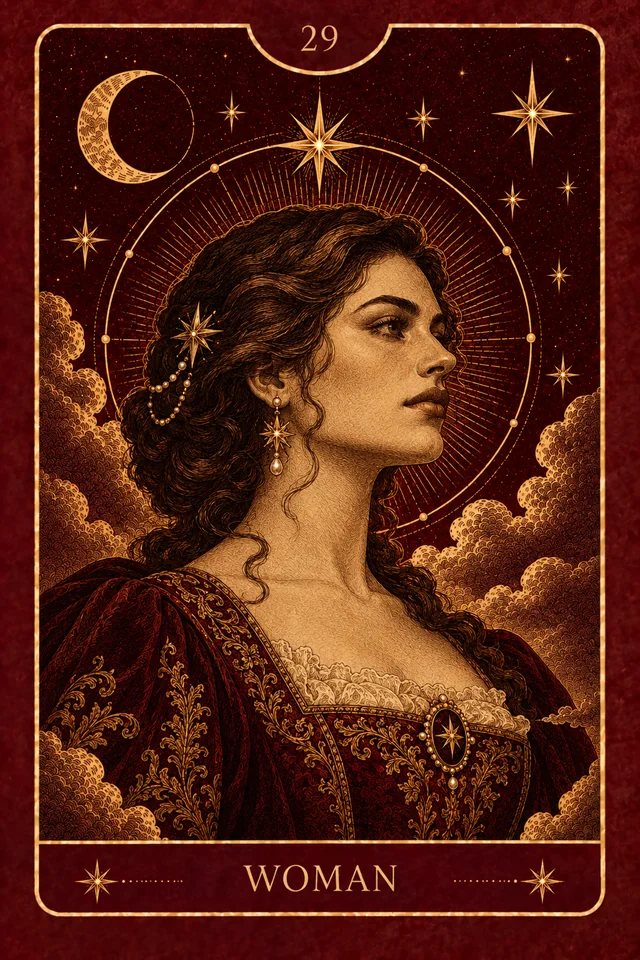
Woman is usually a significator, not a list of feminine qualities. It marks the querent or the specific woman named in the question, giving the spread a person to arrange itself around.
Core meaning
Woman denotes an actual person: traditionally a female querent, or a particular woman involved in the question. Modern practice can select Man or Woman by identity, role or preference, provided the choice is made before the cards are seen. This card does not automatically mean receptive, intuitive, emotional or nurturing; those are cultural projections, not Lenormand vocabulary. Woman functions like a proper name. Cards close to her describe what belongs to her experience, approaches her or occupies her attention. In a relationship reading, she may be one member of the pair, but she is not automatically a lover. The question decides her identity; the neighbours decide what is happening.
One card is a word, not a sentence
Woman alone says only “this person.” A single Lenormand card is a word, not a sentence, and a significator is an especially incomplete word. It cannot reveal her feelings, intentions, reliability or future action. Any detailed prediction from this card alone comes from the reader, not the deck. Name whom Woman represents before shuffling, then read the cards touching it. They turn the label into a sentence. If no specific woman was assigned, the card may announce that a woman matters, but a second card is still needed to say why.
The image
The traditional image is a single woman in ordinary period dress. She may face left or right depending on the deck, and that gaze can organise a tableau: what lies before her receives attention, while what falls behind her may be overlooked or past. Some modern decks provide alternate person cards so readers can choose figures that fit the people involved. That changes representation, not grammar. The playing-card insert is the Ace of Spades, but it does not make Woman severe, unlucky or secretive. The portrait’s neutrality is deliberate: personality must come from neighbouring symbols rather than from assumptions about the figure.
In love and relationships
In love readings Woman anchors the woman involved, often the querent or the partner being asked about. Heart touching her brings affection close; Ring shows a commitment tied to her; Snake signals complication around her without proving she causes it. Man and Woman close together show the two selected people strongly connected to the same part of the reading. Cards between them describe the bridge, distance or issue separating them. If they face each other in a directional deck, attention may be mutual; if they face away, their focus may differ. None of these spatial clues guarantees love, reunion or compatibility. The surrounding sentence must support that conclusion.
In work and career
At work Woman identifies a real person: the applicant, colleague, manager, customer or decision-maker named in the question. Bear can place authority or protection near her; Fox can show strategic self-interest or a work setting requiring care; Key can show access or approval in her hands. Avoid translating Woman into vague “feminine energy” when a concrete person is present. If no woman has been mentioned and this is not the querent’s significator, the card can indicate that a woman becomes relevant. Even then, the adjacent card tells you whether she brings information, a contract, a delay or support.
In money questions
In financial readings Woman locates the person whose money or choice is being discussed. Fish beside her may be her income, business or resources. Ring may be an obligation she holds; Mice can show a drain affecting her; Key can show she has access or approval. Woman itself means neither wealth nor dependence. Its practical value is ownership: it helps separate the querent’s resources from a partner’s, employer’s or family member’s. In a tableau, financial cards close to Woman affect her directly. The same cards clustered near Man may belong to his side of the situation instead.
As a person
Woman is already a person marker and carries no fixed character. She may be the querent, partner, relative, friend, manager or another named woman. Adjacent cards describe her condition or role: Lily may show maturity, Child youth or a new beginning, Dog loyalty, Bear authority, Clouds uncertainty. Those descriptions belong to this moment in the spread, not to her entire identity. When several women are relevant, assign Card 29 clearly before shuffling and use other cards, context or additional person cards to distinguish the rest. Changing the assignment after the layout appears makes the reading fit whatever story the reader prefers.
Timing
Woman has no timing value of its own. It answers who. Use a neighbour for when: Rider suggests soon, Clover a short opportunity, Tree a long development and Mountain a delay. A card close to Woman is close to her life or awareness, but that does not automatically mean tomorrow. Direction can show what she is moving toward or attending to, not a date. If the question needs a calendar answer, use a dedicated timing method and keep Woman in its proper role as the person around whom that answer is organised.
Position in a spread
Proximity is central. Cards directly touching Woman are personal and immediate. Cards farther away can describe background conditions, later matters or events outside her control. In decks with directional portraits, cards in front of her receive attention; cards behind her may be ignored, past or unseen. Between Woman and Man, each intervening card describes what connects, occupies or separates them. Beyond the other significator, a card may belong more strongly to that person’s side. These are relationships in space, not tarot-like fixed positions. Woman remains the referent wherever it lands.
In the Grand Tableau
Woman is one of the main anchors in the Grand Tableau. Locate her first when she represents the querent, then inspect the immediate ring of cards, her gaze, the path toward Man, and the houses occupied by both person cards. Near symbols are active in her life; distant ones are peripheral, delayed or outside her reach. The card in the House of Woman describes what currently fills her role or shapes how she enters the story. If Man is the querent’s significator, Woman is only the counterpart when the question assigns her that role. The matched cards are tools for mapping people, not a compulsory heterosexual couple.
Yes or no
Woman is neutral for yes or no. It confirms that a woman or the selected person matters, but it does not answer whether an event happens. Read the next card: Key or Sun can confirm, Clouds can obscure, Mountain can block, and Coffin can close. For the narrow question “Is she the person involved?”, Woman may confirm relevance. For “Will she contact me?” it is incomplete, because contact requires Rider, Letter or another action card. A significator without a verb is still only a subject.
Common misreadings
The commonest mistake is loading Woman with stereotypes such as emotional, passive, intuitive or maternal. It carries none of those meanings automatically. Second, it is often assumed to be a wife or girlfriend when it may be the querent, boss, sister or client. Third, some readers change who it represents after the layout, weakening the entire method. Fourth, Woman and Man together do not guarantee romance; they identify two people, and other cards define the bond. Finally, a distant Woman is not cold or unavailable by nature. Distance only says she is less connected to that part of this particular spread.
Card combinations
Woman is a proper noun in the sentence. The first card is the noun and the second modifies it: Woman + Heart describes affection close to her or an affectionate woman; Heart + Woman describes love directed toward or represented by her. The same distinction applies to money, uncertainty and endings. Proximity tells you how directly a condition belongs to her, while order tells you what the sentence is about.
- Woman + Man — The woman is oriented toward or connected with the man. If both are selected significators, the reading begins from her side of the relationship. Cards between them explain what connects or separates them.
- Man + Woman — The man is the subject and Woman identifies his counterpart. The same pair is present, but attention begins with him. Neither direction automatically means romance; the question and neighbours define the bond.
- Woman + Heart — A woman with affection close to her, or a woman focused on love. Heart modifies her condition. It may describe her warmth, her love life or someone she cares about.
- Heart + Woman — Affection directed toward the woman, or love embodied by her. Heart is the subject now, so the pair does not by itself prove what she feels in return.
- Woman + Ring — A woman tied to a commitment, contract or repeating cycle. The agreement belongs closely to her: her relationship, promise or obligation. Other cards describe its quality.
- Ring + Woman — A commitment involving or leading to the woman. The bond is the subject and she is the person attached to it, useful when identifying who holds a contract or promise.
- Woman + Clouds — A woman experiencing uncertainty or missing information. The confusion is close to her, but it is not proof that she is deceptive or emotionally inconsistent.
- Clouds + Woman — Confusion about the woman: her role, identity or intentions are unclear to the querent. The uncertainty is the subject, so gather information instead of defining her character.
- Woman + Fish — A woman closely connected to money, income or business. It may show her resources or financial priorities, not wealth as a personality trait.
- Fish + Woman — Money belonging to, controlled by or moving toward the woman. Fish is the subject, which helps establish whose income, payment or business the spread describes.
- Woman + Coffin — A woman reaching the end of a phase, entering a pause or releasing a role. It does not predict death. Read the next card for what begins after the closure.
- Coffin + Woman — An ending or closed chapter concerning the woman. The closure is the noun and she identifies whom it affects; the pair is about transition, not physical harm.
Frequently asked questions
What does the Woman card mean in Lenormand?
Woman is a significator for the querent or a specific woman named in the question. It identifies a person; neighbouring cards describe her circumstances, feelings or actions.
Does Woman always mean a wife or girlfriend?
No. It can be the querent, partner, relative, colleague, manager, client or any selected woman. The question determines her role.
How do I choose between Woman and Man as my card?
Choose by identity, role or preference before laying the spread. Traditional gender rules are common, but consistency matters more than forcing someone into a card that does not represent them.
What does distance from the Woman card mean?
Cards touching Woman affect her directly and immediately. Distant cards are more peripheral, delayed or outside her reach, especially in the Grand Tableau.
Is Woman a yes or a no card?
Neither. It says a person is central. A neighbour such as Key, Sun, Clouds, Mountain or Coffin supplies the actual answer.
Does the Woman card have a reversed meaning?
No. Lenormand does not traditionally use reversals. Proximity, direction and neighbouring cards change how Woman is read.
Do Man and Woman together mean a relationship?
They show two selected people connected in the spread, but not necessarily romantically. Cards between and around them define whether the connection is love, work, family, conflict or something else.