Man (Card 28)
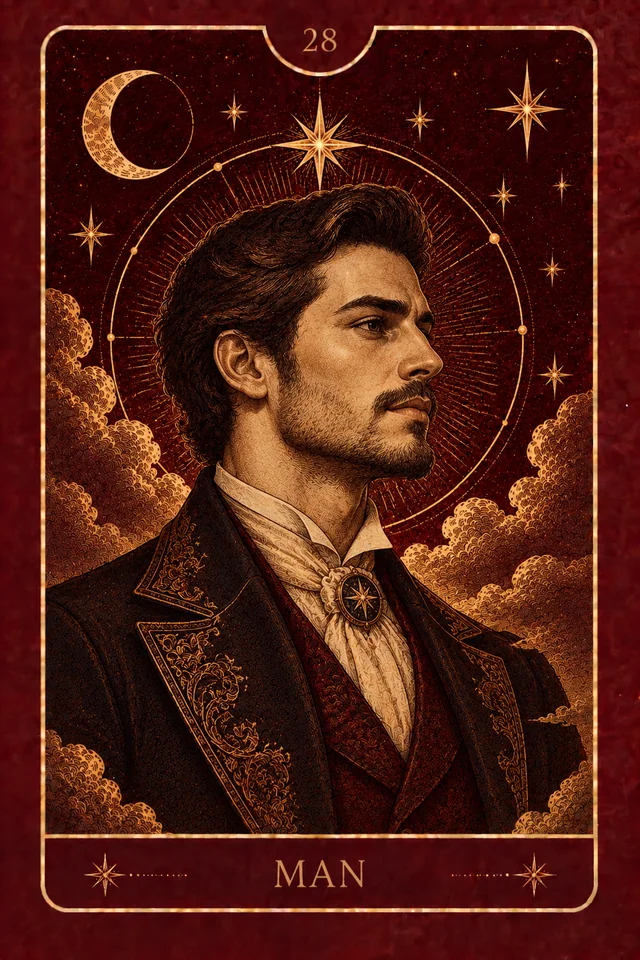
Man is usually not a personality description. It is a significator: the person the spread is about, often the querent or the specific man named in the question. Its job is to locate that person inside the reading so the cards around him can speak.
Core meaning
Man denotes an actual person. In traditional practice it represents a male querent; in a reading for someone else, it can mark the man they are asking about. Many modern readers choose Man or Woman by identity, role or whichever image feels most representative rather than applying a rigid gender rule. The choice should be made before the cards are laid, not after seeing which arrangement gives the preferred answer. Unlike Heart, Fox or Bear, Man does not automatically mean loving, calculating or powerful. It is closer to a name pin placed on the table. The neighbouring cards describe what belongs to him, what approaches him and what stands between him and the matter asked about.
One card is a word, not a sentence
A single Man card says very little because its main function is reference. One Lenormand card is a word, not a sentence, and here the word is simply “this person.” It cannot tell you what he feels, what he will do or whether he is trustworthy. Building a character profile from Man alone invents the useful part. Select who this card represents before the reading, then move straight to the combinations. The cards touching it provide the verbs and descriptions; without them, Man only identifies the subject.
The image
Traditional decks show a single well-dressed man, sometimes facing left and sometimes right depending on the edition. The portrait is intentionally ordinary. He carries no emblem that assigns temperament, profession or moral quality. The direction of his gaze can matter in a tableau: cards in front of him may receive his attention, while cards behind him can show what he overlooks or leaves behind. That directional method only works when you know the artwork in your deck, because mirrored editions reverse it. The playing-card insert is the Ace of Hearts, but the person-card function outweighs any romantic association of that insert.
In love and relationships
In love readings Man identifies the man in the relationship rather than proving a relationship exists. If the querent asks about a named partner, this card can anchor that person; Heart beside him shows affection close to him, Ring shows commitment, and Clouds shows uncertainty. Distance matters in larger spreads. A love card touching Man is immediate and personal. The same card far away may describe a feeling or relationship elsewhere in the story, not necessarily his. When Man and Woman appear close together, the two people are engaged with the same part of the reading; cards between them describe the conditions connecting or separating them. Their distance is information, not a verdict on compatibility.
In work and career
In work questions Man usually marks a specific colleague, manager, client or applicant already named in the question. It should not be turned into “masculine energy” when a real person is clearly involved. Bear beside Man may identify a boss or protector; Fox can show his self-interest or a work role that requires caution; Ring can show a contract involving him. If no man is relevant and the querent did not choose this as their significator, the card may indicate that a man will become important to the matter, but the neighbouring card still tells you how. Man alone does not promise help, obstruction, hiring or promotion.
In money questions
For money, Man points to whose resources or decision matter. Fish beside Man can show his income, funds in his control or a financially significant man. Mice beside him can show a drain affecting him; Key can show that he has access or authority. The card does not mean wealth and does not describe an amount. Its practical use is to distinguish your money from another person’s money in a crowded spread. In a Grand Tableau, Fish close to the querent’s significator describes finances directly affecting them; Fish close to the other person card may belong to a partner, client or counterpart instead.
As a person
Man already is a person card, but it does not describe personality. It identifies the selected man: the querent, partner, relative, employer or other named person. Age, temperament and intentions come from adjacent cards. Lily may make him older or more mature; Child may make him younger or place him at the beginning of something; Dog describes loyalty; Snake describes a complication or self-interest around him. Treat those as grammar, not labels stamped permanently on a human being. If more than one man is involved, state before shuffling which one Card 28 represents and let other person cards or contextual cards identify the rest.
Timing
Man has no traditional timing interval. It answers who, not when. In a timing question, use the card beside it: Rider can bring contact soon, Clover opens a brief window, Tree slows the matter, and Mountain delays it. Proximity can still tell you whether an event is close to the person represented, but that is closeness in the reading, not a calendar measurement. Do not turn the man’s apparent age, posture or facing direction into a date. If timing is central, draw or designate a timing card rather than asking a significator to perform a job it was not designed to do.
Position in a spread
Position is the heart of this card’s function. Cards touching Man have direct, immediate relevance to him. Cards several places away belong to the wider environment or may take time to reach him. In directional decks, what he faces receives attention; what falls behind him may be ignored, past or outside his awareness. A card between Man and Woman describes what connects or separates the pair. A card beyond Woman may belong more to her side of the story. These are spatial relationships, not fixed meanings assigned to numbered slots. The card stays “the person”; distance and neighbours tell you how the sentence relates to him.
In the Grand Tableau
In the Grand Tableau, Man is one of the main anchors. Readers begin by locating it, then examine the cards touching it, the direction it faces, the line toward Woman, and the houses occupied by both significators. Near cards are active and personal; distant cards are background, later developments or matters outside his reach. The card landing in the House of Man describes what currently occupies or characterises his role in the story. If Man is the querent’s significator, the tableau is mapped outward from him. If Woman represents the querent, Man is read as the relevant counterpart only when the question supports that choice.
Yes or no
Man is neutral in yes-or-no questions. It says the answer depends on a person, or confirms that the named man is central, but it supplies no yes or no by itself. Key or Sun beside him can support a yes; Mountain, Coffin or Clouds can delay, close or obscure the matter. Even then, read the pair rather than treating Man as an empty positive card. If the question is “Is this about him?”, Man can be a direct confirmation of relevance. If the question is “Will he do it?”, one card cannot answer because the action is still missing.
Common misreadings
The largest mistake is assigning Man a personality: logical, dominant, emotionally unavailable or protective. None of that belongs to the card without neighbours. The second is assuming it must represent a romantic partner. It can be the querent, a brother, boss, client or any selected man. Third, readers sometimes choose its identity after seeing the spread, which makes the method impossible to test and easy to bend. Fourth, Man and Woman are not automatically a couple. They are matched significators, and their relationship depends on the question. Finally, distance is not moral judgement: a faraway Man is not uncaring; he is simply less connected to that part of the tableau.
Card combinations
Man behaves like a proper noun, so pairing grammar is especially clear. The first card is the noun and the second modifies it. Man + Heart describes the man as affectionate or focused on love; Heart + Man describes affection directed toward or embodied by him. Proximity also matters: a card touching Man belongs closely to him, while a distant card may only sit in his environment. Order is not interchangeable, and Woman is treated as the matched significator rather than as an automatic romantic partner.
- Man + Woman — The man is oriented toward or closely connected with the woman. If they are the selected significators, attention rests on the relationship from his side. The cards between them explain the connection; the pair alone does not define it as romantic.
- Woman + Man — The woman is the subject and the man identifies her counterpart. The same two people are present, but the sentence begins from her side. Direction and neighbouring cards show whether she approaches, considers or is affected by him.
- Man + Heart — An affectionate man, or a man whose attention is on love. Because Man is the noun, Heart describes what is close to him: sincere feeling, warmth or someone he cares about.
- Heart + Man — Affection directed toward the man, or love whose subject is this person. The feeling is the noun now; Man tells you who receives or embodies it. This is not automatically proof of his own feelings.
- Man + Ring — A man in a commitment, contract or repeating cycle. The bond belongs closely to him: his marriage, his agreement, his obligation. Neighbours show whether it is warm, difficult or simply formal.
- Ring + Man — A commitment involving or leading to the man. Ring is the subject, so the focus is the bond itself and he is the person attached to it — useful in questions about who holds an agreement.
- Man + Clouds — A man who is confused, uncertain or surrounded by missing information. The uncertainty is close to him; it does not automatically mean dishonesty or lack of feeling.
- Clouds + Man — Confusion about the man. The unclear matter is the subject: his identity, role or intentions are not yet visible to the querent. Wait for information rather than assigning him a motive.
- Man + Fish — A man closely connected with money, income or business. It can be his resources, a commercial role or financial priorities. It says nothing about generosity without another card.
- Fish + Man — Money connected to or controlled by the man. The resources are the subject, making this useful for identifying whose funds, payment or business interest the spread is discussing.
- Man + Coffin — A man reaching an ending, pause or closed phase. This is not a prediction of death. Something attached to his role stops, rests or is released, and the next card shows what follows.
- Coffin + Man — An ending that concerns the man, or a closed chapter bringing him into focus. Coffin is the subject, so read the closure first and the person second — not as harm happening to him.
Frequently asked questions
What does the Man card mean in Lenormand?
Man is a significator: the querent or a specific man named in the question. It identifies a person rather than describing a personality, and the cards around it provide the meaning.
Does Man always mean a romantic partner?
No. It can be the querent, partner, relative, colleague, manager, client or any selected man. Decide whom it represents before laying the cards.
How do I choose between Man and Woman as my significator?
Traditional readers choose by gender; many modern readers choose by identity, role or the image that feels representative. Consistency matters more than the rule: choose before the spread, not after seeing it.
What does it mean when Man and Woman are close together?
The two selected people are closely engaged with the same matter. Cards between and around them explain the nature of that connection; closeness alone does not guarantee romance or harmony.
Is the Man card a yes or a no?
Neither. It says a person is central. For a yes or no, read the neighbouring card; Key and Sun support yes, while Clouds, Mountain or Coffin qualify the answer.
Does the Man card have a reversed meaning?
No. Traditional Lenormand does not use reversals. Man’s meaning changes through proximity, direction and the cards beside it.
Can the Man card describe personality?
Not by itself. It is a name pin, not a character profile. Heart, Fox, Bear, Dog and other neighbours describe qualities or conditions around the person.